Apple Podcasts
 Spotify
 YouTube
 RSS Feed
 Burnout in First Responders: Signs You're Checked Out in Uniform with hosts Bonnie, Stacy and David | S6 E19
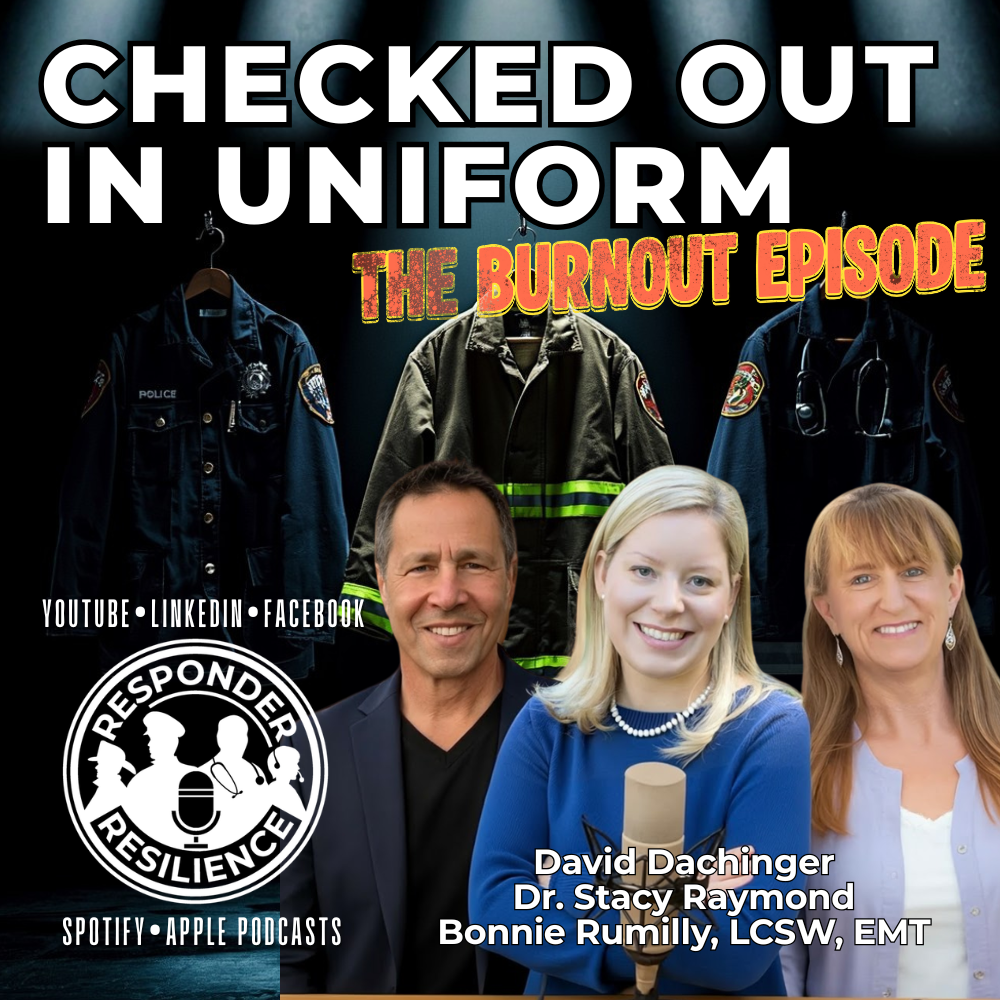
Burnout in first responders doesn't announce itself. It doesn't look like a crisis. It looks like a paramedic who still shows up, still runs the calls, still does the job — and feels absolutely nothing while doing it. In this episode of Responder Resilience, Lt. David Dachinger (ret.), Dr. Stacy Raymond, and Bonnie Rumilly, LCSW, EMT have the conversation that first responder culture has spent decades making almost impossible to have.
Burnout in first responders doesn't announce itself. It doesn't look like a crisis. It looks like a paramedic who still shows up, still runs the calls, still does the job — and feels absolutely nothing while doing it.
In this episode of Responder Resilience, Lt. David Dachinger (ret.), Dr. Stacy Raymond, and Bonnie Rumilly, LCSW, EMT have the conversation that first responder culture has spent decades making almost impossible to have.
What burnout actually is — clinically, culturally, and personally. Why the stoicism and dark humor that help providers survive the job can quietly accelerate its damage. How moral injury, powerlessness, and the erosion of empathy compound over years of service. What untreated burnout does to families. And what it actually takes — beyond a hotline number and a mandatory training — to come back from it.
This episode is for providers, for leaders, and for anyone who loves someone who wears a uniform. Because the quiet collapse is real. And it doesn't have to be the end of the story.
Contact Responder Resilience:
Phone: +1 844-344-6655
Email: info@respondertv.com
Our website with past episodes and more: https://www.respondertv.com/
YouTube: https://www.youtube.com/c/ResponderResilience
LinkedIn: https://www.linkedin.com/company/responder-resilience-podcast/
Instagram: https://www.instagram.com/responder.tv/
00:00 - Cold Open On Burnout Reality
00:45 - Welcome And Why Burnout Hides
03:45 - Stoicism That Turns Into Avoidance
05:42 - Signs Leaders And Families Notice
08:20 - Peer Support And Better First Steps
11:50 - Repeating Calls And Empathy Erosion
17:27 - Control Training Meets Uncontrolled Outcomes
23:35 - Negativity Bias And Permission For Mistakes
28:47 - Moral Injury Versus PTSI After COVID
34:00 - When Admin Triggers Old Wounds
39:37 - Energy, Heart Rate Variability, And Protection
46:26 - End Of Shift Check-In And Reset
49:29 - Final Takeaways And Resources
Cold Open On Burnout Reality
Bonnie Rumilly
We have to take responsibility for our own energy, if you think about it. And checking in with where we're at, what did we do, and what do we need.
SPEAKER_03
Then their comfort zone is pretty much chaos. So they're stepping into chaos.
Bonnie Rumilly
The culture also gets so fixated on perfection, this idea of perfection that doesn't exist.
SPEAKER_03
What I find myself doing is having first responders focus on the wins and teaching them that their brain is a negativity bias.
Bonnie Rumilly
When I see lack of empathy in a first responder, that's when I know burnout is living and present. Part that troubles me is that in some areas, especially of EMS, it's a badge of honor to have burnout.
Voiceover
Welcome to Responder Resilience Halone with my co-hosts, Bonnie Rimley, LCSW EMT, and Dr. Stacey Raymond. I'm David Dashinger. Every shift, somewhere in this country, a good paramedic sits in the cab of an ambulance before the call and feels nothing. Not fear, not purpose, not the thing that brought them to the job in the first place. Just nothing. And they go on responding anyway because that's what we do. And nobody on the outside ever knows the difference. That's not just a bad day, that's burnout, and it's happening everywhere. This episode is brought to you by Fight Camp, real training on your schedule. Head to jointfightcamp.com/slash RR and use code RR10 for 10% off. There's a new app built by Firefighters for Firefighters, and it's called Crackle. Download the app now for free as a legacy member and get early access to exclusive content, tools, and updates as they drop. Get the free app at crackle.responderTV.com. We invite you to like and subscribe, YouTube, Responder Resilience, Facebook, Responder TV, LinkedIn, Apple Podcasts, Spotify, and our website is respondertv.com. Past episodes and guest information are there. We'll be right back to speak about burnout after this. Ask a first responder who they are, and you're likely to hear I am a police officer. I am a firefighter. I am a paralytic. I am a 911 communications operator. Not I do this work, but I do this job. Ask a clinician why they work with first responders.
Bonnie Rumilly
And they may say, There's no fire calling and helping help them.
Stoicism That Turns Into Avoidance
Voiceover
Join us in shaping a culture where mental health, wellness, and leadership are prioritized, not whispered about, where support is a sign of strength, not failure, and where no one has to carry the weight alone. Welcome to Responder Resilience. We shine a spotlight on the unseen battles of first responder reality and celebrate the powerful wins that come from the grit of post-traumatic growth. We understand the culture, honor the trust, and bring you conversations from the change makers, passionate about helping first responders come home whole. With your hosts, retired Lieutenant David Dashinger, Dr. Stacy Raymond, and Bonnie Roomily, LCSW EMT. So on this episode, we're gonna do a slightly different format. We're gonna have the three of us do kind of a roundtable platform uh discussion about burnout. And today that's our topic. It's a thing that ends more careers than bad calls ever will. We'll talk about what burnout actually is, why the culture of first responders makes it nearly impossible to see it coming, and what it looks like to come back from it. So if you've ever driven home from a shift and couldn't explain why you felt so empty, this one's for you. So let's get into it. Stacy, I'll pitch this one to you for starters. First responder culture, stoicism, dark humor, they're almost like survival mechanisms. From a clinical standpoint, how does that cultural armor actually end up maybe even accelerating burnout? And what does that cost the provider over time?
SPEAKER_03
Well, certainly those are coping mechanisms and you know, used in the right way in the right amount, very helpful, and I would advocate for that. However, that can easily trip over into cynicism, and then it becomes an issue of like over-compartmentalization, you know, tucking it away in that closet in the mind or that bucket in your head, whatever, however you want to look at it, and it becomes avoidance. That's how I see it clinically. If it happens too much. So when that happens, then you know the closet starts getting full, the bucket starts getting full, and usually people start having symptoms.
Voiceover
What uh if you want to comment on that, Stacy, what are some of the symptoms that you would say were indicators of burnout?
SPEAKER_03
First and foremost, sleep issues, right? Having trouble falling asleep, having trouble staying asleep, um, you know, waking up multiple times, waking up uh too early for what you were hoping for and not feeling rested, irritability, um, having a short fuse, um, increased alcohol use, if you're paying attention to that, you know, because that I think is the go-to for a lot of people to kind of keep the bucket from overflowing or the closet from bursting open. Um, and there's like an increased need for interpersonal distance. So like pulling away becomes something that's noticeable by peers, family, friends, and and the responder themselves may not notice those things.
Voiceover
Okay. Um, and Bonnie, if you were to sort of put your EMS leader uniform on, what would a leader want to be looking out for? Like warning signs, maybe knowing uh an awareness that someone that's uh you know in their agency is struggling with burnout. Um, what do people, leaders, need to know and what should they recognize as symptoms of burnout?
Bonnie Rumilly
Well, I'm happy to answer that, but I also want to take a step back just quickly. When you were doing the intro and you're talking about a responder, specifically a paramedic or an EMT, feeling nothing, that's numbness. You know, we hear that in our offices a lot. They just don't feel anything, they don't take pleasure in the things that they used to enjoy. And I think the part that troubles me is that in some areas, especially of EMS, it's a badge of honor to have burnout. It's like a badge of honor to have no emotion and to be living kind of in that black hole of 100 hours a week or however many shifts. Um, I see in some work environments, it's more of a toxic environment because, again, it is that badge of honor to say, well, you know, I'm doing real EMS. I'm doing 100 hours a week, I'm not sleeping, I'm living off energy drinks, you know, all of the things that we're seeing that are hurting our EMS providers, it's hurting all first responders, but some of what I'm talking about in this little sentence is really referring to some of the EMS things. Um, and then on the flip side about leadership and what they should be looking for. If you notice that someone's calling out or their attendance is starting to suffer, that can be a sign that something is happening. Somebody that used to hold a lot of balls and a lot of responsibility is all of a sudden slipping and not able to attend to that. Um, also, you'll start to see an attitude change. You know, maybe they're a little bit more aloof, maybe they're not engaged in going out to an activity after work that maybe they used to do. Um there are slight changes, but then there are really big noticeable ones. And I just think the demeanor is really, really important. And something that first responders and leaders are good at is reading behavior. We have to do it on the job and on calls. So you're good at reading it in each other. I think the problem therein lies when people notice these behaviors, they don't know what to do about it. They don't know how to approach the person, or they don't have the right tools, or they say, Well, I can't mandate this guy to do anything. So I just have to keep thinking he's gonna show up to work. So that opens a whole other can of worms.
Voiceover
Yeah, well, let's uh let's dive into that again. Um, and I'd invite you both to kind of pitch in on this. So let's talk about tools, resources, kind of real-world actionable steps. Stacey, what are some things that uh a leader might turn to um that would help one of their members who's struggling with burnout?
SPEAKER_03
Well, if certainly if you have a peer support team, and I don't know if that's prevalent among EMS companies, that so I know with uh police and fire, it's uh it's growing. And um, if there is any semblance of peer support at that EMS department, then definitely direct the uh the EMT or the paramedic to you know to that department. But usually there's um someone who works there that is kind of a go-to. It's like, you know, someone who is safe to talk to. And so, you know, maybe redirecting the person, you know, that that's struggling toward that person who's well known and trusted as a confidant and someone who is very supportive. So that's first and foremost what I think leaders should do. And unless they're you know trained in um on-the-job resources for calming the nervous system, then they shouldn't get into that with with um, you know, the first responder. But if they do have knowledge of tools and techniques, then they can share those.
Voiceover
This episode is brought to you by Fight Camp. If your job already demands everything from you, your training shouldn't add chaos to your day. It should give you structure. This is for firefighters, EMTs, paramedics, dispatchers, and police officers who still want a way to train with purpose. Fight Camp brings structured boxing and martial arts training into your home. No commute, no waiting, no guessing if your workout actually moves you forward. Every strike is tracked, so progress is visible, not vague. Every session gives you a clear standard to meet and a way to improve the next time you show up. Head to joinfightcamp.com slash R R and use code RR10 for 10% off.
Repeating Calls And Empathy Erosion
Bonnie Rumilly
I think the other mistake that we see happen in our offices are people are leaders, are handling it sometimes with punishment rather than with kindness and approaching someone and realizing that these behavior changes are caused by something. People don't wake up and change. So we don't know if it's one trauma that's happened to them. We don't know if it's the accumulation and the burnout that we're talking about today. But the bottom line is punishing that person is only going to add another layer of betrayal to whatever they're already dealing with. So I think you have to approach it sensitively, carefully, and not punish people. Um, they are a victim of the system in a lot of times. We know that first responders, especially EMS, are coming to the work with difficult childhoods. They're already coming with a bucket full, as Stacey would say. So we don't know what's in the professional bucket that's tipping it over right now. And we have to always be mindful, I think, in EMS leadership as to we don't know the full picture of our EMTs and medics working for us. So it behooves us to give them grace and give them some space and not punish them for what's going on.
Voiceover
Right. And you started to touch on something that um has been termed death by a thousand cuts, and that's kind of like where you are repeatedly going, say, to the same kind of call, the same facility, doing the same kind of transport that may just be to get a patient out of a nursing home to a hospital so the nursing home doesn't have to, you know, deal with them. And um that starts to wear, I think, on a provider, especially an EMS provider over time. Um, how do you how do you reframe that in a way that you can kind of keep a perspective on why you got into this in the first place? You know, the kind of you know, mission statement of like helping people. How do you kind of change someone's uh perspective on that who's struggling with like I just feel like I'm you know on a hamster wheel doing that same call over and over again?
SPEAKER_03
I would say that that um that those changes probably have to happen in therapy. You know, where um there is, I mean, there's research with police, I've done it, you know, that shows that um, you know, there's a significant number of police who come in with um childhood trauma, and that likely primes them for wanting to be the helper or the rescuer, and hasn't been done yet. But I imagine that speaks to a lot of firefighters and uh EMS providers as well. We kind of know that, Bonnie and I know that from just our clinical work with this population, with these populations. So I work a lot with police, so that prompted me to do research with police, but hopefully down the road that research will be done for um fire and uh EMS. But to in therapy with a clinically, I mean a culturally competent therapist to um validate that you know you you went into this work to help other people and to perhaps give other people that are in crisis something that you had to deal with alone. And you don't deep down, you don't want them to be alone. You want to remedy the situation. But if you don't take care of yourself, you're it's gonna be hard for you to do this job properly. And then, you know, helping the you know, the EMT or the paramedic understand that they deserve, you know, that attention. Maybe they didn't get that as a kid, but they certainly deserve it. And um, they need to start doing that now or they are gonna burn out.
Voiceover
Right, right. Yeah, Bonnie, what do you think?
Bonnie Rumilly
Well, and I'm sitting here and my gears are turning because I think about I think about myself, to be honest with you. In my childhood, I was a caregiver to the adults around me. So I was never taught how to take care of myself, what taking care of myself would even look like or mean, because the needs of the adults around me were always ahead of whatever my needs were. And I think from a young age, I was succumbing and setting aside my own needs without even ever realizing that. Because in my life, it was just serving. That was what you do, that's your existence. And so when I think of some of our providers, it's easy for us as therapists to say, you know, you need to learn self-care, you need to take care of yourself. Yeah, they do not know how.
SPEAKER_03
They don't know how and they need permission. Right. So just to explain to whoever's listening, Bonnie, what shifted that for you without getting into too much personal detail?
Bonnie Rumilly
No, it's fine because I think in this case, it's helpful that I walked the other side of that line. I really had to learn, you know, in my 20s is when I decided to learn how to take care of myself because I realized very quickly, you know, when you start an EMS and all of these things, if you do not take care of yourself, you will crash and burn. So I had to go through a learning process. But again, I chose that learning process. I chose how to learn how to care for myself. And now it's something I've become very good at, right? But people do not know. And I think that's where we can be really helpful as therapists to give them the permission, but to give them the tools. And what does that actually mean? And then I think when I was hearing David talk about um the person who's going on, you know, call after call to the same nursing home. I mean, let's face it, some of our city paramedics and EMTs alone, they're doing call after call after call after call after call. They can barely go to the bathroom. So for someone like us to say, hey, you got to eat healthy, you got to work out, you got to go to the bathroom regularly, that's totally deaf. And we're asking them to do something that the system that they're in is not allowing for. So when I hear of an empty paramedic getting upset because, oh man, I'm going to that nursing home again. I hate that place. Okay. To me, that shows there's a lack of empathy there. And when I see lack of empathy in a first responder, that's when I know burnout is living and present. So I listen for empathy in my office. I used to listen for empathy, you know, on the road when I was with partners. And I think that is something that we could reflect back to a person if we're close enough to them and say, hey, you used to be so loving when we went on these calls, and I see a huge difference.
unknown
Yeah.
Bonnie Rumilly
And sometimes the right person being able to say that is better than anything.
Control Training Meets Uncontrolled Outcomes
Voiceover
Right. Yeah. And I'd like to circle back to that empathy piece um a little later in the conversation. Um, there's a lot of good stuff here I think we need to cover in this in this conversation. So um, I'm eager to move on to this next piece. Um, this one I find fascinating. It has to do with control. And maybe this, you know, also will tie back to adverse childhood experiences. But let's just talk about training and and specifically um EMS training. We are trained as EMTs and paramedics to take control, right? Take control of the scene, take control of the airway, control the bleeding. And so much of the job, when you at the end of the day, so much of the job is out of our control, right? Showing up on a scene where all these forces and elements were in play before we even got that 911 dispatch. So what happens when we have this culture of control, but at the same time, we have elements, you know, the job itself is is really we can't control outcomes, we can't control, you know, what we're stepping into. Um, Stacy, how does that Yeah?
SPEAKER_03
So I think on from the positive side, you know, I mean you wouldn't want you wouldn't wish um high score, high score on adverse childhood experiences scale. Um but if a lot of EMS providers likely have scored high on that, then their comfort zone is pretty much chaos. So they're stepping into chaos. Whereas, you know, the average civilian that would really just blow their mind and they're they're stuck frozen and they just know to call 911 and that's it. They may not know what to do beyond that. So I think with the training, you know, because the training is very detailed and very structured what to do if someone's bleeding out or their their um heart has stopped, um, or they have a closed airway, then having a go-to, a know-how is very helpful because these individuals tend to be able to put their emotions aside and compartmentalize and then use the cortex, which is where all the information is stored. Oh, this is happening, I need to do this. And it actually works out quite well until the closet or the bucket is full, and then that is going to call on their attention more so than what they've got stored in their cortex. So the fight or flight part of the brain starts to be dominant, and you hope that they don't wait till that, because then mistakes can be made, or they're you know, they're just when they try to sleep at night, they're not going to be able to because their brain is on fire.
SPEAKER_00
Not everyone is meant to walk this path, and that's okay. But for those who feel the call, for those who read these words and feel not just curiosity but conviction, know this. By the time a first responder sits across from you, they've likely exhausted every internal resource they have. This isn't a routine appointment, it's their 911 call. I don't know how much longer I can do this job. You won't hear sirens, but the urgency is real. If you choose to take that call, understand what it means: to show up, to stay steady, and to carry the weight of someone who spent a career doing the same for others. This is where the work begins. Be the resource they can count on. Order your copy of Helping the Helpers Today on Amazon, and for bulk orders, email us at inforespondertv.com.
Negativity Bias And Permission For Mistakes
Bonnie Rumilly
Well, that control piece is very interesting, and and by the way, it manifests in different first responders in different ways. If I have a first responder who happens to have OCD, what calls mean to them in their brain could be ruminating for days after a call about every little minutiae detail. Did I do that right? Did I do that right? Oh, I heard my colleagues say this. Does that mean I didn't know what I was doing? You know, so we have to remember that every single first responder is different. Although we talk about broad themes and we try to raise awareness on the podcast on all first responders, we also remember they're individual people coming with really individual brains, individual pasts. And so the other thing I think about with the control is a lot of our first responders, knowing there was that childhood bucket, they could not control what was going on in their childhood. If they were watching their mom and dad fight physically and there was domestic violence. And they watch their dad hurt their mom and they're six, they can't intervene. But now they're 26, 36, 46, and they can intervene. And by God, they're gonna do it because they're gonna make sure that no one else has to feel like they did as that little child watching nothing happen. So the control works, yeah, the helplessness of that. So I think, you know, there are aspects of the control where first responders are so good at it because, again, they're used to dealing with it or they know what has to be done. The other flip side of that is the punishment of self after these calls and after these situations and the feeling as though no, I didn't have control. And sometimes control is not possible. If we talk about some of the MCIs that our responders are responding to, no one can control necessarily 100% of that scene. And so I think there's a misnomer of going into a scene thinking you're gonna control everything. So we need to adjust expectations as first responders and say, okay, I'm gonna do my best here, but I'm not gonna control every single thing because inadvertently something goes sideways, or we have something that comes out of left field, or a person that comes in the door, and things just change. So I think first responders have to adjust their expectations of themselves, but then also learning how to relinquish control, which is another lesson.
SPEAKER_03
And it's just remarkable to Bonnie I like how many first responders come away with a sense of failure. And I want to explain that, right? So our brains are hardwired to hold on to negative outcomes way more than positive outcomes, and that served us in evolution. So Mother Nature designed our brains to be wary of those things that didn't go well, and so we put a whole lot more uh brain energy just automatically into the things that didn't go well, and not so much because it, you know, it went as you were you were hoping, as you were as expected. And so you don't really put a whole lot of investment uh filing the good stuff. So what I find myself doing is um having first responders focus on the wins, you know, and teaching them that their brain is it's a negativity bias, is what it's called. And it's not that there's a problem with you. My brain has negativity bias, as does Bonnie's and David's. Um, and you have the more that you're aware that your your brain will lean more toward the negative things and remember those things, then maybe you can accept that it's just natural, and you might you will have to make a concerted effort to pull up the wins. And lo and behold, there's a lot more wins typically than there are uh losses.
Voiceover
So, yeah, and uh I want to take it another step further because touching on this in that first responders can be highly critical of themselves. We have this inner critic, and when something doesn't go well, or according to expectation, we start into this inner language of like I should have done X, right? I can think of a a call where I was transporting a patient to the hospital and I took some wrong turns and didn't take the quickest route to the hospital. And that, even though it was an you know an emergent patient, I beat myself up for that, you know, for days. I just felt like that doesn't look good to the medic in the back, it doesn't look good to the family, it doesn't look good, how long the transport time was. What what kind of self-language do we need to be tell giving ourselves, or how can we restructure that self-language so we're not, you know, just beating ourselves up relentlessly over these things that we, you know, even despite best efforts, don't go exactly according to the way we wanted them to. Bonnie, what do you think?
Bonnie Rumilly
Well, there's the way that we talk to ourselves, and I would love to wave a wand and tell every first responder, don't talk to yourself that way, the way that we just said. But we know people are gonna continue to do it. I did it, you did it, Stacy would do it if she was in a rig. Um I think that we all need permission actually from each other. And this is also where the leaders can come into play. Because in a leadership role, if I had someone beating themselves up, I would give them permission for mistakes. Then I would tell them about the mistakes I've made and I would join them in it and kind of say, Look, you know, I'm in charge and look at this mistake. Um, so we have to normalize it because the culture also gets so fixated on perfection, this idea of perfection that doesn't exist. So I think practicing some kind of gratitude for yourself, yes, it's important. And how do we do it? Well, it's pointing out for every bad thing or every mistake you think you made today, point out a good one. You know, if I see eight patients today and one session, the person left sad and I wasn't able to fix that. I can't focus on just one session that wasn't great because the seven others they did EMDR and they left and they felt lighter and they were smiling. So again, we all do this, but the only way to change it is to change it and to give yourself permission. And I used to set an intention. I'm not saying I was really perfect at it because I would do exactly what you're doing, David, when you talked about that. Um, but I would set an expectation in the end where I said, you know what, I will do my best today. Whatever comes at me or around me, I will do my best. And I would set that intention in the morning, and that was a way of me telling myself that I knew what I was doing, I would do my best. And if something didn't work out, I was leaving the possibility for me to give myself some grace. And I'm not saying it changed everything, but it definitely helped me to adjust my expectations of myself.
Moral Injury Versus PTSI After COVID
Voiceover
Well, um, and that's really helpful. I think language, you know, self-talk, um, even if you consider it sort of an affirmation. Um, I had a similar one in that I would, when I was in those moments of doubt or self-doubt and worry about what's gonna come next, I would just say, I know what to do, and I do it. And I just repeat that. And it really helped me to feel more positive about you know my skill set and my ability to uh to execute them. So so important. I'm gonna shift gears here to uh the topic of moral injury. I'm gonna kind of start with a little setup um anecdotally. If we look at COVID as a time where we were put in situations that nobody trained us for, that you can read about moral injury, you can learn clinical definition, but you don't really know what it feels like until you're standing at the front door of someone's house and full PPE, like dressed out of the movie, contagion. And um, you know, an extra from a disaster film, right? And you're telling an elderly woman that her husband's coming with us in the ambulance, we she cannot. And this might be the last time we kind of know that, and you know, we're following the rules, and you know, we have to we have to make that decision. We carry that, you know, for time. And I'd love to just kind of get into the distinction between moral injury and PTSD, PTSI, and what do we need to know about moral injury in terms of burnouts, Daisy?
SPEAKER_03
Yeah, I mean, I recall distinctly a paramedic who said um with enough of those when it was at its peak, he said, I just felt crushed. I felt crushed, right? And so that's his term for it. But what are we talking about? Uh are we talking about post-traumatic stress injury, or is there something different going on here? And so there is something different going on here. Whereas post-traumatic stress injury is in fact like an overworking or an injury to certain parts of the brain, and that can actually be documented in like a spectr scan. It's a very specific type of scan. A moral injury, however, cannot, and it it's more of a it's harder to define. So I see it as like a soul injury or spiritual injury where you had to deal with something that's um outside of your moral compass. I mean, it just doesn't register on your moral compass, and it really pushes you to do something that really makes you hurt inside. So we're not looking at a brain injury, we're looking almost like at a heartache, you know, this crushing awareness that, you know, either you, you know, you just witnessed something that you, you know, you don't know how else what else to do. You're following protocol. Um, and that's how I depict the difference between PTSI and moral injury.
Bonnie Rumilly
I agree with Stacy, and you know, my brain goes to COVID because you set the stage that way. And I do not believe as trauma therapists, Stacy and I have seen enough people for COVID yet. I think some of the burnout and some of what we're seeing right now is post-COVID. I think there is moral injury in there that people are not even aware of, truthfully. Um, and it's to the point where sometimes people don't even talk about it. And then when you start to ask, you realize how much is there.
SPEAKER_04
Sure.
Bonnie Rumilly
So I think we have this phenomenon where we all lived through hell, those of us who were in that ambulance wearing that PPE. Um, you know, I can think back myself of moments where normally, if someone has difficulty breathing, what do you do? You give them oxygen. Well, when you're told you can't give an aerosolizing procedure and you can't have oxygen, what happens is you watch someone labor to breathe until they don't breathe anymore. And that is the absolute opposite of what we're trained to do. So to ask someone with skills, training, and tools to sit there and not use them and watch something bad happen is totally against every fiber of our brain. And so that didn't happen once to people. We have paramedics, medical professionals who witness that multiple times a day for months. And so, again, I do not think people realize the impact that may have had on them at the time. I think it's still impacting people. So I hope this challenges people to think about it a little bit because it didn't just go away. It's not just this thing that happened five years ago. I do think it lives in people in different ways and it could get re triggered. You know, if you have to wear a mask somewhere else, um, you could get re triggered. On the pit, actually, I'm gonna refer to the show because it's so phenomenally done. Um, there is a scene where Dr. Robbie has a flashback back to COVID and he's seeing everybody in the ER in space suits, and that's what it was like. And that in and of itself, people aren't recognizing how it impacted them long term and after the fact. So those are just some snapshots about my thoughts of COVID and moral injury as it really relates to that time period. But Stacy and I always look out for any time someone was placed in a situation or had to make a decision about something that's out of their control, but that goes against their moral fiber. That's really how we judge or look at moral injury.
When Admin Triggers Old Wounds
Voiceover
This episode is brought to you by Fight Camp, real training on your schedule. Head to jointfightcamp.com/slash RR and use code RR10 for 10% off. Just like their EMDR is kind of like the go-to for post-traumatic stress. Is there is there a tool that you would use for someone who's suffering with moral injury?
SPEAKER_03
Yeah, it would be EMDR. And the negative cognition is is usually um I'm alone with this. Um, you know, like no one understands what what I'm feeling. Um, and so that kind of I'd like to circle now over to like institutional betrayal and and uh leadership. Because this is a new concept, I don't want to throw uh institutions or leaders under the bus. I mean, it's something that they have to learn about, hopefully in some uh wellness presentation. And it's it's new, and we're really just now talking about moral injury and how it not just EMS, but fire and and police um, you know, can witness and feel moral injury. So given that I've done research with police and there's a particular item on the ACES, you know, adverse childhood experiences scale, item number nine, it has to do with um I did not feel like I was important uh in my family or loved, um, and that my feelings mattered, right? So even though um leaders may not be intentionally not asking, not inquiring into a moral injury, it might feel like my supervisor and my admin, they just don't care. Like I'm not doing well. That call really rocked me, and no one seems to notice. And I also don't have the words for it. So not being protected, not being held, you know, that's where it goes back to in childhood. And so, you know, the the moral injury goes deep.
Bonnie Rumilly
Yeah, I agree with that. And what I see with our first responders is they go to work and their admin kind of becomes mom or dad. And if they had an absent father and now they have an absent chief or an absent lieutenant, some of those old feelings are gonna resurface and they're gonna be playing out the relationship they had with their father with this admin. And, you know, just on the flip side, as a leader, you know, I could see that sometimes with situations with me. And I think you could be the most well-intentioned leader trying so hard to let everybody know you care and that you're there for them, but someone still could end up having one of these feelings that resurfaces from their past. Right. But I I think it's important to call it what it is. You know, maybe some first responder will be listening to this and say, Man, you know what? My admin triggers the heck out of me. I never realized why. Like he's annoying, but whoa, uh now maybe I realize what's going on here. Yeah, and not that it fixes everything, but knowledge is power. And so if I'm aware that I'm taking out something on another person, okay, then maybe that's indicative of me having to work on whatever this past thing is.
SPEAKER_03
Right. You're you're hating, hating on your chief. Uh it behooves you to look further that maybe you know there was some un there was some unfinished business toward mom or dad. And what we call that clinically is transference. And Ani and I see it all the time.
unknown
Right.
SPEAKER_03
You know, and that's not a that's not a mistake that someone's making. It's actually just evidence that there's some unfinished business from childhood. And so then Bonnie and I would target that.
Voiceover
Right, right. It's like you could uh you could look at your chief as a guru, right? He's uh he's giving you he or she is giving you this opportunity to do some uh some inner inner work.
Bonnie Rumilly
Well, he's trying to get people to feel that way, right?
SPEAKER_03
Some of our teachers are the people that we mother F, you know, in in our heads, you know, over and over again.
Bonnie Rumilly
So or you know, even just in general life, if there's someone that just keeps feeling like they're under our skin, we need to look at that ourselves because I think we always make it about the person, but we have to look at what is the person eliciting in me? What is the feeling that's really driving me nuts about this? Um, and so it sounds like a tangent a little bit, but in a way it's not.
SPEAKER_03
So it's relevant.
Bonnie Rumilly
Like sometimes this will be playing out at work with coworkers. Sometimes your co-workers are your siblings, you know, and there was a brother that you compete with all the time, and you might recreate that at work. Um, look, and and Stacy and I see this with therapists, we see it with everybody, these things happen. Yeah, um, again, awareness is important, and we're not saying that every admin or every chief is going to have your back. We realize that's not true either. And so every single situation has to be looked at individually. What are the factors in it? And how do we tease out what's PTSI, what's depression, what's moral injury? And then that's where Stacy and I come into the therapy room and say, okay, let's parse all of this out, let's make a treatment plan. We make clinical decisions together on how we're gonna tackle these issues.
Voiceover
That's all good stuff. I'm so happy we're covering this, and there's probably a lot more we're not gonna get to. But last question that we'll tackle is this. And it may seem a little woo-woo to some, but we talk about, you know, there's there's energy when we go to calls, right? There's energy in the room. Uh, you know, people are in highly traumatic, dramatic situations sometimes when we show up on scene. So after years of absorbing this emotional weight of other people's worst moments, um, how does that factor into perhaps losing empathy without even realizing it? And how do we rebuild that empathy? What are some of the ways you know EMS providers and other first responders can actually kind of get back to where they, you know, can feel some compassion for people, other than you know, just uh looking at them as another another call, another run?
SPEAKER_03
I could start with that. Let's go to the science. All right. Um, we know, and there's evidence out there, if you go to um heartmath.com or.org, they one of them has the um they have products and the other has um research. And we know from heart uh heart rate variability, which is a very accurate measure of internal stress. And then any of us that are around people, whether you're first responder or therapist or chaplain, maybe around someone who's in distress, your heart rate variability is going to change and it's gonna become more like staccata, like like very uh sawtooth pattern. Because you're you're being impacted by that individual again, while whether or not they're a patient of yours, or in my case, a a client, mine and Bonnie's. Um so it's a very sensitive measure of um internal stress. You don't need to know what it is, like you don't need to have like a way to measure it, even though there are products that do that now. But what we know is um that we can actually, if we if we ourselves, and it behooves us as you know, clinicians or or clergy or or um coaches, to try to get a grip on our own heart rate variability and kind of like slow it down so that it's it's more of like a wave pattern, and that takes some deep breathing to the point where you you can almost feel like your blood pressure is coming down and your nervous system is now more under control. Why is that important? Because the electromagnetic current coming from a person's heart can be felt six feet away from it, can be measured. So if it can be measured in a 12-foot rate um circumference around an individual, that means you, me, your patients, and your clients, then I'm being affected by my clients, and you know, Bonnie and David were affected by you know, Bonnie's case, clients and patients, and in David's case, patients. So, you know, we affect one another, and so um it is going to impact you if you're in fight or flight and your patient is in fight or flight, it's it's amplifying the sawtooth pattern between the two of you, right? So it behooves you to kind of have a grip on your own nervous system before you enter that chaotic scene. And I try to do that before every therapy session. Um, and here's the woo-woo part, David, and I'll just share this. Um, I I'm very I'm a deeply spiritual person. I don't see spirits, but I do ask for uh protection. I'm like, please put me in a force field that protects me from the negative energy that I know as a trauma therapist, I'm gonna sit in today because my clients are about six feet away from me. So whatever it is that's going on inside of them, it's it's going to affect me. So I ask for protection. And I can't see why, you know, uh, you know, an EMT or a paramedic can't start the day asking for protection from you know what whatever they believe in that's outside of themselves.
Voiceover
No, it's huge. And I I reflect on, and I'm sure Bonnie can relate to this. Um, sitting in the back. of an ambulance with a psych patient who is having a really bad day and we're around that energy like in super close close proximity for 20 minutes. Yeah. Um you know how do you I love your you know your technique for protecting yourself but really need to be aware that that's even you know impacting us. So Bonnie what are your thoughts on all that?
Bonnie Rumilly
I mean yeah it absolutely impacts us whether we want to believe it or not and doing strategies like Stacy just recommended there are others. I think there's a reality here too which is that some of our providers do not have the time to even use a bathroom between calls. So I don't know that they're willing to look at what other steps can I put in place. It's kind of like I got to just get the call done, get the call done, get the call done. I think we have to ask people, challenge people when you have a slow moment so maybe it's not possible after every call but maybe it's possible at the end of the shift.
SPEAKER_03
How about driving to work?
Bonnie Rumilly
I do it driving to work because I I might not have time between clients. But do a check-in at the end of the shift before you go home and say look what was my day take stock of the day who did I have what did I do and how do I feel about it awareness of how you feel about it. Then you can do something there were days that I left Newtown after giving therapy for 12 hours after the shootings and I would sit in my car and I'd say how do I feel about it well I feel a heavy burden today from everything that I heard. And you know what I did I would listen to comedy for the ride home. And by the time I got home I was laughing at the stupidest stuff but guess what? It shifted my state because I checked in I called attention and understood and felt my own emotions which some people are scared of so we got to you know get past that hurdle too feel your feelings and then figure out how do I shift myself out of that state because I don't want to stay in a burdened saddened state because of my workday. I want to go home and feel like I did something in the world not that I'm now depressed right so we have to take responsibility for our own energy if you think about it.
End Of Shift Check-In And Reset
Voiceover
And checking in with where we're at, what did we do and what do we need right and not to burden that our family our loved ones with that energy if we bring it home with us. So um well let's wrap up this conversation and uh why don't you guys just kind of weigh in with some final thoughts Stacey.
SPEAKER_03
Yeah what I would suggest is you know you know that there is so much negativity that you have to deal with um with your job that it's really important that you you realize that as you become kind of depleted with energy and you're getting more tired and that person's you know discordant heart rate variability just suck the life out of you and you're tired there's going to be a tendency to want to kind of get another adrenaline rush now whether it's you know caffeine energy drink or um you know doom scrolling even like looking at the news and just like getting all worked up about you know look at this look at what's happening in the world and you know the politics and um you know just uh very negative information you might be doing that to kind of give yourself a little more adrenaline and energy but it's not helping you. So when Bonnie, you know, you know her idea what she what she put into practice was listening to comedy laughing actually has been proven to improve heart rate variability. I don't know if you knew that Bonnie but it has a direct correlation to reducing the variability. So it's not like this it's more like a sine wave you know very calm. And so she instinctively did that do that for yourself. Find something that calms your nervous system be careful of your phone you know unless you have music on there that helps you calm down. That's that's my piece of advice great great tips.
Bonnie Rumilly
Well the other thing is we're not always gonna get thanked or appreciated by the people that we serve right in policing if they're arresting someone they're not going to be thanked. No one's gonna be grateful in that scenario. In EMS there are people that abuse the system or abuse the providers and that's something we've talked about. So all the more important for people to learn how do I appreciate myself in all this? How do I not get lost in the sauce and just become part of this negative wallpaper that I'm thrust in every day I need to take responsibility for myself in this because no one's coming to save us. No one's riding in on a horse and fixing this issue for us. But we have to take that responsibility individually personally and make the changes necessary to get to a better life and whatever that means for some people it means taking two less overtime shifts for some people don't scroll all night get some sleep to get your brain better yeah what whatever it means you've got to take responsibility for yourself.
Voiceover
Absolutely great great wisdom uh this was an amazing conversation I know we only just kind of scratched the surface but it's such good information and actionable tips as well which is wonderful I'm gonna just uh put the QR code on the screen for our book Helping the Helpers which is a guide to first responder mental wellness because there are chapters in there having to do with moral injury burnout and many other topics that we covered today so if anyone's interested in doing a deeper dive helping the helpers on Amazon um buy it today. Thank you both for being part of this and as always a pleasure to have this collaboration together so thanks for weighing in with your expertise and knowledge.
SPEAKER_03
You're welcome thanks David thank you.
Voiceover
Remember like and subscribe YouTube responder resilience Facebook responder TV LinkedIn Apple Podcasts Spotify go to our website it's responder tv dot com. Till the next time stay safe be kind to yourself take care of the