WEBVTT
00:00:00.400 --> 00:00:02.640
So we're opening that door of communication.
00:00:02.720 --> 00:00:04.959
It's like it's okay not to be okay.
00:00:05.040 --> 00:00:06.639
And we want you to reach out.
00:00:06.799 --> 00:00:10.640
So let us help you get through this rather than you struggling alone.
00:00:10.800 --> 00:00:18.559
And I made it really clear to the sergeants: listen, if you don't feel this is going to bring value to all the members of this organization, we're not going to do it.
00:00:18.800 --> 00:00:24.719
We're all going to have these various clips that we're going to be on at any point during our career.
00:00:24.879 --> 00:00:28.800
How we manage them or mitigate them is going to be really, really important.
00:00:29.199 --> 00:00:32.960
My first operational objective was workforce wellness.
00:00:33.119 --> 00:00:42.320
And I had asked for a full-time wellness coordinator, which I was approved, and we hired, and we've been going full speed ever since.
00:00:45.759 --> 00:00:47.920
Welcome to Responder Resilience, along with Dr.
00:00:48.000 --> 00:00:48.719
Stacey Raymond.
00:00:48.799 --> 00:00:50.000
I'm David Dashinger.
00:00:50.079 --> 00:01:01.759
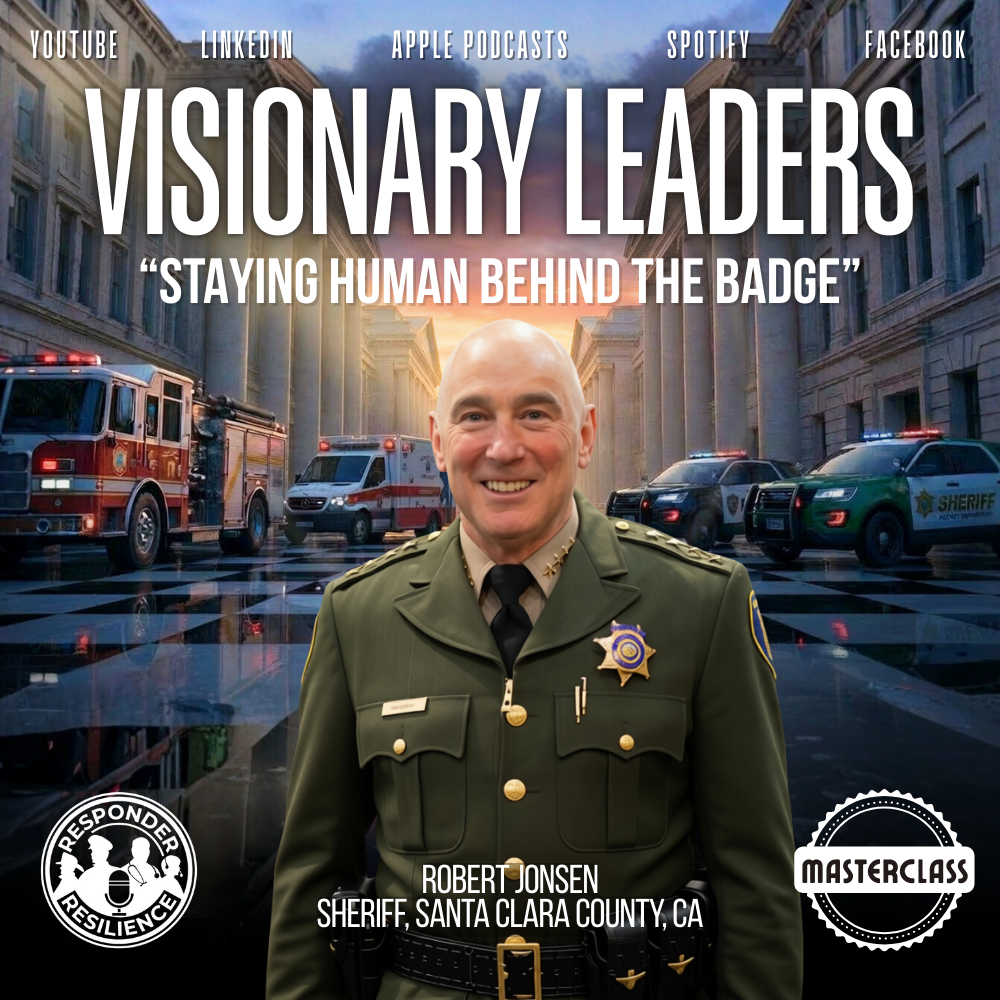
Today we're sitting down with Sheriff Robert Johnson from the Santa Clara County Office of the Sheriff, and we're going to get into the topic of stress and wellness and law enforcement and talk about how leaders can change the narrative around seeking help.
00:01:01.920 --> 00:01:16.239
We'll also explore the potential challenges wellness programs face, especially when it comes to cultural competency, and we'll talk about Bob's upcoming book, Got Your Sticks, which offers the blueprint for resilience and reform in policing.
00:01:16.560 --> 00:01:27.359
We invite you to like and subscribe, YouTube Responder Resilience, Facebook, Responder TV, LinkedIn, Apple Podcasts, Spotify, and go to our website, it's respondertv.com for past episodes and guest information.
00:01:27.519 --> 00:01:30.719
We'll be right back to speak with Sheriff Johnson after this.
00:01:31.680 --> 00:01:36.959
Ask a first responder who they are, and you're likely to hear I am a police officer.
00:01:37.120 --> 00:01:38.319
I am a firefighter.
00:01:38.560 --> 00:01:39.840
I am a paraledic.
00:01:40.079 --> 00:01:44.239
I am a 911 communications operator, not I do this work.
00:01:44.400 --> 00:01:45.760
But I do this job.
00:01:46.239 --> 00:01:49.040
Ask a clinician why they work with first responders.
00:01:49.200 --> 00:01:52.879
And they may say, There's no fire following something out.
00:01:53.680 --> 00:01:59.680
Join us in shaping a culture where mental health, wellness, and leadership are prioritized, not whisper.
00:02:00.079 --> 00:02:05.680
Where support is a sign of strength, not failure, and where no one has to carry the weight alone.
00:02:06.079 --> 00:02:08.319
Welcome to Responder Resilience.
00:02:08.479 --> 00:02:17.439
We shine a spotlight on the unseen battles of first responder reality and celebrate the powerful wins that come from the grit of post-traumatic growth.
00:02:17.599 --> 00:02:25.199
We understand the culture, honor the trust, and bring you conversations from the change makers, passionate about helping first responders come home whole.
00:02:25.599 --> 00:02:29.039
With your host, retired Lieutenant David Dashinger, Dr.
00:02:29.199 --> 00:02:33.759
Stacy Raymond, and Bonnie Roomley, LCSW EMT.
00:02:40.000 --> 00:02:42.159
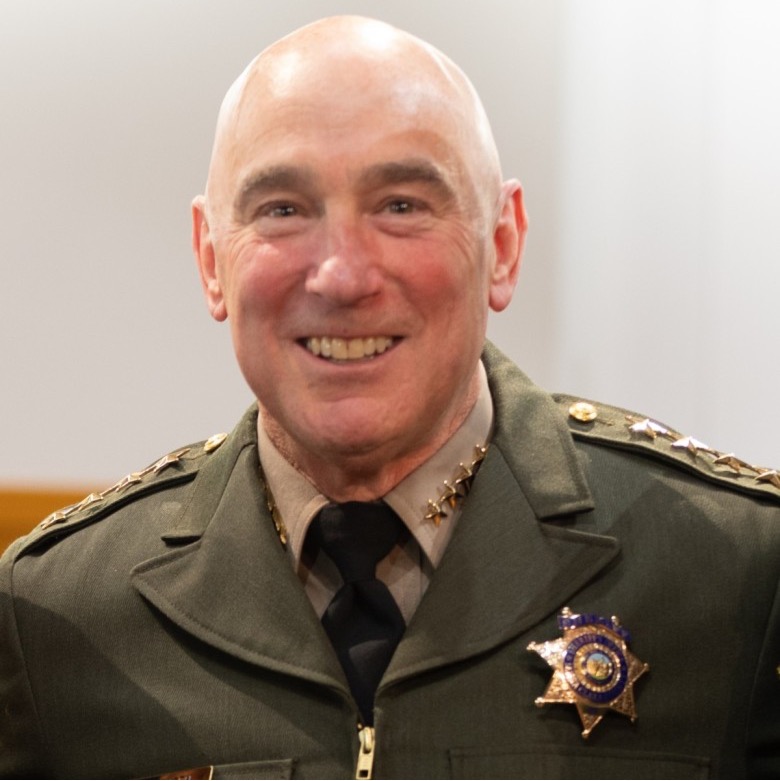
Today we're speaking with Sheriff Robert Johnson.
00:02:42.240 --> 00:02:44.560
He's the 29th Sheriff of Santa Clara County.
00:02:44.639 --> 00:02:49.840
He's got 40 years in law enforcement, including 27 years with the Los Angeles County Sheriff's Department.
00:02:50.000 --> 00:03:05.039
He previously served as Chief of Police for Palo Alto and Menlo Park, where his leadership earned the IACP Cisco Community Policing Award, and he's a certified compassion cultivation training instructor and UCLA trained mindfulness facilitator.
00:03:05.199 --> 00:03:08.400
He co-developed Courageous Heart, the human behind the badge.
00:03:08.479 --> 00:03:14.159
And Sheriff Johnson also chairs the California State Sheriff's Association Wellness Committee.
00:03:14.400 --> 00:03:16.560
Sheriff, welcome to Responder Resilience.
00:03:16.879 --> 00:03:20.560
Oh, good morning, and really I appreciate the opportunity to be here with you, David.
00:03:20.639 --> 00:03:21.599
So thank you for having me.
00:03:21.759 --> 00:03:23.599
Looking forward to the conversation with you, Dr.
00:03:23.759 --> 00:03:24.800
Ring, likewise.
00:03:25.199 --> 00:03:36.240
Let's start by you sharing with us your journey in law enforcement and what inspired you to become an advocate for um workforce wellness initiatives.
00:03:36.639 --> 00:03:38.479
Yeah, how much time do we have?
00:03:39.280 --> 00:03:46.400
You know, I I'll start really for me, and David mentioned that my career started with the Los Angeles County Sheriff's Department.
00:03:46.479 --> 00:03:47.520
I was 23 years old.
00:03:47.599 --> 00:03:51.360
It does 2026 marks my 40th year in this profession.
00:03:51.680 --> 00:03:57.120
My first day was March 13th, uh 1986 with the Sheriff's Department in LA.
00:03:57.280 --> 00:03:59.680
And you know, I grew up in the Northern California.
00:03:59.840 --> 00:04:04.960
So moving to LA, I thought I'd only be down there for maybe a semester or two for school.
00:04:05.120 --> 00:04:09.759
One thing led to another and needed a real job, and that's what prompted me to apply.
00:04:09.919 --> 00:04:12.479
I got hired and then life took hold.
00:04:12.639 --> 00:04:19.439
And, you know, I had an incredible journey uh down with Los Angeles County Sheriff's Department, an incredible organization, lots of opportunities.
00:04:19.680 --> 00:04:29.199
But there also comes a lot of trauma with that and a lot of exposure to things that I had never been exposed to growing up in Northern California, uh, very quickly in my career.
00:04:29.360 --> 00:04:34.720
You know, once I graduated the academy, you go into a custody facility for a couple of years.
00:04:34.879 --> 00:04:37.199
Mine was in a maximum security facility.
00:04:37.360 --> 00:04:46.560
You know, and all of a sudden here I am 23, responsible for the care security of individuals who had a much harder life than mine.
00:04:47.040 --> 00:04:49.759
And so it was a great opportunity to mature a little bit.
00:04:49.920 --> 00:04:51.199
I really appreciated that.
00:04:51.439 --> 00:05:02.160
And then when I went into patrol in South Central Los Angeles in 1988, that's where some of the exposure to trauma at a level I had never been exposed to before was constant.
00:05:02.319 --> 00:05:08.879
And I think that was the beginning of the drip uh as far as that constant cumulative exposure to trauma.
00:05:09.120 --> 00:05:11.839
And you know, when you're young and you're just doing it, you just do it.
00:05:12.000 --> 00:05:16.319
It's just one thing, you know, one call after another, and you don't think much about it.
00:05:16.639 --> 00:05:19.839
In time, it starts to accumulate and starts to take its toll.
00:05:20.000 --> 00:05:28.160
And uh, you know, I really started noticing it probably as I ascended through the organization, uh, became a lieutenant in 2004.
00:05:28.399 --> 00:05:34.879
And then all of a sudden I was responsible for managing men and women that were out there risking their lives every day.
00:05:35.040 --> 00:05:46.240
And we had some a few significant incidents early on in my tenure there as a watch commander in the Antelope Valley that really hit home and both on a professional and personal way.
00:05:46.399 --> 00:06:02.480
And then that's when I started realizing things were shifting for me, both physically and maybe even psychologically, having a much tougher time sleeping, much tougher time coping with the stress, much tough, tougher time really decompartamentalizing things.
00:06:02.639 --> 00:06:05.040
And it's almost and I share this experience.
00:06:05.199 --> 00:06:08.079
You know, all of us know what it's like to wear that protective vest.
00:06:08.319 --> 00:06:15.120
And you ask any police officer out there the best part of their day, and they're gonna tell you it's taking that vest off at the end of the day.
00:06:15.439 --> 00:06:17.680
Well, I've gotten to a point where it wasn't coming off.
00:06:17.759 --> 00:06:20.720
I just felt that constant contortion on my chest.
00:06:21.120 --> 00:06:34.800
That's when I thought, you know, maybe, maybe it's the environment, and maybe I need a change because 27 years in Los Angeles was definitely starting to impact me, turning me into somebody and someone I really didn't uh like anymore.
00:06:35.360 --> 00:06:37.519
So but I still have the profession.
00:06:37.680 --> 00:06:47.519
So that's when in 2012 I applied to uh chief of police position in Northern California, got accepted, got hired with the Menlo Park Police Department.
00:06:48.000 --> 00:06:54.720
Incredible journey uh transformation, going from the largest sheriff's department in the world to a really small organization.
00:06:55.519 --> 00:07:02.720
Um but I realized very quickly, it doesn't matter if it's large or small, the trauma, the exposure, the stress is still there.
00:07:02.959 --> 00:07:12.160
But it was also in that uh time at Menlo Park where I had again a couple of incidents, both personal and professional, that really escalated things.
00:07:12.319 --> 00:07:16.879
And I'd gotten to a point where one incident, my blood pressure was 220 over 180.
00:07:17.199 --> 00:07:20.399
Uh, and as you know, both of you know, that's probably not a good thing.
00:07:20.560 --> 00:07:23.759
I had been diagnosed with high blood pressure when I was 34.
00:07:23.920 --> 00:07:25.120
That's when I was in LA.
00:07:25.279 --> 00:07:29.040
So again, I I knew things needed to change.
00:07:29.279 --> 00:07:37.360
In 2015, I actually had a coffee meeting with our mayor, who actually suggested mindfulness for us to consider it.
00:07:37.600 --> 00:07:38.560
Never even heard of it.
00:07:38.800 --> 00:07:41.120
Wasn't part of the conversation back then.
00:07:41.279 --> 00:07:41.600
Yeah.
00:07:41.839 --> 00:07:47.279
But I told her I'd explore it, I'd look into it, which I did, and I went to this three-day retreat.
00:07:47.519 --> 00:07:56.160
I'll be honest with you, when I came back, I felt more excited, more energized about this profession, about the possibility of this profession than I had in decades.
00:07:56.319 --> 00:08:00.560
And that's where the journey really began in this world of resiliency and mindfulness.
00:08:00.639 --> 00:08:21.839
And I started working, well, let me just put it this way I I went down the rabbit hole pretty deep as far as incorporating uh meditation, concepts that had never been taught in this profession, uh, and really wanted to know why it was working for me, because it was working very well for me and managing the stressors I was confronted with.
00:08:22.000 --> 00:08:28.879
And I started working with Stanford University, going to some compassion cultivation uh classes there, and then working with the Compassion Institute.
00:08:29.120 --> 00:08:35.519
That's really the formation of the program that David had mentioned, Courageous Hearts, The Human Behind the Badge.
00:08:35.679 --> 00:08:42.000
And I've been all in ever since and been a big advocate in California for workforce wellness.
00:08:42.159 --> 00:08:50.960
Uh, I chair, as David said, the State Sheriff's Association, and we have quarterly meetings and annual uh uh training symposiums.
00:08:51.200 --> 00:08:59.519
When I was hired or elected here as sheriff in 2022, my first operational uh objective was workforce wellness.
00:08:59.679 --> 00:09:08.320
And I had asked for a full-time wellness coordinator, which I was approved, and we hired, and we've been going full speed ever since.
00:09:08.480 --> 00:09:14.399
So I'm really excited about the opportunity in this profession of actually opening the door to these concepts.
00:09:14.559 --> 00:09:22.960
I think it's super important and really, really appreciated to both of you for having this podcast and communicating the things that need to be heard.
00:09:23.360 --> 00:09:27.200
Not everyone is meant to walk this path, and that's okay.
00:09:27.440 --> 00:09:34.879
But for those who feel the call, for those who read these words and feel not just curiosity but conviction, know this.
00:09:35.200 --> 00:09:41.759
By the time a first responder sits across from you, they've likely exhausted every internal resource they have.
00:09:42.000 --> 00:09:45.840
This isn't a routine appointment, it's their 911 call.
00:09:46.960 --> 00:09:49.039
I don't know how much longer I can do this job.
00:09:49.279 --> 00:09:51.840
You won't hear sirens, but the urgency is real.
00:09:52.000 --> 00:09:55.519
If you choose to take that call, understand what it means.
00:09:55.759 --> 00:10:02.720
To show up, to stay steady, and to carry the weight of someone who spent a career doing the same for others.
00:10:03.039 --> 00:10:05.120
This is where the work begins.
00:10:05.440 --> 00:10:07.679
Be the resource they can count on.
00:10:07.919 --> 00:10:16.000
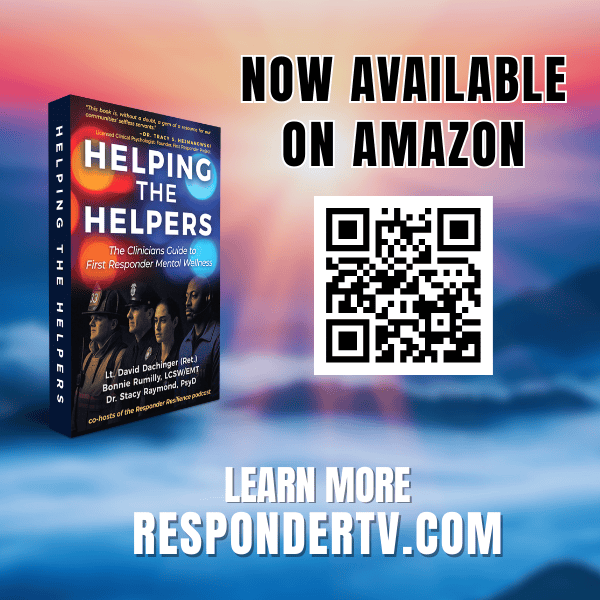
Order your copy of Helping the Helpers Today on Amazon, and for bulk orders, email us at info at responderTV.com.
00:10:23.519 --> 00:10:37.519
Thanks, and it's inspiring for us to hear someone with your tenure uh in this job and so many different uh levels to seek this kind of different way of approaching things that we traditionally haven't done.
00:10:37.679 --> 00:10:39.279
Um and I'm curious about that.
00:10:39.360 --> 00:10:46.080
Like as you brought that to your department, your agency, what was that like to roll it out?
00:10:46.159 --> 00:10:49.600
Was it was there buy-in from the rank and file?
00:10:49.759 --> 00:10:54.799
Did it take some you know process to get everybody or does everybody um embrace it?
00:10:54.879 --> 00:10:56.399
Like how's how does that work?
00:10:56.799 --> 00:10:58.080
How did it work for you?
00:10:58.399 --> 00:10:59.120
Well, I think Dr.
00:10:59.279 --> 00:11:05.279
Redmond's response summed it up perfectly that you know, just a little bit of, are you kidding me?
00:11:05.440 --> 00:11:12.000
It was it's and I've had it three different organizations, which has been really a blessing, but also a learning as an executive.
00:11:12.240 --> 00:11:25.519
You know, the one of the values when I went to that resiliency training from Metlo Park Police Department, when I came back and met with the mayor, I said, okay, I see some value in this training, uh, but we there's no funding for this.
00:11:26.000 --> 00:11:29.919
Our certification, post-certified training in state of California.
00:11:30.000 --> 00:11:33.519
There were no programs on mindfulness or resiliency, and there was no funding.
00:11:33.679 --> 00:11:37.600
So I said, I don't see how I'm gonna be able to do anything with this.
00:11:37.919 --> 00:11:55.200
To her credit, she went back to the council and approved a hundred, I think it was$175,000 for us to send every employee, not just every officer, but every employee to this resiliency training, which we did over the next two years from 2017 through 18.
00:11:55.519 --> 00:11:59.360
And so that was a blessing because and it was also a learning.
00:11:59.919 --> 00:12:05.440
And why I say that for me as a learning objective is that we decided, okay, we got this funding, everybody's going.
00:12:05.600 --> 00:12:08.720
We didn't ask, we just said everybody's going.
00:12:08.960 --> 00:12:13.840
And quickly we realized something that it's not for everybody, right?
00:12:14.000 --> 00:12:21.200
Yeah, it's certainly not, especially when you're talking about uh introducing mindfulness, maybe some concepts of meditation.
00:12:21.360 --> 00:12:27.440
I don't call it meditation anymore, I call it tactical breathing for you know just to get some body in.
00:12:27.919 --> 00:12:31.279
The reality is that first wave, we did it in three waves.
00:12:31.440 --> 00:12:34.960
Now, in the first wave were all the early adopters who were actually excited.
00:12:35.039 --> 00:12:37.519
They wanted they wanted to go and see what this was about.
00:12:37.840 --> 00:12:49.759
The second wave was the ones that were curious, and a lot of it had to do with the feedback from the first wave, but that third wave were all the ones that had creatively found ways not to be part of the first two waves.
00:12:49.919 --> 00:12:50.480
Uh huh.
00:12:50.639 --> 00:12:53.360
They were the ones totally opposed to it.
00:12:53.440 --> 00:12:53.840
Yeah.
00:12:54.080 --> 00:12:59.679
And I actually had a sergeant who I'm a very good friend with, uh, and we talk about it all the time.
00:12:59.840 --> 00:13:02.399
He was upfront about it from day one.
00:13:02.639 --> 00:13:04.000
Do not make me go to this.
00:13:04.080 --> 00:13:04.960
I don't want to go.
00:13:05.360 --> 00:13:07.279
You oversaw our narcotics team.
00:13:07.440 --> 00:13:09.279
Uh, he was an incredible individual.
00:13:09.440 --> 00:13:15.600
But you know, we said, hey, a lot of this funding was to ensure you went to this training.
00:13:15.840 --> 00:13:18.799
And so he went, but it did not go well.
00:13:18.879 --> 00:13:22.080
And because he just didn't have that mindset, he wasn't ready for it.
00:13:22.240 --> 00:13:22.480
Right.
00:13:22.720 --> 00:13:24.240
I get that, I understand that.
00:13:24.399 --> 00:13:30.480
And so, you know, we've had conversations since, and that since then, to be very honest and transparent, he's actually changed.
00:13:30.639 --> 00:13:32.159
It's been 10 years since that time.
00:13:32.240 --> 00:13:38.399
And now he actually, you know, really adopts some of these concepts because he realizes the value they bring.
00:13:38.639 --> 00:13:41.200
And when he went to Palo Alto, here's what was interesting.
00:13:41.360 --> 00:13:50.399
Palo Alto, I realized I was uh selected as a chief for Palo Alto, which is a neighboring city, different county, but neighboring city to Venlo Park.
00:13:50.559 --> 00:13:58.720
And I was hired there, in my opinion, not only because of my experience, but because of this interest in resilient workforce resiliency wellness.
00:13:58.960 --> 00:14:02.480
And the city manager at the time had a big interest in that as well.
00:14:02.720 --> 00:14:05.679
And he really wanted me to bring it into the organization.
00:14:05.919 --> 00:14:08.320
But I realized I had to be thoughtful about it.
00:14:08.399 --> 00:14:13.519
So I started a little differently and I may opened it up to our peer support to get their buy-in.
00:14:13.840 --> 00:14:16.000
And then we gradually introduced it.
00:14:16.480 --> 00:14:20.799
But the difference in Palo Alto was I was there during the pandemic.
00:14:20.960 --> 00:14:34.799
So when the pandemic hit, it's all of a sudden it opened the door that I didn't anticipate, meaning the entire workforce wanted some kind of relief, meaning the entire workforce, the librarians, public works, the entire city workforce.
00:14:34.960 --> 00:14:39.600
So we started offering it to the workforce, and it was really, really well received.
00:14:39.840 --> 00:14:46.720
But to answer your question today, when I came to the sheriff's office, you'd have to know a little bit about the history here.
00:14:46.799 --> 00:14:52.240
And they went through a pretty traumatic period, very stressful, chaotic period prior to my arrival.
00:14:52.559 --> 00:15:00.720
And so I think they've probably been the most open organization to the concepts because they were about as stressed as you could ask an organization to be.
00:15:01.440 --> 00:15:11.600
So we started off right from the beginning, introducing it to the executives, to the managers, to the sergeants, because I needed the sergeants to really believe in it.
00:15:12.879 --> 00:15:14.480
I don't think it would have gone anywhere.
00:15:14.720 --> 00:15:22.320
And I made it really clear to the sergeants, listen, if you don't feel this is going to bring value to all the members of this organization, we're not going to do it.
00:15:22.559 --> 00:15:25.840
But the surveys came back, they thought everybody should go through it.
00:15:25.919 --> 00:15:27.200
They thought there was value.
00:15:27.360 --> 00:15:32.559
So here we are in year three, and we're going to be starting to roll it out uh to the entire workforce.
00:15:32.720 --> 00:15:35.039
But I did it in a more gradual progression.
00:15:35.200 --> 00:15:38.159
And I'm probably going to stick to I'm not going to mandate it.
00:15:38.320 --> 00:15:42.639
I'm going to allow people to sign up as they feel they can uh gain some value out of it.
00:15:42.879 --> 00:15:44.480
And we'll take it from there.
00:15:46.240 --> 00:15:50.799
It's crucial to um have the audience be receptive to it.
00:15:50.960 --> 00:15:55.279
And so and especially it's effective when it comes from leadership down.
00:15:55.440 --> 00:16:00.080
That's what I have in my experience, I believe.
00:16:00.960 --> 00:16:09.120
So, Sheriff, how would you define wellness in the context of public safety and wellness beyond just physical health?
00:16:09.600 --> 00:16:15.600
Yeah, so you know, I've had a motto ever since I've been an executive, and it's be fit, be well, be more.
00:16:16.159 --> 00:16:21.919
And early in my career, the be fit, it's always been the thing that I thought was the most important, right?
00:16:22.080 --> 00:16:24.879
We have to stay physically fit, which I still believe in today.
00:16:25.039 --> 00:16:28.320
I'll get down and do push-ups with anybody on any given day.
00:16:28.960 --> 00:16:36.480
But the reality is as time went on, I realized that be well is really, really super important, meeting both in body and mind.
00:16:36.559 --> 00:16:44.080
And I think that's where sometimes these wellness boxes, we check off on a lot of the things that have to do with the physical being.
00:16:44.320 --> 00:16:57.440
We make sure they have the weights, we made sure they can work out on duty, we made sure they have access to things, you know, to keep their body healthy, which is really important, but not as much so with the mind and the psychological aspect.
00:16:57.600 --> 00:17:04.559
And I think, you know, especially in your world, Doctor, I think that is so important and it's underutilized in our profession.
00:17:04.720 --> 00:17:09.359
And it's been decades and decades of this, you know, kind of culture.
00:17:09.519 --> 00:17:13.839
And I'm, you know, we talk about that warrior kind of guardian mentality.
00:17:14.000 --> 00:17:15.920
And I don't believe it should be one or the other.
00:17:16.079 --> 00:17:26.880
I think it's a mending of blending of both, is having the skill set we need to survive what we do, but also the guardian mentality, not only for our community, but for ourselves.
00:17:27.039 --> 00:17:37.680
And that's where wellness to me is really making sure you as an individual are both physically and psychologically well so you can serve the community to the best of your ability.
00:17:37.920 --> 00:17:42.000
Because if we don't have both, we're going to be struggling at some point in our career.
00:17:42.400 --> 00:17:49.759
So I see that far too often people may take great help uh care of their physical being, but not their psychological being.
00:17:49.839 --> 00:17:50.880
And that's what breaks them.
00:17:51.039 --> 00:17:57.839
But they'll take great care of their psychological aspect, their mind, but they don't take care of the body, and the body will break down on it.
00:17:58.000 --> 00:18:04.480
So again, I think it's that combination of uh opportunities for our workforce that blend all of the above.
00:18:04.640 --> 00:18:06.240
And there's so many other aspects.
00:18:06.319 --> 00:18:13.599
And what we're seeing when we have our Whelms coordinator meetings is to your comment earlier, it does start at the top.
00:18:13.759 --> 00:18:20.079
If the organization doesn't take it seriously as from the executive down, it's only going to go so far.
00:18:20.240 --> 00:18:22.720
So I do think that really needs to be a priority.
00:18:23.759 --> 00:18:25.519
Well, I'm curious about this too.
00:18:25.680 --> 00:18:35.759
Like when you have a program like that that's obviously being funded by the county or your, you know, municipal administration, do you have to quantify that it's having an impact?
00:18:35.920 --> 00:18:47.359
Is there a concrete way to show that, hey, we're, you know, we're helping people, we're seeing less people leave, we're having less comp claims, or there's some definable tangible benefit to doing this?
00:18:47.519 --> 00:18:49.279
Like how does that how does that work?
00:18:49.680 --> 00:19:02.240
Yeah, and I I think that's a great question, but I think, you know, especially with both of you being involved in this so intimately, I think that's where research really needs to dedicate some resources because I and they are, they're starting to.
00:19:02.400 --> 00:19:06.160
So thank you for the researchers out there dedicated to this work.
00:19:06.400 --> 00:19:14.720
But up to this point, there really hasn't been a lot on law enforcement, and especially in regards to workforce wellness metrics.
00:19:14.960 --> 00:19:21.359
So we have, you know, we did a survey in California of our sheriff's organizations, who's doing what?
00:19:21.599 --> 00:19:22.480
But that's about it.
00:19:22.640 --> 00:19:23.279
Who's doing what?
00:19:23.359 --> 00:19:30.400
Whether it's cortico, the weight training, whether it's access to uh psychologists, whether it's chaplain program sphere support, whatever.
00:19:30.480 --> 00:19:40.799
So we have a pretty good understanding of what they're doing, but we don't have a really good understanding yet of how that's working out as far as the resiliency, retention, everything else.
00:19:40.960 --> 00:19:47.519
And I think you know, UC San Diego is starting uh working, they have a Senate 720 program that they kicked off a few years ago.
00:19:47.599 --> 00:19:53.759
So they're starting to collect some of that data, and hopefully we'll have some of that research coming out, at least here in California.
00:19:53.839 --> 00:20:01.519
But it's definitely an under-researched area, and I think there's tremendous value in finding out how well these programs work.
00:20:01.680 --> 00:20:10.319
So we can actually dedicate resources to the ones that work well, uh, you know, compared to just checking off a box that's saying we're doing this.
00:20:10.880 --> 00:20:14.400
Boxing has the power to change lives, especially for first responders.
00:20:14.559 --> 00:20:21.440
Fight Camp embraces your journey, whether you're stepping into the ring for the first time, returning after a break, or aiming to elevate your fitness.
00:20:21.680 --> 00:20:28.640
Harness the strength of boxing to release stress, build resilience, and connect with a supportive community one punch at a time.
00:20:28.799 --> 00:20:33.920
Use code RR10 for a 10% discount on Fight Camp packages and accessories.
00:20:34.079 --> 00:20:38.000
Go to joinfightcamp.com slash shop.
00:20:42.720 --> 00:20:50.960
So, Sheriff, uh, what do you see as some of the most significant stressors for public safety professionals today?
00:20:51.599 --> 00:20:55.440
Well, in 2025, I think there's a lot.
00:20:55.519 --> 00:21:02.000
I, you know, I really, and depending on where you're at in this country, you know, the the typical trauma we're always gonna have.
00:21:02.160 --> 00:21:10.640
We're always gonna have those incidents where we respond to an accident, you know, somebody in distress, an overdose, a shooting, a murder, a homicide.
00:21:10.799 --> 00:21:16.079
Those visuals, that that handling those cases are I call them memory markers.
00:21:16.240 --> 00:21:18.799
We're not gonna be able to extract that out of this profession.
00:21:19.039 --> 00:21:23.680
But I think what's causing a lot of stress in today's environment is the political uncertainty.
00:21:23.839 --> 00:21:27.279
Uh without going too deep into politics, because it varies.
00:21:27.440 --> 00:21:45.200
But here in California, you know, we are, I don't want to say an outlier, but with, you know, regards to federal policy right now, especially around immigration, we have state laws that prohibit us from working with, you know, federal agencies in regards to immigration enforcement.
00:21:45.519 --> 00:21:54.079
Right now, that's becoming a lot of creating a lot of divide in our our state because there's a lot of pressure uh from both sides, right?
00:21:54.480 --> 00:22:12.400
So I think that political uncertainty of what we should do, how we're gonna do it, when we should do things is Creating an anxiety and stress that you know I wish wasn't here at this particular moment because we already have enough stressors going on without this portable influence uh enhancing it.
00:22:12.559 --> 00:22:25.279
And I think you know, with the fiscal times of you know, the last few years, at least in California, especially here in the Bay Area, that uncertainty of are we going to grow or are we gonna stagnate or are we gonna actually have to lay off audits?
00:22:25.519 --> 00:22:28.960
So again, that career uncertainty is causing pressure.
00:22:29.119 --> 00:22:31.519
There's some fiscal things that create anxiety.
00:22:31.680 --> 00:22:48.480
But again, I think, you know, the the hope I have is that people can see past the immediate cliff that may be in front of us and see the broader landscape and really how this profession is finally opening its door and understanding that our people need resources.
00:22:48.640 --> 00:22:58.240
So let's get them resources so they can continue to climb and overcome whatever cliff or whatever mountains in front of them today, because it changes so often.
00:23:02.400 --> 00:23:08.960
How does this work in terms of someone who's new to the agency, a recruit who's just starting out in this profession?
00:23:09.279 --> 00:23:11.680
Um what kind of tools do you give them?
00:23:11.759 --> 00:23:20.640
And and I'm assuming it's very different now than it used to be, where perhaps back in the day it was just focused on skills to become a police officer.
00:23:20.799 --> 00:23:28.960
Now there's a lot more to consider, especially wellness as a component, because we want these want these folks to have a long, resilient career.
00:23:29.119 --> 00:23:31.599
What how's the how do you approach that piece of it?
00:23:32.000 --> 00:23:34.079
Yeah, so that's a great question.
00:23:34.240 --> 00:23:45.200
And again, because we were able to bring in a dedicated wellness coordinator, she has done a phenomenal job addressing this throughout the organization of different areas that need to be addressed.
00:23:45.359 --> 00:23:53.759
And so over the past couple of years, and we started it really when I came in because of the directive I've given the organization and the focus on wellness.
00:23:53.920 --> 00:24:03.599
You know, in California, they actually have a learning domain in the academy regarding wellness, but it's an overall kind of general approach and introduction.
00:24:03.759 --> 00:24:10.480
And what we do here in Santa Clara, as soon as individuals get hired, we have an two-week orientation.
00:24:10.640 --> 00:24:15.759
And when they come in the doors, we start integrating them or introducing these concepts.
00:24:15.920 --> 00:24:19.680
We start being very upfront with them about the disruption and sleep they're gonna have.
00:24:19.839 --> 00:24:22.480
And by the way, I read your article, a very good article on that.
00:24:22.720 --> 00:24:31.279
But it's something they don't think about, but with the stressors that are all all of a sudden they're gonna have just by being in the academy, it's gonna disrupt certain aspects of their lives.
00:24:31.440 --> 00:24:44.240
So we prepare them for that during this orientation, give them tools and skill sets to address it as it starts to develop and let them know hey, when a stressor seems to be too much for you, don't hesitate to ask.
00:24:44.400 --> 00:24:48.799
So we're opening that door of communication, is like it's okay not to be okay.
00:24:48.960 --> 00:24:50.480
And we want you to reach out.
00:24:50.640 --> 00:24:54.400
So let us help you get through this rather than you struggling alone.
00:24:54.559 --> 00:25:10.480
And that has really helped because we've seen actually quite a quite a uh difference in the amount of time they're spending in the academy now compared to we used to almost always have one or two individuals quit within day one or day two of the academy.
00:25:10.799 --> 00:25:20.640
But now we're building this bond, this relationship before they even start, and they're really going into it more as a team and they're supporting each other, and they know that we're supporting them.
00:25:20.799 --> 00:25:22.160
So that mindset has helped.
00:25:22.240 --> 00:25:26.799
And as soon as they get out of the academy and those lectures continue throughout, right, right.
00:25:27.039 --> 00:25:33.359
We actually have a mental performance specialist assigned to the academy that works with them on a daily basis.
00:25:33.519 --> 00:25:41.279
Uh, and so it's integrating some of those tools early on so they know, okay, this isn't just one and done, this is part of my career now.
00:25:41.359 --> 00:25:43.759
So I not have available to me.
00:25:44.160 --> 00:25:47.119
And that's critical to have a wellness coordinator.
00:25:47.279 --> 00:25:49.279
I don't hear about that on the East Coast.
00:25:49.359 --> 00:25:54.559
And I I wonder if it's just the West Coast is more progressive in that, in that sense.
00:25:54.799 --> 00:26:10.799
So for those departments that don't have a wellness coordinator, um, how do you suggest that leadership can influence officers to see getting help, if they need it, as a strength as opposed to a weakness?
00:26:11.440 --> 00:26:13.839
Yeah, I I think that's uh another great question.
00:26:13.920 --> 00:26:20.319
And I think to your point, though, just for clarification, I do think California is a little more progressive in this area.
00:26:20.400 --> 00:26:25.680
I I have noticed wellness is a topic that's being talked about throughout the country, obviously.
00:26:25.839 --> 00:26:26.079
Yeah.
00:26:26.240 --> 00:26:30.160
But to your point, very few are dedicating resources specific to that.
00:26:30.319 --> 00:26:41.759
And in California, you know, we were fortunate to have a grant rolled out a couple of years ago that opened the door for every agency because every agency received a little bit of money to start a wellness program.
00:26:42.000 --> 00:26:47.920
And by doing that, every organization had to assign somebody as their wellness liaison.
00:26:48.480 --> 00:26:52.079
Now, we actually chose to hire a dedicated person.
00:26:52.240 --> 00:26:57.759
There's only, I think, three or four agencies that have a dedicated wellness coordinator.
00:26:58.000 --> 00:27:03.519
Most have assigned it to a sergeant or lieutenant, okay, staff member as a collateral.
00:27:03.680 --> 00:27:07.279
And we realized early on that's not really the best approach.
00:27:07.759 --> 00:27:10.960
A lot of people had no idea what they're supposed to do or how to do it.
00:27:11.200 --> 00:27:13.680
Yeah, they're not trained in wellness necessarily.
00:27:14.480 --> 00:27:23.200
So they a lot of the times, especially in that first year, we saw they were doing whatever they knew of, meaning if it was a cortico app, we're gonna do this.
00:27:23.359 --> 00:27:26.880
If it's uh finding weights for their gym, we're gonna do that.
00:27:27.119 --> 00:27:41.279
But really getting into some of the key things, such as training and skill set uh on sleep deprivation, yes, whether it's access to mental health, whether it's uh mental health check-ins, you know, that really takes somebody that understands the overall landscape.
00:27:41.599 --> 00:27:49.200
So I my recommendation for you know executives that maybe don't have a liaison is to create a position.
00:27:49.440 --> 00:27:55.359
Try to find somebody who has a true interest in this and give them the freedom to go and do what they do.
00:27:55.519 --> 00:28:04.880
And I think that's really important not to dictate how it gets done, but be holistic about it and really find out from the workforce what is it that's challenging you?
00:28:05.200 --> 00:28:08.559
What is it that we can get you to help you through these challenges?
00:28:09.759 --> 00:28:17.359
And so if you have a member who's struggling and they need help beyond the wellness program, they need to seek out some kind of uh clinical help.
00:28:17.440 --> 00:28:20.720
Um, is that included in the program or how do you handle that piece of it?
00:28:20.799 --> 00:28:30.880
And is that something that's tracked by the agency where they get, you know, they sort of go outside of um the paper trail so that they have some anonymity?
00:28:31.359 --> 00:28:32.559
A little a little bit of both.
00:28:32.720 --> 00:28:38.720
We have a pretty comp very comprehensive peer support team, uh, which covers the entire organization.
00:28:38.960 --> 00:28:45.519
So a lot of the times those that are really facing uh you know challenges, they'll reach out to the peer support.
00:28:46.640 --> 00:28:53.599
What I'm about to say may be a little controversial, but it which I think I think every agency needs a peer support, no question.
00:28:53.839 --> 00:28:54.400
Oh yeah.
00:28:55.759 --> 00:29:04.079
But I want to make sure the individuals that are not at that level where they're really feeling uh I need help to have access to something.
00:29:04.240 --> 00:29:05.839
And I think that's also important.
00:29:05.920 --> 00:29:11.200
And what I mean by that is we're really trying to create a culture of just regular check-ins.
00:29:11.680 --> 00:29:20.319
It is even if you don't think that you're having a mental health crisis or a major crisis in your life, an occasional check-in can be very, very beneficial.
00:29:20.559 --> 00:29:32.319
So we're setting up those kind of resources, really messaging that out through our ESA and through our concern program, which gives access to two clinicians uh at any given time.
00:29:32.480 --> 00:29:39.839
Our workforce, I think it's about 20 visits a year that they can have access to, which is really important that they know and it's free of charge.
00:29:39.920 --> 00:29:42.400
And we don't have to go through the organization.
00:29:42.559 --> 00:29:43.599
We just give them the list.
00:29:43.759 --> 00:29:45.839
They know of the list because we message it out.
00:29:45.920 --> 00:29:49.359
Uh, and they can just reach out and say, I'd like to talk to somebody.
00:29:49.519 --> 00:30:02.240
We're working with some um companies right now to look at how we can better connect people with the cultural competency clinicians that may be better suited to address their specific needs.
00:30:02.960 --> 00:30:04.799
Again, we heard that from the beginning.
00:30:04.960 --> 00:30:11.279
It's one thing, and no disrespect to clinicians out there, but it's one thing to be a really good clinician.
00:30:11.519 --> 00:30:21.200
It's a whole nother world to be a really good clinician for this profession because of that relationship and understanding what the men and women go through on a daily basis.
00:30:22.160 --> 00:30:28.640
And that speaks to our book, the book that David, myself, and Bonnie wrote, um, Helping the Helpers.
00:30:28.720 --> 00:30:41.440
It's a um a book um not just for clinicians, it can be for peer support um leaders, chaplains, and uh we have found that um first responders themselves are enjoying reading the book.
00:30:41.680 --> 00:30:50.960
But that book is really, it just has gold nuggets in there of wisdom for clinicians that want to work with this population and veterans.
00:30:51.200 --> 00:30:53.680
So um that's why we wrote the book.
00:30:53.839 --> 00:31:04.000
It's it's absolutely needed because not every therapist can um deal with the material that that first responders or veterans bring to them.
00:31:04.400 --> 00:31:04.640
Right.
00:31:05.279 --> 00:31:14.640
You you actually just framed it perfectly, and and thank you for that book because you know, I think to your comment, it's those golden nuggets that can change a culture.
00:31:14.799 --> 00:31:17.599
You know, it's just that awareness, like, ooh, I didn't know that.
00:31:17.680 --> 00:31:19.519
I didn't know this resource was there.
00:31:19.759 --> 00:31:34.799
And, you know, that was the original feedback we were getting when we opened up the door to clinicians, is we were getting that feedback from some of the officers that, yeah, I tried this person, but they actually just, they just I could tell they weren't understanding it.
00:31:34.960 --> 00:31:37.519
Yeah, they weren't understanding what I was going through.
00:31:37.680 --> 00:31:44.480
You know, we're pretty good at reading body language, and we're not the psychologist or the clinician, but we can pick up these little cues.
00:31:44.559 --> 00:31:52.480
Yes, I'm like, no, this person, they're not getting me, they're not seeing me, they're not uh realizing that this is really impacting me.
00:31:53.440 --> 00:32:03.440
You know, because we can become, and you know this, we can put on a pretty good facade, we can be pretty stoic because that's what we have to do, but it doesn't mean we're well inside.
00:32:03.599 --> 00:32:11.680
And I think they that connection with the clinician is super, super important to bring out some of the things that are most uh harmful within us.
00:32:11.920 --> 00:32:12.240
Right.
00:32:12.799 --> 00:32:22.000
You're trained to help people heal, but first responders, they carry trauma that's buried under silence, stigma, and stress.
00:32:22.319 --> 00:32:30.319
Helping the helpers gives you the framework to connect, to speak their language, earn their trust, and actually make an impact.
00:32:31.200 --> 00:32:37.440
From the experienced team and clinicians behind the Responder Resilience Podcast, this isn't theory.
00:32:37.599 --> 00:32:40.799
It's real-world support for the ones who need you most.
00:32:40.960 --> 00:32:43.279
And this book isn't just for clinicians.
00:32:43.440 --> 00:32:55.599
If you're an agency leader, peer support team, chaplain, EAP, wellness program coordinator, or family member, helping the helpers will equip you with the tools, language, and insight to make a difference.
00:32:55.920 --> 00:32:58.400
Be the resource they can count on.
00:32:58.720 --> 00:33:02.559
Order your copy of Helping the Helpers on Amazon today.
00:33:32.880 --> 00:33:37.759
Um, just you know, things having to do with first responder culture uh make a big difference.
00:33:37.920 --> 00:33:53.279
And even where the um responder sits in that office, um, you know, having a view of the exit, there's a lot of nuances to it that build that trust and that rapport that uh a clinician who hasn't worked in in our world may not have any idea about.
00:33:53.519 --> 00:34:03.440
So um we just felt these are important things and we want to we all we we want to see more competent clinicians out there to work with all the responders that um you know that are looking for the help.
00:34:03.759 --> 00:34:03.920
Yeah.
00:34:04.079 --> 00:34:25.440
Well, you know, David, you just brought up a really fascinating insight that again I think to the clinicians, and listen, I'm not trying to educate anybody on this, but you know, that aspect of understanding what's going on in our mind based on years of exposure and stress, you know, and I look I didn't realize this until I started teaching meditation or tactical breathing.
00:34:25.599 --> 00:34:31.679
But even asking in a typical meditation, you would almost always ask the participants to close their eyes, right?
00:34:31.920 --> 00:34:32.960
Or lower their gaze.
00:34:33.199 --> 00:34:40.639
Well, to ask a law enforcement officer, uh, especially in a room of uncertainty, to close their eyes is not going to help settle their mind.
00:34:41.119 --> 00:34:43.360
It's probably gonna shoot it right through the roof, right?
00:34:43.519 --> 00:34:43.679
Right.
00:34:44.079 --> 00:34:51.679
We have to be aware of who we're dealing with and how to slowly bring them to where you want them to be at their own pace.
00:34:51.920 --> 00:34:55.760
So uh again, really grateful for both of you for what you've been doing.
00:34:56.159 --> 00:34:57.920
Yeah, great point in meditation.
00:34:58.000 --> 00:35:08.719
Uh, you know, everything from the way we uh we label it, um, having calling it tactical breathing is a brilliant way to uh, you know, re lower that barrier of resistance that we can tend to get.
00:35:09.039 --> 00:35:15.360
Talk about your upcoming book, Got Your Six, a Sheriff's Blueprint for Resilience, Reform and Staying Human Behind the Badge.
00:35:15.519 --> 00:35:17.280
Uh, what was the motivation for writing it?
00:35:17.360 --> 00:35:20.960
And tell us uh what's in it, what people should uh take away from it.
00:35:21.440 --> 00:35:29.599
Well, as I mentioned to both of you, I should have seeked uh a psychologist, a therapist before I started this, but it was definitely not what I anticipated.
00:35:29.760 --> 00:35:29.920
Yeah.
00:35:30.079 --> 00:35:37.760
What I mean by that is, you know, 40 years I've accumulated a lot of information, exposure to a lot of different things.
00:35:37.920 --> 00:35:43.199
I've had my challenges, and it's really what I thought, I'm just gonna start putting this down on paper.
00:35:43.440 --> 00:35:45.599
And I had no idea where it would take me.
00:35:45.760 --> 00:35:50.880
But where it took me was to some really amazing spaces, and it took me to some very dark spaces.
00:35:51.280 --> 00:35:54.800
Because again, I'm bringing up things that I hadn't thought of for years.
00:35:55.039 --> 00:36:04.639
And to be very honest with you, why I made the comment about talking to a psychologist is that it became almost overwhelming cathartic.
00:36:05.280 --> 00:36:05.760
Right, right?
00:36:06.000 --> 00:36:22.880
Yeah, it was it was, but you know, I was finding myself, I'm a huge advocate for sleep, but during that process, I was not sleepy because I was constantly waking up in the middle of the night with some other memory that would pop up, some other incident that I had forgotten about, and I had to write it down.
00:36:23.119 --> 00:36:23.360
Sure.
00:36:23.519 --> 00:36:26.559
And so I'm really happy that I've gotten through that phase.
00:36:26.960 --> 00:36:34.639
The book started off more as, you know, my journey, but then it got into the work that I've been doing around mindfulness and compassion training.
00:36:34.800 --> 00:36:42.800
So it really is broken down into three different areas: the journey, which is not a children's book because there's nothing pretty about this work, right?
00:36:42.960 --> 00:36:46.079
Especially over the areas that I've worked in my career.
00:36:46.239 --> 00:36:51.760
And then it's the cost, which is even maybe a little darker, but very open and transparent.
00:36:51.920 --> 00:37:02.400
If, and I think those conversations need to start being had, is that hey, we're all gonna have these various cliffs that we're gonna be on at any point during our career.
00:37:02.639 --> 00:37:08.159
How we manage them or mitigate them is gonna be really, really important for survivability.
00:37:08.320 --> 00:37:14.559
And then the ending in the section three is really getting into how do we manage that, how do we mitigate that?
00:37:14.719 --> 00:37:22.239
And it goes from sleep uh guidance to meditation to compassion cultivation to seeking psychological help.
00:37:22.400 --> 00:37:29.199
So it's a it's a pretty comprehensive journey, cost and solution type uh memoir and workbook.
00:37:29.280 --> 00:37:30.320
But I'm excited about it.
00:37:30.400 --> 00:37:33.119
I'm even more excited that it's off my table for now.
00:37:34.800 --> 00:37:39.440
It's at the editors that uh, you know, I think, and I've shared with you, David.
00:37:39.599 --> 00:37:54.400
I started in the meantime, I started building a soundtrack in connection with the book to just kind of get it out into a different venue, uh, which I've actually had a lot of fun with and actually been getting a lot of response to.
00:37:54.559 --> 00:37:59.679
And the reason is is because you know, we can talk about this all day long, we can read about it all day long.
00:37:59.760 --> 00:38:00.000
Right.
00:38:00.320 --> 00:38:05.840
For some people, they they learn differently, they can have it, even in music form.
00:38:06.159 --> 00:38:10.960
And my son, who is an artist, he keeps telling me, Dad, there's too many words in your song.
00:38:11.119 --> 00:38:18.480
And I'm all I'm not trying to knock off Taylor Swift, I'm just trying to I'm just trying to get people to start a conversation.
00:38:18.639 --> 00:38:24.480
So these songs are really about the journey, the cost, and then how do we stay healthy?
00:38:24.719 --> 00:38:27.199
So it's been it's been a fun journey.
00:38:27.599 --> 00:38:28.079
So important.
00:38:28.159 --> 00:38:38.559
And I think we talked about this uh when we first spoke is that uh different people are gonna process and receive information in different forms, and sometimes uh a book is not is not for everyone.
00:38:38.639 --> 00:38:41.360
Um a song may be a different different way to reach them.
00:38:41.519 --> 00:38:51.440
And uh, especially now when we're looking at different generations across our profession, uh, they all have different ways of of uh digesting information and communication.
00:38:51.599 --> 00:38:58.639
So uh to your point, you know, I think it's super important to be creative and flexible like you are with uh what you're putting out there in the world.
00:38:58.960 --> 00:39:00.559
Yeah, it's been it's been exciting.
00:39:00.719 --> 00:39:08.639
It's also been enlightening because uh I think I shared with you the two songs there's on that first soundtrack that's out on Spotify.
00:39:08.800 --> 00:39:11.440
The first song is Got Your Six, the theme song.
00:39:11.599 --> 00:39:14.559
And that's been trending the best of the album so far.
00:39:14.800 --> 00:39:17.519
But but well, but here's what gets interesting.
00:39:17.599 --> 00:39:26.079
So the song that I think I shared with David, uh A Thousand Stones, really reminded me of your opening video with the backpack, all the stones, the rocks in there.
00:39:26.159 --> 00:39:34.239
Yeah, I thought that without question, and it's been the one that I've received the most feedback from officers about because it's really the cumulative toll.
00:39:34.400 --> 00:39:35.360
Sure, yes.
00:39:35.840 --> 00:39:39.519
But it's uh the love song, because every uh every soundtrack needs a love song.
00:39:39.679 --> 00:39:42.000
Has to have a love song, has to have a love song.
00:39:42.159 --> 00:39:45.440
That one, and it's about uh the meeting of my wife.
00:39:45.599 --> 00:39:50.000
Uh, and it's that one's actually climbed the charts in this album.
00:39:50.239 --> 00:39:52.800
Not it's not knocking off Taylor Swift, right?
00:39:52.960 --> 00:40:02.960
But it's it's number two, awesome, you know, which I thought, and my wife's super happy because she's on it's only number two because only five people have listened to it, and you've listened to it four times.
00:40:04.000 --> 00:40:09.440
Not true, but it's just interesting how you know, again, we hear things, we absorb things differently.
00:40:09.519 --> 00:40:11.039
So I'm excited about all of it.
00:40:11.360 --> 00:40:14.480
Is there anything else we didn't cover that you'd like to speak about?
00:40:14.880 --> 00:40:20.159
No, I'm just really like I said, I'm hopeful after 40 years that things are changing in this profession.
00:40:20.400 --> 00:40:35.760
And when I'm gonna retire, I don't know, but I'm hoping when I do that this conversation will be worldwide, that every executive, law enforcement, and public safety will be, you know, truly engaged in making their workforce priority number one.
00:40:36.000 --> 00:40:43.920
Because I think we've been asking for far too long our men and women to do things and do more things without giving them the resources to care for themselves.
00:40:44.400 --> 00:40:45.920
So that's my hope and aspiration.
00:40:46.079 --> 00:40:48.320
But again, thank you so much for having me on.
00:40:48.400 --> 00:40:49.519
I really appreciate it.
00:40:49.840 --> 00:40:50.159
Sure.
00:40:50.239 --> 00:40:51.440
And where can people find you?
00:40:51.679 --> 00:40:55.119
Any social media websites, any other contacts you want to share?
00:40:55.360 --> 00:40:58.159
Yeah, they can find me at obviously in Santa Clara.
00:40:58.239 --> 00:41:00.639
Um here every day with the Santa Clara Sheriff's Office.
00:41:00.719 --> 00:41:13.920
Uh, but we do have um through the training portal, the Compassion Institute, the Courageous Heart program, if they're interested in that, just look at the Compassion Institute, Courageous Heart to hear from Behind the Badge, and we can get resources out.
00:41:14.000 --> 00:41:19.840
And they train primarily in California, but they have also started doing that training in Cat Canada.
00:41:20.000 --> 00:41:27.920
So again, it's available and it is paired with uh a police officer or somebody trained in this profession to kind of co-facilitate it.
00:41:28.000 --> 00:41:31.360
So it's a great program to introduce if you're looking for that kind of thing.
00:41:31.519 --> 00:41:34.719
But otherwise, you know, all it takes is a phone call and I'm around.
00:41:34.880 --> 00:41:38.159
But I am on social media LinkedIn and uh Instagram.
00:41:38.480 --> 00:41:38.800
Excellent.
00:41:38.880 --> 00:41:40.880
And the book, uh, where can people find that?
00:41:41.199 --> 00:41:46.719
Well, when it gets done with the editor, hopefully it'll be out and uh I'll give you an update when that time comes.
00:41:46.880 --> 00:41:51.280
So again, one step at a time, and maybe I can get some guidance from both of you on that.
00:41:51.760 --> 00:41:52.000
Sure.
00:41:52.559 --> 00:41:53.519
We'd be happy to.
00:41:53.760 --> 00:41:55.199
Stacey, any final thoughts?
00:41:55.599 --> 00:42:04.000
I just want to commend you, Sheriff, for you know, bringing the words compassion, you know, and wellness, you know, to the forefront as a leader.
00:42:04.239 --> 00:42:14.320
Um, and also, you know, giving the workforce uh permission to be vulnerable, to realize that this job is going to impact you and at some point you may need help.
00:42:14.559 --> 00:42:19.679
Just giving them permission, hearing that from a leader is um it's just paramount.
00:42:19.760 --> 00:42:21.760
I mean, it's it's gonna be so effective.
00:42:21.920 --> 00:42:32.639
And I second you on, you know, when you retire, I hope it is kind of worldwide that leaders are more invested in the wellness of their um of their constituents.
00:42:33.280 --> 00:42:36.639
Yeah, and if you if I may, I mean, you brought it up the compassion.
00:42:36.800 --> 00:42:41.760
Just for clarity, I'm not asking people to be out there hugging everybody on the street corner.
00:42:42.079 --> 00:42:43.199
Um, they can do that.
00:42:43.280 --> 00:42:52.719
I'm not gonna stop them, but really I think where we need to focus is that self-compassion, self-compassion, making sure they take care of themselves uh so they can be there for their community.
00:42:53.599 --> 00:43:20.559
Well, we uh you know we are blessed to have conversations like this with leaders like yourself, and um, we do get to see that there's um there's a movement afoot where um leaders, sheriffs, fire chiefs, um, people who are in leadership in EMS and 911 are embracing this concept that you know we need to do a better job taking care of our our people that show up every day to do this work.
00:43:20.800 --> 00:43:29.119
So um can't commend you enough for for modeling the behavior that you do and for um going the extra mile to make sure that this program is a success.
00:43:29.280 --> 00:43:32.159
So thank you so much for sharing everything you're up to.
00:43:32.480 --> 00:43:33.840
Thank you, David, and thank you, Dr.
00:43:34.000 --> 00:43:34.480
Red.
00:43:36.480 --> 00:43:40.320
Remember to like and subscribe, YouTube Respond Resilience, Facebook Responder TV.
00:43:40.400 --> 00:43:47.440
We're on LinkedIn, Apple Podcasts, and Spotify, and go to our website, it's respondertv.com for the past episodes and guest information.
00:43:47.599 --> 00:43:51.360
Until the next time, stay safe, be kind to yourself, take care.