Apple Podcasts
 Spotify
 YouTube
 RSS Feed
 A Lifeline For NYC’s EMS with Guest Danielle Gustafson | S5 E53
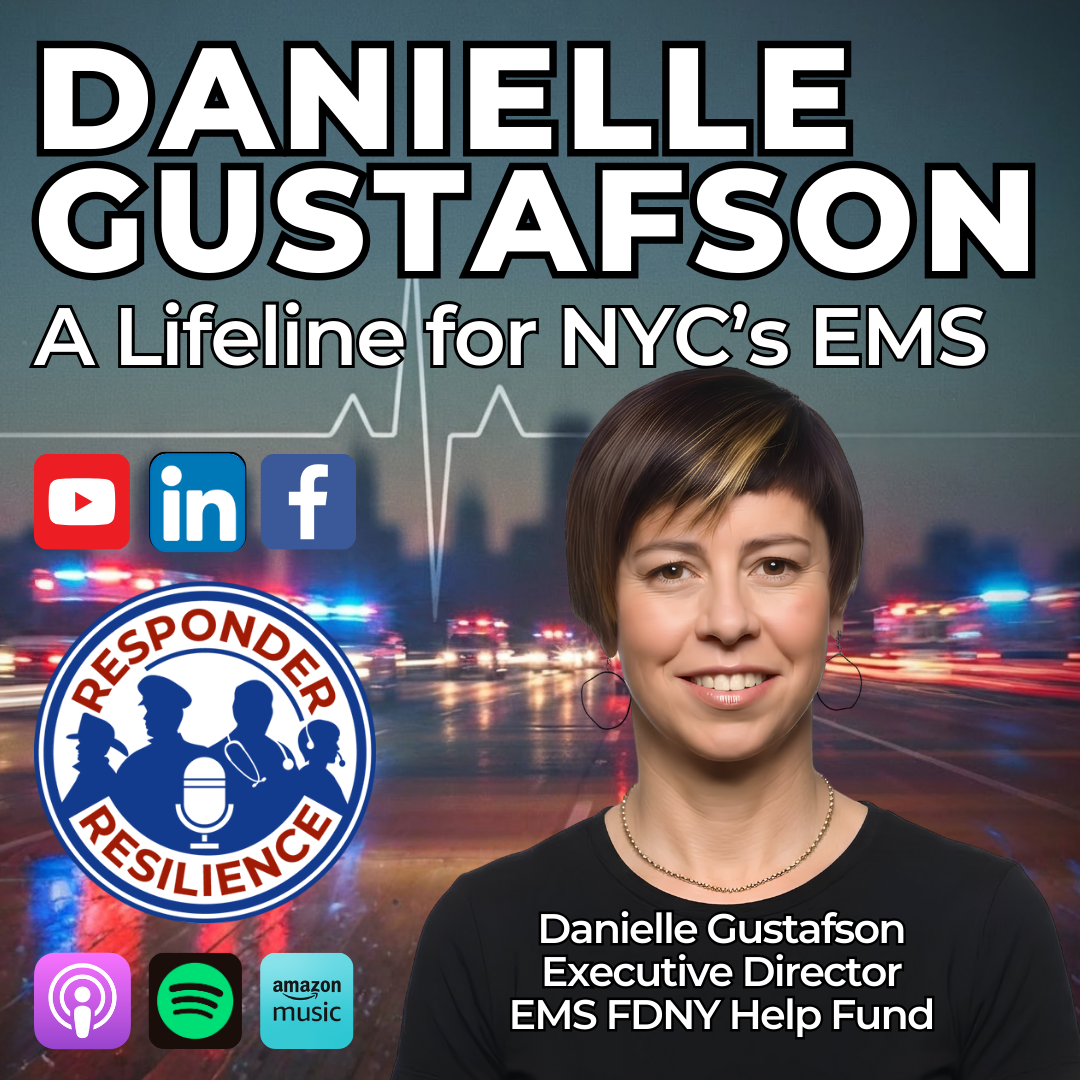
We sit down with Danielle Gustafson, the passionate Executive Director of the EMS FDNY Help Fund, a beacon of hope for New York City's Emergency Medical Technicians and Paramedics. These first responders confront an array of obstacles—from the relentless pressures of their job to the barriers in accessing the care they desperately need.
In this episode of *Responder Resilience*, we sit down with Danielle Gustafson, the passionate Executive Director of the EMS FDNY Help Fund, a beacon of hope for New York City's Emergency Medical Technicians and Paramedics. These first responders confront an array of obstacles—from the relentless pressures of their job to the barriers in accessing the care they desperately need.
Danielle reveals the unseen struggles these rescue warriors face, shedding light on how the Help Fund steps in during times of crisis—providing vital support systems in the wake of death, injury, illness, or hardship. We’ll explore the fund’s initiatives, including urgent counseling services and its monumental response during COVID-19, when it provided meals and shelter to those fighting on the frontlines.
Throughout our conversation, we’ll tackle poignant questions: What do NYC’s EMS personnel truly need? How do their challenges differ from those faced by their fire counterparts? This episode unearths the raw truth behind the sirens, the silenced stories of sacrifice, and the unyielding resolve of those who answer the calls. Join us for a compelling dialogue that underscores not just the importance of mental and emotional support for our first responders, but why their well-being is essential for the safety of us all.
Now available! Helping the Helpers: A Guide to First Responder Mental Wellness. Get your copy here: https://www.amazon.com/dp/1969267003
EMS FDNY HELP FUND:
Website: http://emsfdnyhelpfund.com/
https://www.facebook.com/emsfdnyhf/
https://www.linkedin.com/company/emsfdnyhelpfund
https://www.instagram.com/ems.fdny.helpfund/
Contact Danielle Gustafson:
Facebook: https://www.facebook.com/thedaniellegustafson/
Instagram: https://www.instagram.com/thedaniellegustafson
LinkedIn: https://www.linkedin.com/in/daniellegustafson/
Contact Responder Resilience:
Phone: +1 844-344-6655
Email: info@respondertv.com
Our website with past episodes and more: https://www.respondertv.com/
YouTube: https://www.youtube.com/c/ResponderResilience
LinkedIn: https://www.linkedin.com/company/responder-resilience-podcast/
Instagram: https://www.instagram.com/responder.tv/
Facebook: https://www.facebook.com/responderTV/
Having a confidential counseling service that is really focused on EMS would be tremendous for them. Things are challenging in terms of like there was more death sometimes in a week of COVID than many of these EMTs and paramedics have experienced in their entire career. I asked them to actually go and do some EMDR counseling. And the way I positioned it is they should kick the tires and they should be able to tell their constituents about how it works and what the benefits are.
SPEAKER_07Welcome to Respond Resilience, along with my co-host, Bonnie Romoli, LCSW EMT. I'm David Dashinger. Join us as we speak with Danielle Gustafson. She's the executive director of the EMS FDNY Help Fund. We're going to be talking about the vital support systems they provide to ensure the security of New York City emergency medical technicians and paramedics and their families in the event of death, injury, illness, or hardship. We'll be diving deep into this essential lifeline, the barriers EMS personnel face in accessing care for themselves, and why their well-being is crucial not just for them, but for the public.
SPEAKER_05Thanks to our resource partner, First Responder Project, whose no-cost First Responder Retreats offer you a chance to reclaim connection and learn vital skills. This isn't just a retreat, it's a lifeline to keep you mentally strong at work and emotionally present at home. Take a stand for your well-being and the connections that matter most. Sign up now for your FRP retreat. Learn more and register at Firstresponder Project.org.
SPEAKER_01There's a new app built by Firefighters for Firefighters, and it's called Crackle. Download the app now for free as a legacy member and get early access to exclusive content, tools, and updates as they drop. Get the free app at crackle.responderTV.com.
SPEAKER_07We invite you to like and subscribe, YouTube, Responder Resilience, Facebook, Responder TV, LinkedIn, Apple Podcasts, Spotify. Go to our website, respondertv.com for past episodes and guest information. We'll be right back to speak with Danielle after this.
SPEAKER_08In this family, more of us die by our own hands and by the hazards of the job.
SPEAKER_03In this family, up to a quarter of 911 telecommunicators have symptoms of post-traumatic stress. In this family, our mental health and wellness are in crisis, while responders are quietly suffering.
SPEAKER_02In this family, many struggle with job-related stress, burnout.
SPEAKER_08In this family, we have helped help.
SPEAKER_02With vital information and resources, resilience strategies, and success stories of overcoming the obstacles.
SPEAKER_06Welcome to Responder Resilience.
SPEAKER_07With us today is Daniel Gustafson. She's the executive director of the EMS FDNY Help Fund, which is a vital organization dedicated to supporting emergency medical technicians and paramedics in New York City. With a robust background spanning over two decades as a digital pioneer, Danielle's been instrumental in launching notable digital initiatives, including the first websites for UNICEF and the New York Stock Exchange. Her expertise encompasses a strong track record of serving as a trusted advisor to various stakeholders, from team members to C-suite executives. Under her leadership, the HELP Fund continues to provide critical support to those who serve on the front lines of EMS. Danielle, welcome to Respond to Resilience.
SPEAKER_02Thank you so much for having me. Welcome, Danielle, and thank you for all you're doing for our brothers and sisters in EMS in New York. We know they need it. So your work is vital. Thank you. Great to meet you, Bonnie. Great to meet you, David. Thank you. We always like to jump into the history part of things before we talk in depth about what you're doing now. But how did you get into this world of EMS? We know that many people come in many different forms, and looking forward to seeing how you stumbled on this.
SPEAKER_04Well, I have to say that I believe in meaningful service. So I come from a long line of taking vacations and volunteering on scientific expeditions. But there was a moment where I've had quite a bit of board service, and someone that I met via conservation boards reached out to me just after I'd moved out of New York City. And she said, Danielle, I'm about to make a donation, and it's not to a conservation organization. She said, you know, the only thing happening here in New York City, it was early April of 2020. She said, the only thing happening is ambulances. There are EMTs and paramedics, and they are up and down the streets, and I'm going to make this donation. And then she said, but I think they need some help. Would you mind talking to them? So she called me on a Thursday. On Friday, I'm doing a Zoom with them. And on Saturday, I have basically agreed to match her donation with my time. And I'm going to work for them for two weeks and help them out, help them figure out a couple of things. And um, and that's what I think the assignment is going to be. So I start on a Saturday and Verizon walks through the door. Verizon basically says to us, we know the EMTs and paramedics are working these 16-hour shifts. They're working seven days a week, and we believe that they aren't eating. We'd like you to figure out how to open the restaurants, the local restaurants that were all closed, because this is April 2020. We want you to figure out how to open them up and deliver meals to these EMS so that we can make sure that at least one meal a day isn't coming out of a vending machine. And so that was day one. And of course, this idea that it was going to be like a halftime job and it was going to be five days a week, that was just right out the window. Um there were 12-hour days for me. Of course, my entire board are EMS at the time, and they are working crazy hours. And Verizon is just the beginning of donors coming to us and saying, How can we help? And so at the end of two weeks, I told my board, okay, now I need to go get a real job and become one of your donors. And they were like, Why? Maybe you should stay. And I said to them, You have EMTs and paramedics giving you two dollars a paycheck. That's you started this fund. I have huge respect for EMS helping EMS, but I don't think you can afford me. And I don't want to take your money if I can't do something meaningful with it. And they were like, You're doing a very good job tap dancing for us. So I thought I'll just an aside, we hadn't filed our first 990 yet. So we're a very new fund. And so by tap dancing, they meant that we hadn't filed the 990. And even though donors were coming to us and saying, send your 990, I would say we are working on it and uh it's in progress. And the donors were very generous anyway. So, anyway, the idea was maybe we'll just try it for three months, and here I am five years later.
SPEAKER_07Probably my highest profile time of EMS being in the public eye, in the news, um, and and being an important asset, much more even more so than it is on a on a daily basis. Um, so it's kind of like baptism by fire, I would think you you jumped in to I'm uh I'll just jump in.
SPEAKER_04I'll just say New York City was the epicenter of the arrival of COVID in the US. And Verizon was so pleased with the work that we were doing, and it was so meaningful that they extended an extra week. So we started doing those meals for EMS and delivering them to the 37 stations in New York City. We started on Easter Sunday and we finished on Mother's Day. Um, and of course, after that, after the initial kind of COVID push, we started seeing other issues arrive. There were a series of suicides. I believe you talked to Anthony Almajara, and he details in his book some of the heartache. Um, so there was a time when, you know, we had finished the meals and we were handling donations for the EMS, and my board came to me after this series of suicides, and they said, we have to do something. Uh, there are services for EMS in terms of counseling, but they're really set up for firefighters. The timing is set up for firefighters. Our EMS, you know, they're they're working, sometimes they're working overnight, and having a, you know, a confidential counseling service that is really focused on EMS would be tremendous for them. And so that becomes the beginning of us starting to find a confidential counseling partner that would really focus on EMS specific issues and be dedicated in their response to EMS.
SPEAKER_05You're trained to help people heal, but first responders, they carry trauma that's buried under silence, stigma, and stress. Helping the helpers gives you the framework to connect, to speak their language, earn their trust, and actually make an impact. From the experienced team and clinicians behind the Responder Resilience podcast, this isn't theory. It's real-world support for the ones who need you most. And this book isn't just for clinicians. If you're an agency leader, peer support team, chaplain, EAP, wellness program coordinator, or family member, helping the helpers will equip you with the tools, language, and insight to make a difference. Be the resource they can count on. Order your copy of Helping the Helpers on Amazon today.
SPEAKER_02And um it was amazing what those EMS providers were able to do. They really held the backbone and the ribs of that city through COVID. And for anyone listening who doesn't know that, I hope that you do know it now because they all sacrificed themselves, like Danielle is saying, um, physically, mentally. And so for me, it's very, very heartwarming to hear that you jumped into action to help them. And you didn't find EMS, it found you, which I think a lot of us in EMS could share in that sentiment. But talk to us even more about what some of the challenges that you see, even post-COVID, when you said you're doing this work longer term. What are some of the things that you're seeing?
SPEAKER_04Well, the fund was really set up by EMS for EMS, for hardship assistance. And I think when you spoke with Anthony Almajara, he spoke about the line of duty death of Yodira Arroyo. And at the time she had five children, and there was no line of duty death benefit for EMS, even though they're part of the fire department. Um, so that hardship assistance was how the fund was started. And it's fairly straightforward. If someone has a fire, that they're going to need a set of um, they're gonna need a new toothbrush, they're going to maybe need another pair of boots and uniform, you know, there's a whole set of things that they may need. And this fund was very well um situated to be able to provide those things. COVID, however, made things more difficult. Um, we EMS, because of their benefits, they have 10 sick days as part of the fire department. So if you were talking about doing self-isolation in order not to infect your multi-generational family, these people were sleeping in their cars. And so we would provide hotel vouchers and and later on the the FDNY started providing those as well. So that burden wasn't on our fund, but things are challenging in terms of like there was more death in a sometimes in a week of COVID than many of these EMTs and paramedics had experienced in their entire career. That kind of stress is something that EMTs and paramedics carry with them. And so the question is how to provide an outlet for them to work through that stress and perhaps mitigate it in some way. Um I think the confidential counseling is is very, very meaningful even post-COVID. There are calls that are challenging. And I'll tell you, when I meet paramedics, sometimes I'm talking about the services that our fund provides. And I I had a paramedic recently who turned to me and said, Oh, you know what? I don't really need counseling because I've got my husband and he's a paramedic, and so I have an outlet to talk. Um and then she basically shared with me a story that was so upsetting that um I myself sought counseling afterwards because I found here I am in my home office, which you can see, and I was crying every day just thinking about that story that I hadn't experienced that she had told me. And I just thought these stories you have to be able to park them somewhere, you have to be able to share them in a way that allows you to continue to do your life-saving work. And um boy, if I need help and I'm not even having this experience, it has to be that my EMTs and paramedics need this service. So we're very, very um pleased to have found a partner uh that is willing to accept the insurance that our EMTs and paramedics have. And I feel like I'm gonna stop there because I feel like that in and of itself is meaningful. Like the idea that they are using their insurance. Now, our fund picks up the copay, so we're very much in a position where we want to remove any obstacle to an EMT or paramedic taking up the services that might help them. So if a copay is a barrier, we're gonna pluck that out of the way. We found a provider that's willing to do virtual visits. So the whole idea of showing up in person, having to commute to a service that is provided by the firearm department, but may cost a lot of time away from family in order to get there, and time away from the job because many of my EMTs and paramedics are working second and third jobs, let alone lots of overtime. So removing the barriers to the services becomes very meaningful. I think I've fallen off your question though.
SPEAKER_07Um I think you're not at all. You're in a great uh role here, Danielle. I was gonna just kind of ask you to piggyback on that. You mentioned a key word, which is confidential, along with you know, removing the barriers. Can you talk a little bit about the buy-in? In other words, what kind of you know, response or uh utilization are you seeing of those confidential counseling services? And do you have any possible success stories of how that's affected somebody's impacted somebody's life?
SPEAKER_04Yeah. So I got I'll tell you a couple of things about the confidential counseling. The first people that came to us, and we found them because of Anthony Almojarra, and he was doing some work with Theater of War that do very interesting programming around mental health. Um The Trauma Recovery Network of New York City came to us and said that we believe that EMDR could be a very, very kind of productive type of counseling for EMTs and paramedics. We can do it virtually, and they don't necessarily have to be willing to talk too much. So I think a lot of EMTs and paramedics, they are used to being the people that come in and save, and the people that come in and fix, and the people that come in and are strong. And so there's a there's a there's a kind of barrier to thinking about themselves as needing to talk. So one of the things we did is I asked my board members who are leaders um in the union, some of them, I asked them to actually go and do some EMDR counseling. And the way I positioned it is they should kick the tires and they should be able to tell their constituents about how it works and what the benefits are. And so they did that and they came back, their eyes were like, you know, I didn't think of myself as someone who needed to work on on trauma, but wow, that was very impactful. So then we took them and we put them on video. So you have you have union leaders that are speaking about their experience, and they're very direct about saying it's not right that you can't sleep. It's not right that you feel like you're carrying. This burden alone, and you don't have to do it alone. And they're speaking from their own experience that it is a benefit and that they can have access to it free of charge, and no one's gonna know it's confidential. That was amazing. And um, I'll just say the the we eventually lost the pro bono services of the New York City Trauma Recovery Network because they went on to do trauma counseling in the Ukraine. Um, so from our great COVID epidemic in New York City, they moved to another um kind of global disaster, if you will. So um we couldn't thank them enough for those, you know, getting us started with that.
SPEAKER_00Announcing new on our website, over 400 new tools and resources. First responder grants, hotlines, discounts, support, and mental health links. Over 400 national and state resources. Find helpful tools and resources today. Go to respondertv.com slash resources to connect.
SPEAKER_02I'm also familiar with that New York City TRN because I'm one of the leaders of the Fairfield County trauma response team, which was an offshoot because we started as a TRN as well. Um so these TRNs, for any listeners or viewers, it's an amazing thing. There are several across the country, and they really jump into action to help the most traumatized victims. And some of the TRNs now TRTs are focused on first responders, which is beautiful. So I did not know that, and I'm so happy to hear what you just described. And it's a further validation for our listeners and viewers to check EMDR out.
SPEAKER_04Absolutely. You asked about did we have any kind of testimonials about the service that we have now in terms of confidential counseling? I have some verbatims. Um, you'll cut these uh as you see fit. Here's one. This genuinely has helped me get through life within the past few months. It has been a great tool to help me process and deal with my anxiety and stress. Another verbatim from our uh qualitative feedback survey. Keep this going. That was a good one. Um the services provided by this organization is powerfully impactful to FDNY EMS members in need of mental health services. Many members don't know where to turn, and this organization is a shining beacon in turbulent waters. So we've gotten really wonderful feedback about this. So, and um, I would say, you know, one of the keys to our success with the confidential counseling is really word of mouth. So it's about one EMT telling another EMT or a paramedic that they tried it, they saw benefit, and that it is available to others. So the word of mouth is a really big deal for us. And then um, I think Anthony has talked about this partner, hands-on health. Um, they are developing a real expertise in EMS trauma. So different than the general first responder trauma, real EMS trauma. And you know, to my mind, there's a real difference in the type of work that EMS do. Um, when I talk to people, donors, um, members of the public, I say, think about you have a crew of people living in a firehouse, they're cooking together, uh, they get the call, they jump on the truck, they go to the building, they get the people out of the way, and they fight the fire together. Meanwhile, I've got empties and paramedics, they're two in a truck or in the bus, as they call it, and they're sitting on a corner, and they don't know where they're gonna go to the bathroom, they don't know where they're gonna get lunch or breakfast or dinner. They get the call, they go to the building, and they've got to connect with the people or person or family, it may be an entire, you know, multi-generational family. They got to connect in 30 seconds and start to provide services. It's a really different orientation to the world, and it's a really special person that's able to provide those medical services without a hospital, without a whole backup of nurses and doctors and equipment. They're basically bringing the hospital directly to the person, but they they have no time to sort things out, they've just got to get in there, connect, and serve.
SPEAKER_02You could be amazing. You couldn't be more right there. Um, and the intimate nature of EMS is something that people also misunderstand. So I'm glad you're touching on it, the ability to get right in there. And and sometimes you're really in people's personal space. You're you are assessing their body, you're taking care of them in such an intimate way. So I'm really happy that you're spotlighting that because it's something that we don't talk a lot about.
SPEAKER_04And I was gonna say, and that is the context of the trauma that may follow. It's about understanding what that person that they just treated may be going through. There's a level of empathizing that I feel like needs to be recognized.
SPEAKER_07Well, Daniel, um, I wanted to jump back to the EMS Help Fund. And can you talk about who helps to sponsor that? How does it get funded? And anything you want to share? Maybe if somebody's out there thinking about donating, how can they uh make that donation?
SPEAKER_04Okay. So as a reminder, it was founded by EMS for EMS. So these are EMTs and paramedics helping each other. Um, at a certain point, they got too busy, and that's when I came in. And my mission is to make the donations that are coming in via paychecks from the EMTs and paramedics. I'm going to multiply that by by 10 is a good number, in order to be able to support having an executive director. Now, part of that is about introducing our fund to people that don't know us and don't know the work that the EMTs and paramedics are doing. They don't know that um that we are providing hardship assistance. That may be in the form of uh an emt or a paramedic that is having a domestic violence situation. So they may be actually living in a shelter with their family. And then our job to confidentially work with them. They they do an application and we'll work with them and we'll work to provide their um what's necessary to get them into an apartment, to get them secure. So our fund is is basically set up to partner where we are not the experts. So we understand we're not the experts in terms of financial counseling. We have a fabulous partner called Operation Hope that does financial counseling pro bono for our EMTs and paramedics. Um, we are not providing the mental health services. We have hands-on to health as a partner. So where we're not experts, we're going to partner with those who are. And then we're going to fund the services through donations large and small. Um, in some cases, we we are actually doing targeted fundraising for individuals. I have a paramedic that just passed last week from World Trade Center disease. As soon as we're done here, I'm actually going to the Wake. And I'm really proud to say that we are we have been able to raise the funds necessary to pay for the entire funeral. Um, that's not typically what this fund does, but through this targeted fundraising, we've been able to do that. Um, fundraising is happening through our website, so EMSFDNYhelphund.com. I know it's a big mouthful. Um, and then separately we have two fundraising events that were really originated by our EMTs and paramedics. We have a golf classic in June, so I think it's um June 22nd of 2026, and we invite you all to join us there. And then a new thing that we do is we have turned our awards dinner into a gala, and we plan on having a gala in October of 2026. And I'll just say it's amazing because it's at the classic car club in Manhattan, so it's got these amazing doors that open onto the Hudson. It has unbelievable cars, but we push the cars out of the way and drive the ambulance into the middle. We have dinner with the ambulance, we'll save the life of a mannequin, put it up on the big screen. Even even my EMTs and paramedics came to me after the first one. They were like, hey, what we do is cool. And I'm like, yeah, yeah, look at that. I mean, goosebumps. It's it's really fun. Of course, you can practice your chest compressions and uh learn about intubation and other things while you talk to real EMTs and paramedics about their work and their amazing work.
SPEAKER_08Great, great.
SPEAKER_02Look, your passion really, really shines through. And I think this is a really, really valuable episode. I hope so many people listen to it. And I think the last thing I'd like to ask you is if there are any New York City EMTs or paramedics listening or watching today, how do they get in touch with you as quickly as possible if they need it?
SPEAKER_04Okay, so back to the website. Um, all the services we have start on our website. So there's a fly out and the confidential counseling. Um, one thing I forgot to say about the confidential counseling that has made it so successful is that there's a hotline. And the hotline is is sometimes someone will call and they just need to talk. And they don't necessarily follow through with services, but to my mind, that call that may have come on New Year's Eve is just as important as someone starting EMDR or some other long-term therapy. And sometimes people just need to be heard, um seen. And so I just want if you if you're an EMT or a paramedic and you need to talk to someone, use that hotline. Um, there's other kinds of services there for the therapy, but that's how we that's how we get people started. And and I should have talked about that more, the the role of the hotline and um how quickly we provide confidential counseling to people. So a lot of times if you decide you need therapy, it takes a couple of weeks to get started, and our intake is really quick, um, sometimes two days or less. And I think that really makes a difference. Um, the hardship counseling or hardship assistance, that is through a form on the website and the financial counseling, same thing. So um everything starts with our website, including donations.
SPEAKER_07So all right, and we will share that on screen and in the show notes um for sure. Uh so let's look forward. Uh, you've created a an amazing program, and or you've added on kind of augmented and um made incredible progress with what you kind of inherited when you came into this. What's your vision for moving forward uh with this? What do you see? What would you love to do?
SPEAKER_04So I'm gonna give you both answers. So I have a cheeky answer, which is in a perfect world, you don't need my fund, right? But I tell people, but the world is not perfect. And so um I don't see our fund going away anytime soon. Um, one of the things that we've discovered is that EMTs that go into their paramedic training, they get their base salary, and it's an 11-month training. If anything happens during that 11 months, we find that they find themselves applying for our hardship assistance. You know, it could be as simple as a family member getting sick. And so one a big big step for our fund, and we may try and pull this off in a pilot, is we would like to provide some kind of of subsidy uh assistance to the to the very we have two classes of 80 paramedic basics a year, and we'd like to provide some kind of support for them in terms of housing. Um, but that's a big dream, and we need we need someone at the corporate level that would like to have their name on a program like that. So if you know anyone, please reach out. That's our that's our big next step dream.
SPEAKER_07Fantastic. We love it. And uh it's hard to overstate the impact that you are having on such an underserved and deserving population. Um, Bonnie and I, both having served in EMS, know um some of the struggles, and we can only imagine in New York City it's on a different level. Um, so we just applaud you for stepping up and being willing to champion these people who are you know giving so much of themselves and by proxy their family, their loved ones, and you know their health and their well-being sometimes. So can't cannot overstate how important this is, what you're doing. And we just uh absolutely are uh big fans of it and and thank you so much for bringing it to the forefront.
SPEAKER_04Thank you so much for your attention. We appreciate it.
SPEAKER_02Danielle, I just want to thank you again for everything you've done, for everything you continue to do. And I would love to see this model be replicated all over the country and world because as we know, our EMS folks are struggling here in Fairfield County where I work as well. So we would love this model to grow and grow. And with you at the helm, I don't doubt that anything's possible.
SPEAKER_04Wow, that's a big dream. I'll just say that we'd love next step, like if it isn't this paramedic scholarship or however we're gonna call it, just to be able to take care of all the EMTs and paramedics in New York City, because I I have a big slice and I think the biggest in the world uh group, but that's not all the EMTs and paramedics that are actually operating or volunteering in New York City. So yeah, Fairfield County, here we come. Um, but we've got the rest of New York City first, maybe. Yeah.
SPEAKER_07Absolutely. Well, Danielle, thank you so much for spending this time with us and all you're doing. And uh we would, you know, we'll happy happily share out all your information and invite people to go to your website, donate, and learn more about the EMS Help Fund.
SPEAKER_02Thanks for joining us.
SPEAKER_07Remember, like and subscribe, YouTube, Responder Resilience, Facebook, Responder TV, LinkedIn, Apple Podcasts, Spotify. Go to our website, respondertv.com, for the past episodes and guest information. Till the next time, stay safe, be kind to yourself. Take care.

Executive Director, EMS FDNY Help Fund
In April 2020, I found a way to support those who were on the front lines of fighting the COVID-19 epidemic in New York City. The EMS FDNY Help Fund is relatively new and its mission is to support the Emergency Medical Technicians and Paramedics that respond to NYC's 911 calls. These Emergency Medical Services are a critical part of the infrastructure of our society - a safety net. I tell people that in a perfect world, you wouldn't need this fund, but the world is not perfect....
I support the Fund with more than twenty years experience as a Digital Pioneer -I launched Unicef's first website along with the New York Stock Exchange's and then ran their digital footprint for over a decade. I am known for serving as a trusted advisor and partner for all stakeholders - team contributors to C-Suite and Board.