Apple Podcasts
 Spotify
 YouTube
 RSS Feed
 The Spiritual Side of Responders and Military (Mini-Doc) | S5 E52
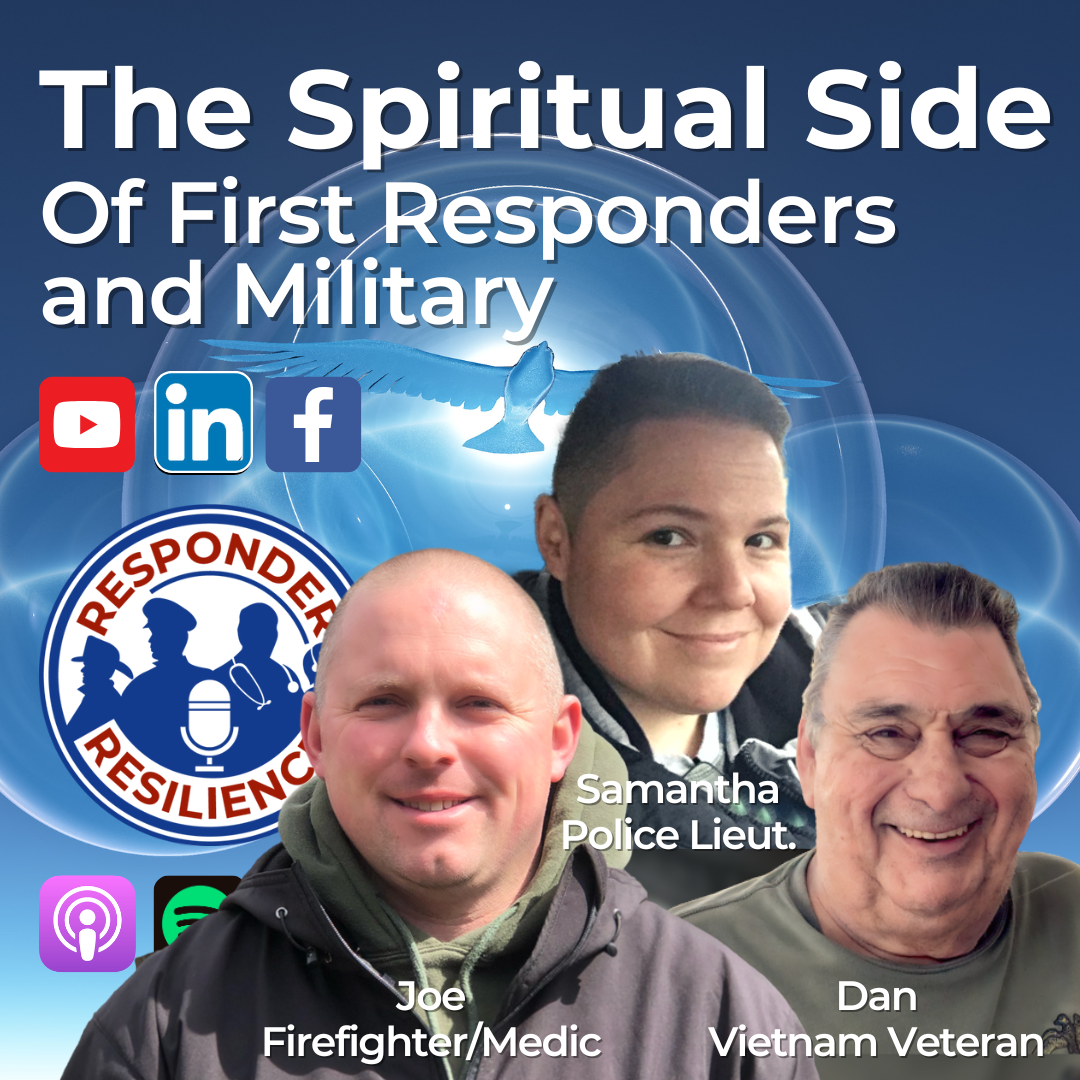
In this encore of our mini-documentary, Responder Resilience takes you on a profound journey into the heart of spirituality—a complex tapestry woven from the experiences of those who stand on the front lines of life and death: our First Responders and military personnel.
In this encore of our mini-documentary, Responder Resilience takes you on a profound journey into the heart of spirituality—a complex tapestry woven from the experiences of those who stand on the front lines of life and death: our First Responders and military personnel.
They exist in a realm where courage meets chaos, and their harrowing encounters shape unique philosophies of resilience and meaning. Through their poignant stories, we witness the raw truth of trauma and the undeniable power of belief in transforming suffering into strength. From the burning buildings they rush into to the moments when they hold the hands of grieving families, these brave souls reveal how spirituality serves as both a lifeline and a guiding light.
In a world often overshadowed by despair, their reflections offer an inspiring testament to the human spirit's quest for purpose amidst unimaginable pain. Tune in for insights that challenge our perceptions and invite us to contemplate the deeper connections that bind us all.
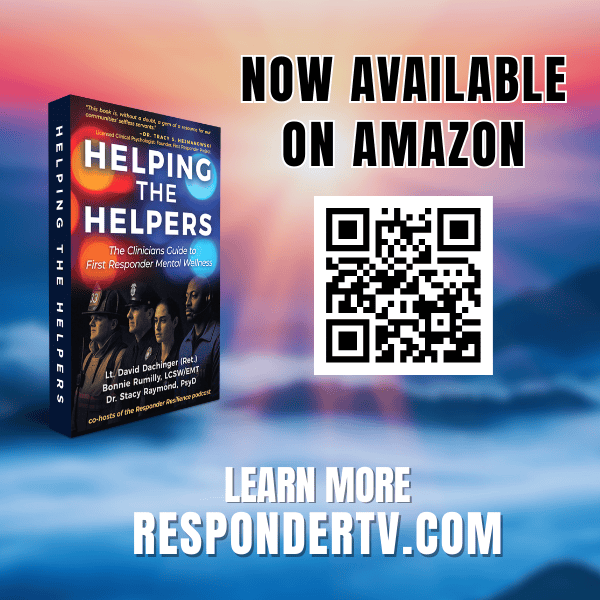
Now available! Helping the Helpers: A Guide to First Responder Mental Wellness. Get your copy here: https://www.amazon.com/dp/1969267003
Thanks to our resource partner, First Responder Project, whose no-cost first responder retreats offer you a chance to reclaim connection and learn vital skills. Take a stand for your well-being and the connections that matter most. Learn more and register at FirstResponderProject.org
Thanks to our resource partner, CRACKYL. Download the FREE CRACKYL App: http://crackyl.respondertv.com
Thanks also to our resource partner, FightCamp. Harness the strength of boxing to release stress, build resilience, and connect with a supportive community. For free shipping and a free month of membership, go to https://joinfightcamp.com/shop/ and use the code RRPONE.
Contact Responder Resilience:
Phone: +1 844-344-6655
Email: info@respondertv.com
Our website with past episodes and more: https://www.respondertv.com/
YouTube: https://www.youtube.com/c/ResponderResilience
LinkedIn: https://www.linkedin.com/company/responder-resilience-podcast/
Instagram: https://www.instagram.com/responder.tv/
Facebook: https://www.facebook.com/responderTV/
David, Stacy, and I would like to dedicate this episode to Dan Welch. Dan was a retired Marine and he was a dear friend to all of us. He meant the world to anyone who knew him. And he meant a lot, especially to our podcast, as he had done several episodes for us. You will also get to see Dan in this episode on spirituality. Rest easy, Dan. We love you.
SPEAKER_09During my years as a firefighter and later as an officer, I would use some of the 40-minute drive time into the firehouse to pray. I would ask God and my guardian angels to watch over my crew and myself to keep us safe, to help me make sound decisions and know what to do, even to watch over my apparatus and equipment so it worked perfectly and safely. After I'd been recently promoted to lieutenant, a call came in for a smoke condition in a house in my district. We began responding to the location. And on arrival, I had my driver set up the pump while I did my 360 size up. As soon as we had additional personnel on scene, we made entry into the building. As we saw a light to moderate smoke condition on the second floor, we stretched a line up there and felt no heat, were able to stand up with no problem as we searched for the fire. As I began to update Intimate Command on our progress, suddenly, everything went black. I couldn't see, I couldn't tell where I was. Soon as we had more people in the building doing fire attack and searched, I exited. I saw that my mask had a thick layer of black soot and was melted, and my helmet was incinerated. I understood that I had been in a flashover situation and felt absolutely no discomfort, heat, pain, anything, although my gear was toasted. Two days later, the fire investigator sent me some photos of the bedroom which was directly behind me in the hall. What I see on the wall appears to be the wings of an angel and a heart. I take this as a sign that my guardian angels were there protecting my crew and myself from what could have been a catastrophic event. To this day I feel like I've been blessed by that protection my whole life, and I think it's a testament to the power of prayer.
SPEAKER_08First responders and those who serve in the military oftentimes witness extremes of the human condition, from delivering a baby, putting out a raging fire, keeping the peace and saving lives, to dealing with the carnage of car accidents and war, suicides and murders, and the heartbreaking inhumanity of racism, violence, and abuse. Many of our first responders in the military see more trauma in one day than the rest of us typically encounter in a lifetime. I thoroughly enjoy my work with these brave and skilled individuals. They undeniably are a rare breed. They are drawn to serve. They must serve. While the average person is running from danger, first responders are moving toward it, toward the fire, the gunshots, the victims, and as a result, their work carves deep grooves into the soul. These remarkable people have an unmistakable depth of character. This depth is best captured by poet Khalil Gibron. In his poem On Joy and Sorrow, he says, the deeper that sorrow carves into your being, the more joy you can contain. Is not the cup that holds your wine the very cup that was burned in the potter's oven? And is not the lute that soothes your spirit the very wood that was hollowed with knives? In my experience as a trauma therapist, I believe there are two sides of the coin when it comes to the chronic impact of being in the trenches and facing trauma. First is the post-traumatic stress that anyone exposed to such trauma can develop immediately or years later, such as difficulty sleeping, nightmares, intrusive sights, sounds, smells, depression, guilt, a hair-triggered temper, hypervigilance, relationship problems, and substance abuse. But on the flip side of that harrowing coin lies the quest for meaning and the potential for growth and understanding and joy. A potential for growth and understanding and joy that is equal to the depth of their suffering. Spirituality, the topic of tonight's podcast, is a uniquely personal concept, as different as each and every one of us. A person's spirituality serves as a foundation, a way to cope, a guide for living, and a comfort. For many first responders and members of the military, spirituality can be a lifeline when one feels alone in an unfair world that sometimes makes no sense. In this episode, we will hear what spirituality means to those who risk their lives to protect and in some cases to save our lives. We will learn how their beliefs help them through their darkest moments. Let's hear how several first responders and one veteran define their spirituality. First is Dan. Dan is a United States Marine who fought in the Vietnam War.
SPEAKER_03My grandfather on my mother's side was a Mescalero Apache medicine man. And uh as a little kid, he spent so much time with me because I was the only one that was interested in. And we'd go out in the woods, we'd just build a fire and stay maybe all night or a couple days. And he taught me everything. He taught me about how to how to build, how to trap, how to how to track animals, how to survive. And um when I was six, maybe seven, maybe even younger, and he told me he said it's time for you to go to the spirit world. And he took me there. And ever since then, because it was so peaceful and so protective. When I go to the spirit world, um I'm in a forest of giant pine trees, uh, pine needles on the ground, they're wet but soft. And it's always I'm always in my bare feet so that I can feel 'em. I see the um the great white stallion. The winged stallion, which the Native Americans think that when you die, the great white stallion comes to take you to the spirit world. I I guess uh anybody that's not Native American would consider that an angel. And as long as I could look at him and he looked me in the eyes, and his wings were down, folded down by his side, I knew I was okay. Because he wasn't ready to take me yet.
SPEAKER_08Next is Sam, a police lieutenant.
SPEAKER_11We don't like to talk about it a lot, but uh a lot of cops are very religious. A lot of first respondents are very religious because you get to see the best and the worst. And sometimes when you see the best, you're just reminded that uh that there is something out there bigger than you. It's nice to know that you can be a part of it. Find whatever makes you comfortable. Right, you know, if it's sitting out in nature, communing with the grass, if it's going to church, if it's going to a pagan ritual, if it's dancing under the moon, do for you what makes you feel better. You don't have to explain it. But it's definitely a uh it's definitely a major part in uh helping me cool.
SPEAKER_08Jimmy is a former deputy fire chief. Currently he is emergency management director and fire administrator.
SPEAKER_06I have a unique relationship with God that was really um developed since I went into treatment for alcohol and drug addiction because that was a turning point in my life when my relationship with God had changed. I had grown up in an environment of going to church every day and standing and kneeling and standing and kneeling and sitting and standing, and it was very rote and very um uh calculated, but I walked away kind of still feeling empty. I also grew up with this uh fear that God was a punitive God and that was looking down upon me from the heavens above for every little thing that I did wrong and that I would be held accountable and punished for that. And that was my concept of God. There were several factors that brought me into treatment, and I realized while I was there that the circumstances that led me into treatment wouldn't have happened if it weren't for loving God. Then somebody had um suggested that I read the book called The Shack. So I read the book and it moved me spiritually, and then I went and saw the movie, and that also moved me spiritually, and I began to internalize the feelings of love that I believed that my God could be felt internally, and I usually touch my chest near my heart and feel as though that's where my concept of God lies now. So I went from external punitive to external loving to internal loving.
SPEAKER_08Nick is a retired firefighter. He is currently an EMS operations manager.
SPEAKER_00Um most important thing for me when I think of um spirituality, it really is this concept of meaning. Um, and that you know the work that we do is incredibly meaningful, and that makes the difficult stuff have a purpose. Um because if if it's just if life is just suffering, that's nihilism and that's pretty miserable. Um the optimistic side of it is that you know, from all the horrible things we experience and the difficult things we do, um, you know, that's where where you can find a sense of meaning. And um, I think it's impossible also to go through life in the Garden of Eden and become a human being and and develop in any way. Like you have to you have to do difficult things. And uh EMS has been that opportunity for me. You know, there's people can imagine what makes EMS so difficult, and and imagining will get you so far, you gotta really kind of experience to get the full effect of you know how how hard this job actually is. But if you do the job and you're successful in it, it can help you to develop.
SPEAKER_08Next is Rick, who is both a fire captain and a deacon in his church.
SPEAKER_12So I'm uh Captain Rick Lawler of the Ridgeville Fire Department, and we're in St. Mary's Church, one block from my firehouse. I'm a fire captain, but I'm also an ordained clergyman, a deacon in the diocese of Bridgeport, and I've been serving here for three years. So when I'm not working at the firehouse as a captain, you can find me here serving as a deacon. I go on calls and I walk into people's homes, serious calls, sometimes not so serious, and they say, Oh my god, Deacon Rick is here. And I'm able to help them as a fireman, and I'm also able to help them as a deacon. And when I see them on Sunday in church, we're all smiles as they say to me, Thank you for coming out, deacon. It was so good to see you. Thank you for your help. And they give me an update on the situation. The word deacon is Greek, comes from the word, the Greek word deakanoia, which means service. Deacons spend a little bit of time in the sanctuary where I am right now. But deacons are expected to be in the streets, to meet people out in the streets, in their homes, and deacons need to know the struggles that people are going through. That's what a deacon is about. A deacon is a man of service. And then most recently I went on a call for an elderly gentleman who had passed away, and his wife was very upset, and she recognized me right away as a deacon, and I was able to talk to her, bring her some comfort, and we went to a room in the house where I was able to pray with her, and she was very grateful for that. Yeah, as a fire captain, we definitely struggle, and there's days when you feel like you're being crowned with thorns and scourged at the pillar, just like Jesus was. While we do have authority, it's much more important for rank to be a servant, to serve your fellow firefighters, fight for them, protect them, keep them safe. And these are the things that Jesus did. Jesus came here to save his people, to save us. And there are days where in this great career as a first responder, there's plenty of suffering. If you're doing it right, you're suffering. As a fire captain and as a deacon, I go out onto an emergency call, emergency scene, a situation, and I have my fire truck and medical equipment. I also have holy water. And you'd be surprised at how many times people need to hear a comforting, comforting word from a clergyman, or just someone to sit with them and grieve with them, or hold their hand and cry with them. And I've sat with families, loved ones, as they are going through this horrible moment. And I have transitioned in the last couple of years. I'm on a call and I transitioned from fire captain into uh just a compassionate person to talk to and listen to a family member that's that's in a state of shock.
SPEAKER_08Now we will hear what Matt has to say about spirituality. Matt is a retired police officer and also a police chaplain.
SPEAKER_04Um so, like my definition of spirituality, if you haven't heard me say it before, spirituality is the living out of your most important values and beliefs. If you're religious, plug them in. But if not, you know, you have other values you're living out. Spirituality is how you relate to your community, it's how you relate to humanity, and who more than commons is involved in the nitty-gritty of a community, and who more than commons in my experience, whether they say they're spiritual or not, understands the highs and lows of the things that human beings are going through because they're immersed in that stuff all the time. Um spirituality is how you relate to your higher power if you believe in one. And spirituality is also part of the framework for how you continue to find meaning and purpose through pain, through change, through loss, adversity and suffering, which is common to everyone, and cops are immersed in that.
SPEAKER_08Sid is a deputy fire chief and a retired police officer. Let's hear what he has to say.
SPEAKER_10I was always a churchgoer, but now I'm really devout. I mean, I I I give all my strength and thanks to God for everything in my life. So much so that um I've taken a step back in terms of my obsession with the firehouse. I'm still involved, but I had a real heart-to-heart with my wife, and um we're going to Florida this this winter to look for a snowbird house, and something she's always wanted that I was really not interested in. Now I am interested in. I'm not just doing that to placate her. And it it's it's a change that was a long time coming. And I'm just grateful that uh God's opened my eyes to it. It's just it's just amazing.
SPEAKER_08Lastly, we will hear from Joe of Fire EMT as he defines his view of spirituality.
SPEAKER_05They just talk about uh how my parents and faith and church family have uh affected um decisions in my life. That I probably wouldn't be down this path of first responder if it weren't for my faith. It's always had that urge to help people or show up and have a smile on your face and be the calm person there trying to manage the scene. Pick it apart, you know the Bible's got a ton of pages and a lot of authors. So uh peace that passes all understanding. You'll wipe away every tear and uh you'll have no more pain. Uh talks about the grieving process, you know, pretty much uh one of the oldest books that's still standing that can kind of guide you in uh most facets of your life and how to handle situations. I was having a conversation with one of my pastors years ago about this, and he's like, uh, you know what you are, you're uh ambassador for Christ disguised as a paramedic. So I've I've always uh stuck with that.
SPEAKER_08Let's go a little deeper now. In my work with first responders and veterans, I noticed that many of them encountered inexplicable events in the line of duty, unusual calls that have no logical explanation. Here's what some of them have to say.
SPEAKER_03I know we were at uh Quang Tree, and um one of our guys was running back to the foxhole, and uh the NVA shot an RPG at him, and the RPG was right behind him, and he just kept running and running, and we were hollering to him, get down, get down, and finally jumped in the foxhole, and the RPG went right over him. So we actually outrun that rocket, and it was just a miracle, you know, because they shoot down helicopters with them. That's gotta be an To God, you know. Before we ran a patrol, me and my guys sat down and we said a prayer. Uh 23rd Psalms. The Lord is my shepherd, I shall not. He maketh me to lie down in green pastures. He restores myself. Yea, though I walk through the valley of the shadow of death. I shall fear no evil. For that out with me. And I ride and I staff. Another one of those uh miracles was that uh Wild Bill Hansen, one of my guys, he always carried a uh uh not a new testament small in his left breast pocket, always. And we got hit. And when the firefight was over, uh the next day he opened it up and the bullet entered the um the testament. And he stopped. The bullet was still in there. And he said, look at this. If I hadn't had that in my pocket, of course he would have been dead. And why I didn't penetrate all the way? Had to be the hand of God.
SPEAKER_12So miracles do happen and they happen all the time. Sometimes we see them, sometimes we hear about them, but they do happen. There is a phenomenon that we can't explain, and they're called miracles. It's very good for your faith, but you have to pay attention.
SPEAKER_05Calls it are unexplainable, not by science. This uh 22-year-old kid minded his own business, um, home from college, walking down the street, and the uh there was a gang initiation. So the his car stopped, people jumped out, ran up behind him, and shot him in the back of the head with a 357. And uh we get there, you know, copious amounts of blood, and he's talking to me. I'm like, how is this a thing? What the bullet did is it entered right like back by his uh cerebellum, if you will, and it rode his skull under the skin, but never broke the skin, and then ejected out through the top. And I was like, how does that happen? You know, I was working with a great partner who taught me a lot of things in Danbury and uh driving down uh uh Osborne Street going to a call, and everything shut off on the ambulance. Uh radios, um we thought it was an electrical problem. Then the ambulance started like talking to us. Yeah, I couldn't tell you what it said, but uh it was not a radio, wasn't audible, wasn't a happy radio. Um it uh just sounded like a voice that was talking to us. It sounded like it was coming from under the seats. My partner Ron and I were just we were just like, holy mackerel, I'm not really sure what's going on right now. So we we broke it down after the call. Um we were like, what's going on here, you know? And you talk, you think about it. I mean, there's uh potential for thousands of people to die in an ambulance, you know, in the life lifespan of an ambulance in a busy city. So uh there's potential that there are spirits there and whatnot, you know.
SPEAKER_10I had a spiritual awakening on October 17, 2021, at 23, 46 hours. We had a very serious fire. It was a um a gasoline tank, truck, uh, tractor trailer. He was hit head on by a car that crossed the double line. The the car that hit him head on immediately burst into flames. The driver was incinerated. The tractor of the trailer immediately became fully involved. Fortunately, the truck driver was able to jump out. But I I was driving the first new engine and we got there and I said, oh boy. And the chief and I, uh Gene Malone, he and I have over 50 years experience, and I I don't I don't know besides him and I, I don't know for sure whether the other guys really appreciated how dangerous this was. That event changed my life. In addition to being grateful for us being saved that night from probably certain death if that had exploded, had a flood of memories of the times that I had been saved from from death as a cop and as a firefighter almost being caught in a flashover, bailing out a window just before a fireball blew out the window behind me. And I said, Wow. The things that have opened up since that, since since that incident, like this podcast. I I never even heard of this podcast before, but you know, they say that there are no coincidences in life with something where God seeks to remain anonymous, and this is definitely one of them. I was like, wow, this is amazing. This is God's hand at work. There's no question in my mind. And I'm not a crackpot or a holy roller or any of those things. It just took a traumatic experience like that for me to realize. As a cop, I almost fell off a uh one of these rickety old Metro North footbridges on an aided case, going to to um aid a signal tower man that was having a heart attack. It was a brightly lit night, so I didn't have my flashlight turned on. I had oxygen in one hand, flashlight in the other. And God told me, turn that flashlight on. I turned it on, there was a big section of bridge missing. If I hadn't done that, I would have fallen to the tracks below and probably gotten. If the fall didn't kill me, the train probably would have run over me. Family dispute where a guy came at me with a knife. I almost shot him. My partner said the cylinder on the gun started to turn. And for the longest time, I was just grateful I wasn't stabbed. Now, with this new look on life, I well, God also protected me from not having to live with the fact that I took a life. You know, I didn't have to shoot him. He fortunately stopped when he saw the gun. I I can't even imagine what that must be like. I know because I know vets that had combat experience are haunted by the killings that they had to do. And he spared me that. And I never never even thought about that until recently. And I'm talking about something happening 30, 35 years ago.
SPEAKER_06I was in a structure fire uh one time with uh with a relatively new firefighter. I was his officer, and uh we were on a second floor in a bedroom uh putting water on a fire and doing a good job, and his um air alarm went off. And so he followed the hose line out. I moved up to the nozzle. In a split second, I went from being on my hands and knees with a hose line in my arms to the floor collapsing underneath me. The floor had buckled and my legs had straddled the floor beam underneath. So that saved me from falling down to the floor below. You know, God saw to it to put a floor joist in between my legs rather than going through a hole. Another instance, I was a brand new firefighter assigned to a ladder company. We were on a uh a busy street in a um three-story brick apartment building, and we were up on a third floor doing a search and rescue for occupants, and in a few minutes, the um the heavy haze went to um blackout conditions. The temperature went from uh really hot to untenable, and so I was with two other guys. We turned around to exit the back door where we came in, and next thing you know, I couldn't hear them anymore. And I was not in a hallway anymore, I was in a pantry of a kitchen by myself, uh freaking out, really afraid. I'm like, this is it. Um, you know, I kind of like looked up at the ceiling and said, I guess I'm coming home. Meaning, you know, talking to God. I finally um was about to look for a window when I heard this voice, and it didn't come from anybody outside of me. It just said, follow me. And I listened, and I wound up going into the kitchen, away from a window, uh, through the kitchen, into the hallway, and then I heard some voices, and I turned right and followed the voices. Next thing I know, I was on the outside porch with the other two guys that I entered the building with. To me, there's no reason or uh rationale to explain how I was led in that direction, that the I heard the voice and I followed it and listened to it, but it staked my butt.
SPEAKER_01You're trained to help people heal. But first responders, they carry trauma that's buried under silence, stigma, and stress. Helping the helpers gives you the framework to connect, to speak their language, earn their trust, and actually make an impact from the experienced team and clinicians behind the Responder Resilience podcast. This isn't theory, it's real-world support for the ones who need you most. And this book isn't just for clinical. If you're an agency leader, a peer-support team, catalog, EAP, wellness program coordinator, or family member, helping the helpers will equip you with the tools, language, and insight to make a difference. Be the resource they can count on.
SPEAKER_08Order your copy of Helping the Helpers on Amazon today, most individuals who serve see inordinate amounts of human suffering and carnage. For that reason, their jobs are uniquely challenging. In their own words, this is what they shared.
SPEAKER_03I was 18 years old when I went to NAM. And I was a country boy, you know. I mean, I to hell, you know, I drove horses, I herd cattle, I you know, I was just a backwoods country boy. But I when I went there, I believed I was doing the right thing. And these people had to be dealt with. The Mr taught us that you pull the trigger before you blink an eye or take a breath. It's just that quick. I thought I was a monster. I thought I was this horrible person because of all the stuff I've done. But through EMDR I learned that uh that it wasn't that's not me. That's not the person I am. I am a good person. Just to go out and shoot somebody or whatever, that's wrong. I think that's what the uh the the commandment means. Is you kill for protection and food, you do it for pleasure, then that's when it's thou shalt not kill. We did it because we had to. Oh, you're not gonna see the sunrise. It's that simple.
SPEAKER_12Well, as a first responder and as a fire captain, if you've ever been to a firefighter's funeral, this verse goes right to the heart that firefighters, the intention is to not die. Through training and good equipment, we have many good outcomes every day. But unfortunately, there are times when firefighters do die in the line of duty, and God has a very special place for them because it's a selfless act, and this journey is about serving others, helping others. Being Christian is about selflessness, not selfishness. The world we live in is selfish. We're called to be selfless. And when a firefighter does his job, that's an act of courage, it's an act of faith and trust in God. And unfortunately, sometimes things go wrong, and a firefighter pays the ultimate sacrifice, but his reward will be great. That's what that verse means to me.
SPEAKER_05So that verse, John 15, means a lot. I actually uh I think about that one a lot. If you look at some t-shirts of uh, you know, Marine Corps t-shirts or uh shirts they sell, or even uh plaques. I have a plaque right over my shoulder here that says something very similar, actually. Um it means that uh you just have a love for uh love for all people, you know. Um I mean, don't get me wrong, there's some people obviously uh you butt heads with or you may dislike or something of that nature, but um try to treat people with respect, you know. Always uh tell paramedic students or new students, new hires that every single call, treat them like he's your mother, you know. Um and if you do that, you build a good rapport, be able to uh handle the situation and uh uh make things better ideally. Yeah, but that's a very very powerful verse as far as laying down one's life for another. Um I think that's expected of first responders for the most part, in military. Um I think uh just about every every person I know in the business would have no problem doing that, which is which makes our business very unique. You know, spiritual, unusual things happen in the back of the ambulance uh a lot for me, actually. Um there's a lot of times I would pray with patience if they asked. Um question you get all the time as a paramedic is like, am I gonna die? You know, and of course you want to give them hope and say they won't, but sometimes you know they will. You know. Um what I find very interesting when someone's uh circling the drain, you're doing all you can as a paramedic, or you know, whatever your role may be. But uh people want to believe in something, people are spiritual and people have faith. I mean, they put on a persona they don't, but uh majority of people right before they die said, Jesus, please save me, God help me. You know, and I find that very, very interesting. Um, and I prayed with people before, I prayed silently for people, you know.
SPEAKER_04I was like, you know, what's a a great way to do ministry and I or and learn about psychology and spirituality? Go be a cop. And later in life, if I decide to go into ministry full-time and study theology or psychology, I will have all of these real-world experiences. So I wanted to experience violence and addictions and mental illness and all the things you'll see as a cop to learn about them, but that's an opportunity to serve. And I also recognize that everybody's gonna be having a bad day. Victims and the criminals are not having a good day when the cops show up. So I went into police work as a ministry.
SPEAKER_00A good example is um, you know, you see enough people that, for example, suffer the consequences of alcohol abuse in the acute, like a DUI crash, fatal DUI crash, or chronic. You see someone 38 years old dying of liver failure and you're going to that call every day. You see that and you experience that, you you have to then take those lessons and incorporate them into your life. Uh, because if you don't, it it'll destroy you. I think that's one of the one of the areas that trauma can come from is if you're not living your life in a way that's in accordance with what your experiences have been. You know, if you see someone tragically lose a loved one at 30 or 40 years old unexpectedly, and you have to be there when the news of their death is delivered, and then you don't incorporate that into the rest of your life, you're gonna have a really tough time. Um so that's the gift of this job, though. You you have to go through the difficult stuff, and it's gonna be really challenging, but if you do it, the gift that pays back to you is that really constant reminder um of you know how precious every moment is.
SPEAKER_06As a first responder, we're trained to uh react and behave in a way uh that most people wouldn't. Um you know, we we run into burning buildings when everybody else is running out. Uh we go into harm's way when there's an armed perpetrator as a police officer when most people would be ducking cover. And so um there's a uh extraordinary amount of traumatic events that first responders are exposed to as a result of their career choice. I experienced four different suicide deaths of co-workers in 20 years on the job. That's an average of one every five years. It's pretty significant. In addition to that, you know, the death of a four-year-old um girl on Christmas Eve in a structure fire was a significant event in my career. Um the um Greenwood nursing home fire, where 16 people died, was a significant uh event. Uh, the death of an elderly man in a high rise smoking in an overstuffed chair died in my lap in the outside front corridor of the apartment building, was a significant event. The death of a firefighter uh who died in the line of duty as I was the incident commander of the fire. Um and I bring those up as the you know significant events that happened in my career as a first responder that you know the normal John A. Q. Public uh isn't gonna have regular exposure to. So there's um uh increased exposure to traumatic events that go on in the lives of a first responder, and those things can really be uh impactful.
SPEAKER_08We asked them what gives them hope to get through a particularly difficult call? What compels them to continue at this job that involves responding to child deaths and suicides and gun violence and victims of car accidents and house fires? Let's hear about what inspires them.
SPEAKER_03I guess one of the questions you always ask yourself was uh Is today my last day? Am I gonna wake up in the morning or am I gonna be dead? I would set night in my thoughts and today could be it. I don't know. You know, some people say I got to the point where I wasn't afraid of dying. That's bullshit. I was afraid to die. But of course, of course I didn't want to. But I thought it's it's gonna happen. Because every day that's all you saw was death. And I just thought, it's gonna happen. And I'd go to the spirit world and they'd calm me down. And uh I would see my visions and I'd say, okay. I'm gonna see sunrise in the morning.
SPEAKER_12We are spiritual beings as much as we are uh human beings. There is a spiritual side to every single one of us, and we can look around this beautiful planet, this universe, this galaxy, and we see so much beauty and so much mystery. There is a God, there is a creator, there is a mastermind behind this universe we live in. As a firefighter, Captain EMT, I've had plenty of instances where my faith is tested over the years and my faith is reaffirmed. So let's talk about the first one where faith gets tested. So when I go on a call and I see a child that is hurt, severely hurt, or even killed, you have to question, does God know what he's doing? It's a very human, natural question to ask. But then there's days when you see your own children. You see the beauty of your family, you see other beautiful things in our society, in our world, the beauty of a sunrise, the beauty of a happy family, good things that people do for one another. That's an opportunity for your faith to be reaffirmed. And those things happen in the firehouse, they happen around the firehouse, and they happen on calls. You see good, you help propagate a good outcome. And that is very good for your soul, it's very good for your your psyche, and it's it's very good for your faith.
SPEAKER_05So what gives me hope every day is uh guess the fact that you can uh help people no matter uh how small or large their problem may be, um, in regards to uh calls. Um as far as other hope, uh you know, we only pass through for yeah, a brief period here. You know, some days it's like drag at work. David may be uh uh describe his career, you know, you walk through the door, and before you know it, you're retired. Um so life is kind of the same thing, and I I try to, you know, outside of work, I travel like crazy, move around, do stuff every day, um, knowing that we pass through quick and uh what's waiting on the other side is uh what our objective should be working uh every day towards, you know, fall short all the time, don't get me wrong, screw up uh every day. But uh just gives me hope that uh eternity, I guess you'd say. Yeah.
SPEAKER_06So having a relationship with um with God uh for me has been able to question some of the results of the incidents that I've been on and try to figure out or have a conversation with God as to why things went the way they did. I'll never understand quite fully why friends of mine, partners in the firehouse, uh commit suicide. Having a relationship with God gives me a place to go with that, that uncertainty. You know, I always try to make sense of things that don't make sense. And that's not always possible. Um, so I think having a faith and a belief in God has helped me to accept things that I can't really understand or explain. And so by having a uh like a faithful relationship with God as I understand Him, and to be able to draw the line between what I can control and what I can't control is uh is important. That's where I ask for wisdom on a regular basis. So I've got surrender, I've got wisdom, I've got acceptance, I've got faith, I've got trust in God. Um in all of these things, you know what they do is they take the responsibility for the outcome out of my hands. And when I give those uh over to God and I accept whatever's dealt my way, then uh I'm dealing with what God has planned for my life, even though He doesn't share the plan with me, which I get a little upset about sometimes. It's helpful for me to know that in the past Um God has saved me when I couldn't have saved myself, or has done things for me that I wouldn't have done myself, and that uh if he's done it then, why wouldn't he do it now?
SPEAKER_08For our final topic this evening, we asked our first responders, what do they do on a daily basis as part of their spiritual practice?
SPEAKER_03Today I uh I talk to the Lord a lot, I pray a lot. Anytime that I'm confused, uh I'm like, uh, if something doesn't seem right, then I actually sit down and talk to the Lord and say, show me some guidance. Show me what I'm supposed to be doing. Uh I know that he doesn't give you everything you want, he gives you everything you need. And uh because you can ask for a million dollars, you ain't gonna get it, you know. But um, you know, when I was homeless, uh he made sure that I had something to eat every day. Because I needed that.
SPEAKER_12So when uh the tones go off and the call is serious, it could be uh a structure fire or it could be a bad accident where there's a known extrication, your blood definitely gets pumping, and you can uh actually uh be overcome with anxiety. It's very normal to get a little nervous. Over the years, as a man of faith, I have developed a routine of prayer, even at work at the firehouse, as I'm putting my boots on, pulling up my pants to go to a uh say a structure fire, I'll say a Hail Mary and I'll say a little prayer as I get into the truck, that the good Lord will watch over me, watch over the men I work with, the women I work with. We now have women at the firehouse. Uh watch over us, keep us safe. And that is the incident commander, I make good decisions and then nobody gets hurt.
SPEAKER_04So, like the whole time I was a cop, I didn't own a TV, I had a mattress on the floor, a bookshelf, and a desk with candles. And like after my shifts, for example, I had routines like in Connecticut and in DC. Like if there's a church that's open, I would finish my shift, and if I had time before I rolled in to turn in my paper, I stopped to light a candle and pray in silence. And then I would drive home in silence, and then I had like a contemplative prayer, basically like a meditation practice. I would journal things that I was thankful for on that shift, whether it's a conversation with a partner, or you met some sweet person in the community, or thank God we got to intercede on this situation and prevent something. So, like gratitude journaling, meditating, different types of prayer and meditation, and I had no TV and there was no smartphones back then.
SPEAKER_11So I don't know if any other first respondent will say this, but I'm gonna say it. It's a secret. First respondent is very superstitious. Uh I am at least. I know a lot of people are. Um, I get dressed the same way when I go out on the street. I I open my locker the same way. Um, I put my clothes in the in the locker the same way, I get undressed the same way. Um and part of that is when I put my vest on, I pray. I I I I say a prayer. Um it's the serenity prayer, and I say it every day. Every day I say it, whether I'm at work or not, because I think throughout all the trauma I experienced, throughout my worst times, I never felt like I was alone in my spirituality. Uh I wear a St. Michael's medal that was pinned on my vest for my great-aunt. Um, when I first got out of the police academy, one of the first things she did was pin it on my lapel in my dress uniform. It's still on my vest today.
SPEAKER_05My faith helps me uh cope and carry on as a first responder in a in a few different ways. Um sometimes even while on a call, I'll process some things or ask for uh ask for a little extra strength on something, you know, whether it was a six-month-old that was murdered and beat against the wall, or uh, you know, somebody that you knew that you know put a f uh a gun in his mouth or something like that, you know. But um sometimes you're at the front door get getting ready to crack a nozzle or something, you're like, Lord, just help me uh be safe and come out of here, you know. Some tricky situations. In regards to doing uh some things or rituals, if you will. Um, like I mentioned earlier, I do like a daily devotional. It takes about a minute or two, you know. So I do that first thing in the morning. Um, try to ponder on that throughout the day. Um sometimes, depending on the dispatch of a call, I'll uh say a quick quick prayer, you know, help us get through this uh, you know, bajillion car accident with a bajillion people, you know.
SPEAKER_06I'm at the point now where if I want to talk to God, I talk directly to God. And um that relationship that I have with God has uh developed over years. And uh I don't always agree with what goes on in my life and the uh circumstances that I'm faced with, but I can turn to God at the end of the day or during the middle of the day, it doesn't matter, and just say, I don't understand what's going on or why, but I know that you're in charge and you have a plan and I trust in that. And so while it might be some level of blind faith, it gets me to a place of inner peace that I was never able to experience before because I was always trying to make things go my way. I'm troubled, uh whether it be at work or at home, I can stop what I'm doing anytime and have a conversation with God. Uh just go and find a quiet place and enter into a conversation with God and just kind of surrender, giving that to God to manage and do what he will with it, and just give me the wisdom to understand what his results are going to be. It's helpful for me just uh dealing on it on a daily basis with life.
SPEAKER_08In tonight's podcast, we begin to understand what spirituality can mean to those who serve. Answering the call to protect and save lives exposes first responders and members of the military to the most extreme life and death circumstances. They are forced to think about mortality, to wonder why bad things happen to good people. Defenseless, innocent children, and the elderly. As daily witnesses of trauma, they must find a way to make peace with their work, or surely the emotional effects will take their toll. Having a spiritual practice can be a helpful and healthy tool in one's emotional toolkit. Tonight's podcast shows us the spirituality comes in many shapes and sizes. It can be as formal as religious prayer or going to church. It can be unconventional, like sitting in silent meditation or walking in nature. Others may ask God directly for protection and guidance, very different beliefs and practices with a similar, gratifying result. Something we all yearn for comfort and meaning, a feeling of belonging and purpose in this world, and a way to explain or just accept the unacceptable. I hope you enjoyed tonight's podcast. I want to thank the first responders, especially, who shared from the heart what role spirituality plays in their lives. And for those of you who haven't given your spirituality much thought, may you perhaps come away inspired by what was shared this evening. Thank you.

Paramedic | EMS Operations Manager
Nick Paproski, LP, EMS-I, DICO-C, is an award-winning paramedic field provider and educator with over 18 years of experience working in municipal, fire based, commercial and volunteer EMS systems. Nick served as a career firemedic for the Ridgefield Fire Department from 2010-2020. Nick currently serves as the Director of Education, Safety and Wellness for Vintech Management Services, a 300 employee EMS staffing company based in CT. As a staunch advocate for provider mental health and wellness Nick routinely presents on the topic of PTSD for the Fairfield Country Trauma Response Team and has been interviewed for several podcasts and documentaries.

Law Enforcement Officer (Ret.) | Tactical Chaplain

Deputy Fire Chief

Fire Captain | Deacon

Police Lieutenant

Fire Administrator

Fire Lieutenant

US Marine Corps | Former LEO | Former Fire Chief
Danny Mack Welch of Monroe, CT passed away on December 6th. Danny Mack was born on February 25, 1949, in Wills Point, Texas to Cede and Verna.
From an early age, he lived a life full of grit and adventure. As a boy, he caught catfish with his bare hands, went alligator hunting, and played tag by outrunning snakes. At fourteen, he became a working cowboy—the real kind, long before cowboy hats were fashion statements. By seventeen, he traded the ranch for the United States Marine Corps, to serve his country in Vietnam.
He served with the elite First Force Recon unit during the Vietnam War, earning three Purple Hearts and numerous other medals and commendations. His service was not simply a chapter of his life; it was at the core of who he was. The Marine motto Semper Fidelis guided him always. He held fellow veterans close to his heart and spent much of his life supporting veteran organizations and efforts that provided equipment, including bulletproof vests, for police K-9 officers.
Though he spent his adult years in the Northeast, he never lost his rugged Texas spirit. He had a good sense of humor, a soft heart beneath a tough exterior, and a loyalty that ran deep. He loved a rare steak, a good story, and sharing his favorite foods: fried chicken wings, frog legs, ribs, and his unforgettable BBQ sauce.
He also had a well-known love affair with his trucks. It became a family joke that he’d buy a new one whenever the old one needed tires, even as he swore each time it was “the last truck I’m ever buying.”
Above all, he loved his fam… Read More