Apple Podcasts
 Spotify
 YouTube
 RSS Feed
 Beyond Cultural Competence: Real Talk from the Trenches with Guest Drew Masters | S5 E50
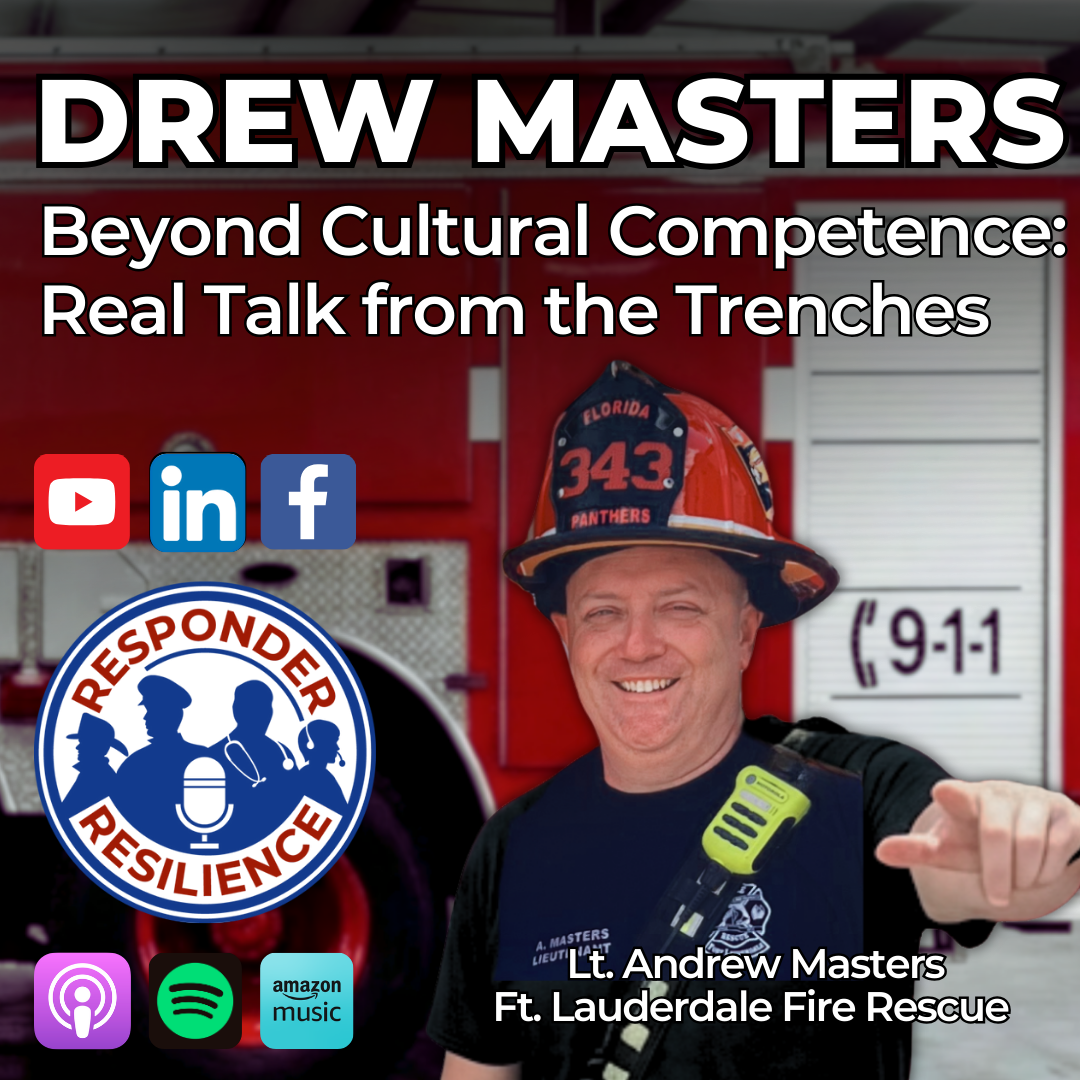
Lt. Masters discusses the critical need for culturally competent clinicians who understand the unique pressures faced by those on the front lines. With his boots on the ground, he shares firsthand insights on how appropriate training can bridge the gap between responders and mental health professionals.
We sit down with Lt. Andrew Masters of Fort Lauderdale Fire Rescue, a man who has stared into the abyss. His raw, unfiltered journey takes us deep into the struggles of mental health within the first responder community, where the weight of despair nearly pushed him over the edge. Andrew opens up about his darkest moments, including his near-suicide experience, and the transformative power of resilience and support.
As a passionate advocate for mental wellness, Lt. Masters discusses the critical need for culturally competent clinicians who understand the unique pressures faced by those on the front lines. With his boots on the ground, he shares firsthand insights on how appropriate training can bridge the gap between responders and mental health professionals.
Join us as we uncover what it truly takes to prepare the next generation of clinicians to effectively serve this critical population. Get ready for an episode that’s as real as it gets—where courage meets compassion, and hope rises from the ashes of despair.
Contact Drew Masters:
Instagram: https://www.instagram.com/comingoutofthestorm/
Contact Responder Resilience:
Phone: +1 844-344-6655
Email: info@respondertv.com
Our website with past episodes and more: https://www.respondertv.com/
YouTube: https://www.youtube.com/c/ResponderResilience
LinkedIn: https://www.linkedin.com/company/responder-resilience-podcast/
Instagram: https://www.instagram.com/responder.tv/
Facebook: https://www.facebook.com/responderTV/
I had taken one of my dad's revolvers and actually pulled the trigger. I put it in my mouth and pulled the trigger and it dry fired. I may be the mental wellness guy, but I had the blinders up. It was it was hard for me to see. I like to say that suicide is a permanent solution to a temporary problem. I think that coming out of the storm, that there is light at the end of the storm, no matter how long the storm lasts, it it doesn't put him in through a basic fire academy class. Talking about our lingo. And we also want clinicians to understand that some of the stuff you may hear, if you can't handle it, then that's fine. We want you to be able to say, you know what, this may not be the clientele for me.
SPEAKER_05Welcome to Respond Resilience, along with my co-host, Dr. Stacy Raymond. I'm David Dashinger. Join us as we sit down today with Lieutenant Andrew Masters of Fort Lauderdale Fire Rescue. He's going to share his raw journey through the depths of despair and the road to recovery. We're going to explore the urgent need for culturally competent clinicians to understand the unique challenges that first responders face. And we're going to discover a little bit about how appropriate training can bridge the gap and prepare the next generation of mental health professionals to effectively serve first responders on the front lines.
SPEAKER_03Thanks to our resource partner, First Responder Project, whose no-cost First Responder Retreats offer you a chance to reclaim connection and learn vital skills. This isn't just a retreat, it's a lifeline to keep you mentally strong at work and emotionally present at home. Take a stand for your well-being and the connections that matter most. Sign up now for your FRP retreat. Learn more and register at FirstresponderProject.org.
SPEAKER_05This episode is made possible by the First Responder Center for Excellence. Discover more at FirstresponderCenter.org and connect with us on X, Facebook, LinkedIn, Instagram, and YouTube.
SPEAKER_02There's a new app built by Firefighters for Firefighters, and it's called Crackle. Download the app now for free as a legacy member and get early access to exclusive content, tools, and updates as they drop. Get the free app at crackle.responderTV.com.
SPEAKER_05Remember to like and subscribe YouTube, Responder Resilience, Facebook, Responder TV, LinkedIn, Apple Podcasts, and Spotify, and our website is respondertv.com for past episodes and guest information. We'll be right back to speak with Drew after this.
SPEAKER_00In this family, more of us die by our own hands than by the hazards of the job.
SPEAKER_06In this family, up to a quarter of 911 telecommunicators have symptoms of post-traumatic stress. In this family, our mental health and wellness are in high stress. Our responders are quietly suffering. In this family, many struggle with job-related stress.
SPEAKER_04Welcome to Respire Resilience.
SPEAKER_05So I had the opportunity to meet Lieutenant Drew Masters recently at a conference, and we sat down, had a long conversation, and uh discovered that he would be an amazing guest, especially because of his expertise working with clinicians. A little bit about him before we dive in. He served with the Fort Lauderdale Fire Department since 2012, and he's been in the fire service then since 2008. As a peer support team coordinator since 2013 and former Broward County SISM coordinator, he's led efforts to support firefighter mental wellness. Lieutenant Masters has responded to major incidents, including the Marjorie Stoneman-Douglas shooting, the surfside collapse, and Hurricane Ian. Having overcome his own near-suicide experience, he uses his journey of resilience to inspire others. A passionate advocate for first responder mental health, Lieutenant Masters continues to lead with compassion, strength, and dedication to those who serve. Healthy, welcome to Responder Resilience. Thank you for having me.
SPEAKER_06So, Drew, I'd like to start out by asking you to share with us what initially drew you to the profession and then share about your journey through fire rescue.
SPEAKER_01So we I come from a family of first responders. My uh dad was a police officer and he's now retired. My brother, who is older, uh got into the police service and everything. And you know, we've had the jokes and everything. Everyone says I'm the smart one in the family becoming the fireman. Um, but my dad telling me growing up, I was always we'd go visit him at the police station. I was always the one that wanted to go see the fire trucks and everything. So I've always been that person gravitating towards fire and everything. So, you know, went through the basic schooling, fire, paramedic school, got hired right out of there, and you know, the rest is just kind of that little bit of of history and everything. So, you know.
SPEAKER_05Tell us a little bit about your journey, your spiral, and how did you cope with that? And kind of how'd you get back to you know, baseline at least? Um, what was that what was that like for you?
SPEAKER_01So it was um there was two instance, two moments in my career where I kind of had like spirals where I kind of one was a lot bigger than the other one. Um back in 2007, 2008, I was hired by um a smaller department down here in South Florida and everything. Loved working there and everything, and it was a great um opportunity for me. Had great mentors there, and they had talked to me about maybe moving moving to a bigger department, which I ended up um in 2012 getting hired with City of Fort Lauderdale. Um, but as you know, once you leave departments, you start on probation again. You're back at the beginning, you know. So back on probation and everything, doing what I needed to do. Um took one of the written tests that was required of us on probation, and I actually failed the written test. Um, not to make excuses or anything. I'm also dyslexic. Um, the day I took the test, my niece had a full-blown febrow seizure and you know, was in the ICU the day I took the test, but because I was on um probation, I couldn't really call out sick or anything. So was there was 13 of us, I believe, that took the test, and 10 out of the 13 failed that test. Well, a couple months down the road, uh, I was placed on administrative leave and I was actually fired three days after Christmas um for failing that one test. I didn't get a retake or anything. Um the next three years I spent applying for any department that I could throughout the state of Florida. I was applying from North Florida down into the Keys, taking tests wherever I can, getting, you know, possible conditional job offers, um, and then them kind of getting taken away from me and everything. So it was kind of like you'd have that roller coaster of okay, it's the the journey the road's over, I'm getting back in the fire service, and then it would be pulled straight from you. Um and I just kind of spiraled out of control. Um made a phone call to him that you know I didn't want to do it anymore, and I was tired of all the rejection, and I'm such a failure, I've let everyone down. Um, my parents had been out of town, they were in England and everything, and that um that week I kind of I would say I fell off the deep end pretty pretty heavily. And one of the days that I was there, I decided that, you know, um was when I had my my suicide attempt. Um I had taken um one of my dad's revolvers and actually pulled the trigger. I put it in my mouth and pulled the trigger and it dry fired. Um learning years down the road that from a from speaking at a police conference that revolvers never dry fire. They're one of the most reliable guns around and everything. So I believe everything happens for a reason. And now just learning that that happened for a reason.
SPEAKER_03You're trained to help people heal, but first responders, they carry trauma that's buried under silence, stigma, and stress. Helping the helpers gives you the framework to connect, to speak their language, earn their trust, and actually make an impact. From the experienced team and clinicians behind the Responder Resilience Podcast, this isn't theory. It's real-world support for the ones who need you most. And this book isn't just for clinicians. If you're an agency leader, peer support team, chaplain, EAP, wellness program coordinator, or family member, helping the helpers will equip you with the tools, language, and insight to make a difference. Be the resource they can count on. Order your copy of Helping the Helpers on Amazon today.
SPEAKER_01Kind of pushed my way back from there. Um, I suppressed a lot of the emotions and feelings that I had. And then was luckily enough in 2015, a new chief had come in with Fort Lauderdale um and we had spoken. Um, they officially pulled my termination and we were I was able to resign. And I was actually rehired by Fort Lauderdale in 2015, where but I would have to start from the beginning again, you know, on probation again, go through everything, which which I didn't care. I had a job, you know, I was hired back and everything. Um suppressed everything down, was happy, you know, doing stuff, got involved with the mental wellness stuff as soon as I got off of probation. Um fast forward a few years down the road. Um, I had kind of three or four major incidents that happened within almost a four to five month span that kind of just you know rocked me again. The big one, I lost my grandfather, um, who was a big mentor. He was like the the family monarch and everything. He lost his battle with with cancer. And then fast forward a couple months, we lost my nephew Dylan, who was seven years old, to um his fight with a brain tumor. And the week after that, this was just a week after we lost Dylan, is when Surfside happened. And I was deployed down the surfside for almost a week and a half, and then about a month or two after Surfside, I was dealing with a breakup from a serious relationship. So it was kind of one of those things where getting those one-two punches, didn't really, wasn't really sure, started to go down that spiral again. One thing I think that was grateful though was being in the mental wellness. I kind of had it in the back of my head that I didn't want to get to where I was before. That I kind of knew the resources, kind of had the talks and everything of, you know, okay, I need to listen to myself and everything. But I did go down the thing, and it was it was weird that, you know, I may be the mental wellness guy, but I had the blinders up. It was it was hard for me to see. I was getting told by people on my my own job that I had turned in pretty much into an a-hole the whole time, and it was um it was hard for me. And one of the big things that made me kind of realizing click is I walked in on a call, um, and I had been working overtime like crazy, maybe putting in over a hundred hours a week of just trying to do whatever I can. So I wasn't at home, I was just working, working, working, working. Um they I walked in on this call, and the captain looked at me, and this is before I was promoted, and he looked at me and goes, Hey, this this patient, she's she's she's a little hungover, she just wants to go to them go to the hospital. And my exact words back to him was I don't see how that's my effing problem. And he yanked me outside, he chewed me a new one that he heard the rumors that I need to check myself and everything. And that night something clicked. Um I'm the next morning, I made three phone calls, which one was to uh a chaplain, Ron Perkins, who unfortunately we lost this year. Um he guided me in the right direction. And then my next phone call was to a gentleman named Sean, who is a clinician who had taken the class that we'll speak of and been immersed in first responders. And then another call was to Candace, who is uh actually now just promoted to captain within the last week, so really happy for her about the mental wellness stuff. And all their reactions was kind of the same, which kind of surprised me. All of them said, You don't know how long we've been waiting for this phone call. And I I said to them, I'm like, You've been waiting for this phone call, why didn't you say me? Tell tell me about this phone call. Um I and they're like, Well, we knew you weren't gonna get the help unless you really were ready for it, and everything. And um the next day I was in Sean's office going to starting to go to therapy and everything, and a lot of the stuff he did, he understands the job and everything, and didn't have to spend time explaining the job, what my schedule was, or or anything. And uh, you know, one of the big things that I think helped me with him getting back on track and to the level I'm at now is he on our second session, he sat around and goes, I want you to go home and write a letter. Just start writing a letter. And don't stop, and then we'll go over it on your next session. So I sat down with the pen and paper, and next thing I knew, I had almost 20 pages written of just random stuff that went down, and I had felt like such a relief was off of my my shoulders and everything. Went over with him the next session, and the sessions went from meeting in his office to eventually we went and got breakfast together and we would fight on who would pay for the check and everything. Um, so it's it was it was a definitely got me to the point to where you know I can sit here today and talk about my story um being comfortable, and it's one of those things where you know I'm not afraid to talk about it because I want to reach that one person that may be hesitant and let them know, like, as the talk, I I've named it coming out of the storm, that there is light at the end of the storm, that there no matter how long the storm lasts, it it does end. And it's all about also getting used to the new normalcy and everything. So that's kind of the talking has has actually been a blessing for me. Um, it's it's an outlet for me to talk and meet the people that I've been able to meet. And I look back at now the opportunities that I've had, including today, of where I've been to where I've been that person that's been down the road of suicide to be able to sit here and talk about it today.
SPEAKER_00Announcing new on our website, over 400 new tools and resources, first responder grants, hotlines, discounts, support, and mental health links. Over 400 national and state resources. Find helpful tools and resources today. Go to respondertv.com slash resources to connect.
SPEAKER_05We appreciate you sharing this um on our platform because we have the same thought is that if we reach one person and impact them uh in a way that might make them more willing to seek help or just recognize that they need help, um, then we've accomplished the mission. So thank you.
SPEAKER_01Absolutely. I mean, one of the most humbling experiences I've had. I've been I was invited up to Chicago to speak at one of their conferences, and they put on an amazing conference every year, um the frontline conference. And I spoke the first year, and it was the first time I'd ever really spoken at a big conference by myself and everything. Went back last year, they invited me back, and I'm just walking through the hallway looking at the different vendors and everything. And I have no other connection really to Chicago besides this conference and maybe making a couple friends. And I was stopped by like three or four different people in a group, and they're like, Oh, we saw your name pop up on the on the program again, and we wanted to bring more people. Like, thank you so much for for talking. It was raw, it was emotional, it was it was so inspiring, and and it just like it like caught me off guard. And you know, I'm like, that's what a lot of us kind of do this for, is to reach those people, like we said.
SPEAKER_06And it's just so impactful when you know a first responder, him or herself can get up in front of people and be vulnerable, right? Because of the the whole stigma of having to, you know, uh be the person that holds it together and shows, you know, shows up and fixes the situation, whether you're a police officer, paramedic, a firefighter, what what have you. How impactful it is to hear it from one of your own. You know, I could get up and talk as a psychologist, and I it's it probably sounds like wah wah, wah wah, wah, wah, talking about you know, post-traumatic stress, wah wah, wah, wah. And um, that's all well and good from an educational perspective, but you know, for you to put yourself in front of people and share your story, there are going to be people that say, well, he can do it, and you know, if I get to that place, then then you know, I now know what to do because of what he taught us. And the big thing is you give permission, you give permission.
SPEAKER_01Yeah, and I think one of the biggest things that people have to understand too is while they're going through their struggling in their journey and everything, that it's not gonna be an overnight fix. That this isn't going to see a therapist or or seeking help isn't gonna be just a simple at-night, overnight type thing. That it's gonna take time, and it could be a year or two down the road and everything. I mean, this is almost been to get comfortable to where I'm at, a 10-year journey for me, you know, getting comfortable talking about different things, and but it was a few a couple of years to where it got me to be to a point to where I just didn't care anymore, and I felt happy and I felt normal and everything. And one big thing that I did also was um, I don't know if you've ever heard about it, was the hard seventy five challenge. Um, it's a workout challenge that's out there that challenge you to do two different workouts a day. One has to be outside, whether it Walking, pickleball, whatever, reading 10 pages of a motivational type book and you know, drinking a gallon of water of a day. And, you know, that ultimately changed my mindset. And, you know, not just physically, but mentally. And I'm learning that mindset is a big, big thing. You know, dealing with the breakup, I think I kind of put myself through it that I would listen to all the sad breakup songs that would come out and everything. And now I'm like, yeah, let's turn those off now and start with the happy songs.
SPEAKER_05Yeah, it's so important to consider, like, you know, the input, right? The what we're putting into the equation, whether it's good food or you know, positive thoughts rather than negative information or um some of the dark stuff that's out there that we could spend hours scrolling through and looking at, but um, really just changing that whole the whole balance to to more positive. And um, Drew, you're you're doing some amazing work, and you have done stuff that I I applaud you for as well. And that has to do with working with clinicians. We we do speak to a lot of clinicians through this podcast, through our book, who are wanting to work with first responders. Talk a little bit about what you have done to help train clinicians to get more familiar with our world. What was that like?
SPEAKER_01So, the class I was teaching, um, I was able to be one of the lead instructors for almost the past eight years. And I ultimately take the class to that's what saved my life because Sean, the clinician that I spoke of, is that's how I met Sean through this class was teaching this class and everything. So I got lucky, you know. We talk about in the class about finding a clinician for you is almost like dating and swiping on the dating apps now that you know you're gonna go, you may go through one or two or three of them that may work for you. You know, you may have to swipe left on a couple of them before you get to swipe right, you know, type of thing. But the biggest thing is for the classes, we gave them an understanding of what our world is like. We put them in through a basic fire academy class talking about our lingo is basically just understanding our lingo and also understanding basic things as much as just to say, why do you have three refrigerators in the in the in in your kitchen and why are there locks on two of them? And we would have them understand, like, well, we lock them because so and the other shifts are gonna steal the it's always the coffee creamer and the ketchup and the coffee that disappears. For some reason, it's only those three three things.
SPEAKER_05Once in a while, the butter, too, right?
SPEAKER_01Yeah. And and we would explain that to them about how it would work, and we'd unwe'd also explain to them how the kitchen table worked. That that kitchen table is our sanctuary, that is where we fix all the world's problems, and we would let them know we're like, listen, if you get invited to eat at a firehouse table, you need to stay and eat. Because if you turn around and tell me no, that you're gonna leave, you've just lost me completely because getting an invite to sit at our table is a big deal. Um, you know, we we explained it to we're such weird characters and out there that I can leave a thousand dollars on a kitchen table at a firehouse and it's gonna be there for months. Someone may even put it in an envelope found on this day. I go, but you you leave a pack of Skittles on that table, you go on one call. I guarantee you it's gonna be one Skittle left, it's gonna be one of the yellow or orange ones, and it's gonna be sitting there just because no one wanted to throw away the packet or something like that. So, you know, that's our culture. Um, other things we would do with them is depending on what city we would teach the class in, as we taught this all over the state of Florida, is we would kind of get someone from the department to speak on something maybe that had happened in the department that they had gone through. Um Orlando, we were lucky enough to have members that responded to the Pulse Nightclub shooting come and speak to them. And we actually took them out to the Pulse Nightclub site to actually get to see it. Um Coral Springs, we had members come and speak about the the high school shooting. Um and we've done different things to where we actually put them in live situations, not uh well, fake live scenarios where we'll put them in bunker gear.
SPEAKER_07Alright, cool. What are we gonna do? We're gonna work as a team. You gotta work as a coordinated effort here, okay? I know, I know you're tired, you guys are doing good. Let me put it to you this way. If I come into your office and I'm in crisis, just because I'm tired and you're tired, you're gonna give up on me now. I can't give up on this victim. I don't have that option. I don't pull this guy out, he dies. Give up on me in your office, what happens? So we're gonna do this. Work together as an easy. One, two, three, four.
SPEAKER_08I have to go.
SPEAKER_07So there's a hole behind the ground. Work together. One, two, three, four. One, two, three, four. You want to? Yep.
SPEAKER_01But we give them the tools and we're right there with them on how to cut open a car and kind of remember those sounds of the the the door popping, the metal crunching, that that may be a trigger for some for someone that you're dealing with that they may have had uh an extracation where they're cutting a child out or something, and they they have those triggers. Um, the big thing that we put them through, and which was always my station that I did them through, is we put them through a search and rescue drill where we put them in full bug bunker gear, we put them in the air pack, and we filled up a room with Hollywood smoke. It was fake smoke, so it was there were no IDLH atmospheres or anything like that. Um and we would send them into a room with an instructor on to search the room. They'd be on their hands and knees crawling around. We would say, There may be a mannequin in there, there may be a person in there. It you don't know. We don't know when we go in, but we have to go search it anyway. And when they came out, we would have a conversation with them and speak about, you know, how did you feel? And most of the times we got like we kind of felt helpless and and hopeless that we didn't know what we were doing, what we should do, or anything. Well, I would flip it on them and say, remember that feeling when we're coming to your office, because we have SOPs for everything in the fire department. We have it even on how the toilet paper should be changed, whether it goes over or under, or is it this, it's that. We don't have an SOP on how to come sit in your office, whether we should, you know, do we take the water, do we drink the coffee you're offering us? Do we sit on the couch? Do we do this? You know, so we kind of want to make it a little bit easier for them. They do have a day of lecture where we go over, like I said, the lingo and everything, and we give them what we call a Rosetta Stone of firehouse culture. And once they're done with that two-day class and everything, to finally finish the class, what we recommend them to do is to go out and actually do ride times with the fire department. That they're gonna be able to do is get in the firehouses, run the calls, kind of get a little bit of understanding. But what we tell them is remember, you're not going out there to do sessions with them. If it happens, it's gonna happen naturally. You're out there to just kind of observe and everything. Don't turn this into you're looking for clients, you're looking for this. No, this is just for you to kind of to get more into our world. And and I tell them, like I said before, you better sit at that kitchen table and eat with them if they offer it.
SPEAKER_02All units, stand by for a confirmed structure fire with report of parts and stream. In a world where first responders save lives, this book could help save theirs by preparing you to answer when they call for help. Based on over 200 conversations and the trusted team behind the Responder Resilience podcast, helping the helpers give you the tools to understand their world, speak their language, and earn their trust. This work is challenging, but deeply needed and profoundly rewarding. Their stories don't start with trauma, but too often they end there. Infused with real-life experiences, this guide reveals the human behind the badge and equips you to build a first responder-centered practice that works, from understanding their culture to the practical realities of working with first responders and chapters across the spectrum of first responder professions. You'll gain insight into the hidden struggles that shape their reality and the steps you can take to help them heal. When trust is shattered, the stakes are high. This book helps you build it before it's too late. Are you ready to make a difference? Be the resource they can count on. Order your copy of Helping the Helpers, the clinician's guide to first responder mental wellness today.
SPEAKER_06And that's what I did. I was invited to um do ride-alongs and to go to dinner, and I have to say, it was such a learning experience, you know. Just uh it was tremendous. Um, and then with police, I did a um citizen citizen of police academy, which you know, they covered everything that police have to know and deal with, and uh with eye-opening as well. Right. So is there anything else that you would recommend for us clinicians um to do or to try to learn about in order to work with you?
SPEAKER_01It's it's it's understanding also like our schedule, our hours is you know, when we tell them, when I tell them about like, oh, I meet my clinician now, my therapist at a diner, and we have breakfast, you kind of see the shocked faces like, what do you mean you don't go to an office and sit on my couch and and talk? You know, we tell them we're like, you may have some different hours and everything that you may have to go see these people. It may be something where it's after hours or first thing in the morning after shift, you know. And we also want you to understand that you're gonna be hearing some of the the worst of the worst things. Um, a lot of times it's it's not to deal with just on-the-job stuff. A lot of times we've been able to trace back some of the suicides that have happened, actually, majority of the the suicides that have happened is trace back to that they have other issues going on, whether it be family, money issues, you know, whatever. Um, so we're like, you know, you're not only just helping them, you're helping with their family and everything. So it's stuff that you've got to be able to go back and forth between the job and off the job and everything. And we also want clinicians to understand that some of the stuff you may hear, if you can't handle it, then that's fine. We want you to be able to say, you know what, this may not be the clientele for me, because we've had instances where clinicians have come in and guys have broken down, and now they're helping the clinician, our first responder instinct kicks in, and now we're assisting the clinician through stuff, and now our members are not getting any help. Um you know, we bring up resources and stuff of as simple as you know things that happen with family and everything of understanding that they may, they may need to, you know, do something of writing a fake letter for for Santa. That Santa understands that you're gonna be on shift for Christmas and that Santa's gonna do the Christmas the day before, you know, with little kids and everything. So it's it's working on everything from the family side to the home side, and also knowing that as simple as maybe driving through to your office, depending on where it is, do you is your office in the city that I work in and everything like that? As we're driving through those those streets and everything, we're reminiscing on calls and everything, and we do it without even realizing it that drive past this intersection. Oh, I narcanned someone on that sidewalk the other week. Oh, we had a fire in that building the other week. Oh, I cut someone out of the car here. You know, I think also on a first responder level, that you know, divorce rates are so high that we have one of the highest divorce rates out of any type of uh profession that's out there between fire police and police, that one of the biggest breakdowns that we ever hear about is there's lack of communication, communication, communication, communication. So I think one of the biggest things that we've been able to do along with the clinicians and everyone else is a lot of departments are starting to create family days. So where we're bringing in the families as they're coming on the job after they've done their their recruit training on days and give them an understanding of this is what your firefighter could be going through, these are resources that we have for you. And I talk to the firefighters and I ask them, I go, Hey, have you ever sat down with your spouse, your loved ones, and say, what's okay for me to come home to bring home? What's okay for me to talk about? You know, there could be a level, you know, I'm not saying to sit here and describe, you know, oh, the kid's head went through the window, yada yada yada, you know, oh, we had a bad call, it involved the kid, you know, so it just kind of got me a little bit. The reason I look at that is because, you know, your spouse knows your behaviors, they're your best friend, your biggest supporter, your biggest fan. They they to an extent want to know how your day was and everything. They're not just asking because oh, we should ask about their day. No, hey, they're gonna know when you're you're having that that difficult time coming home. And, you know, it's being open and honest with them. Yeah, we had a bad night last night. So, you know, understanding. Um it's also one of those things that understanding that, you know, talking with spouses and families, that it's when things go wrong at home, they're probably gonna go wrong while I'm at the firehouse, and there's nothing I can really do about it. The water heater's gonna break while I'm probably running a call, or the kid's gonna be sick at school and everything. So the spouse who's not in that line of work, it may rely on them a little bit more, but I also believe that when it comes down to relationships, especially in the first responder world, that everything's not 50-50. There's days where it may be 60-40, you know, it may be, you know, you may be at 20% today and your spouse's got to pick it up a notch to 80. You may be at 80% that day, and they may be at 20%, you know. So it's it's just understanding and having that those conversations. And, you know, I think it's also letting your family come and be involved in some of the events at the fire firehouse from you know, St. Patrick's Day parades, you know, does Santa come to the station doing toy drives, you know, getting them involved? Because, you know, being in the fire service, it's it's it's not just you that's involved, your family's involved also.
SPEAKER_05Hey, firefighters, let's take a moment to talk about something important. There's a new app built by firefighters for firefighters, and it's not just another wellness tracker or generic resource hub. It's called Crackle. You've probably seen the magazine, but this is the next evolution. The app is about one thing, helping firefighters not fail. Not just on the job, but in life, in your health, your relationships, your mindset, and your longevity. That's why Crackle is designed to meet firefighters exactly where they are, with resources that make sense, are easy to use, and actually respect your time. You can download the app now for free as a legacy member. That means you get early access to exclusive content tools and updates as they drop. Use the QR code on the screen to download the Crackle app, or you can download it from the App Store or Google Play and stay in the fight. Not just at work, but at home and in your own head too. Because your best days shouldn't be behind you, they should be ahead of you. I want to ask you this: like, what feedback have you gotten from clinicians in terms of what they experienced going through that training and how maybe it helped them to do their work better?
SPEAKER_01I know, I know one thing that I did hear was, you know, they wanted more, they've always wanted more time with the firefighters, more time sitting there talking with them, more time doing the drills and everything. And, you know, the way we try and do the class is to make sure is we want firefighters teaching the class. They can sit there and listen to a doctor speak all they want. They've done it throughout their whole careers going through schools and everything. You know, now we're bringing them that kind of down to our level of understanding our world. Um, you know, they could sit there and listen to these doctors speak and everything, and it's nothing against them, and they could understand the culture and everything, but a lot of them haven't sat in the seat like we have and run the calls and you know the cliche that they always say, you know, running out, getting getting a child handed to you as soon as you get off of the truck, you know, it does happen. But we also talk about the the lighthearted side of it too of you're not walking into Chicago Fire or any of those TV shows. That that that's not how the firehouse actually is, you know. You know, one of the one of the questions I got asked during it during a feedback thing was, are you guys really allowed to leave like Severai does on Chicago Fire and just go take care of something and then come back? They I'm like, no, absolutely not. Like if I went in and asked my chief if I could leave for an hour or two to go take care of something, I go, I get laughed at. But you know, we we and a lot of the feedback that we get is I've I've had a couple of them tell me that are married to firefighters, tell me I never understood their job until fully until today. Understanding now of what it's like being in that bunker gear, you know, we always hear about being in the gear being in how much of more of a of a how much harder it is being in that gear doing simple tasks of just walking upstairs, doing this, okay. Why you may be tired, like, oh you had a fire after last night? Okay, great. Well, that's all you did? Yeah, well, now they understand that maybe that fire they were there for a few hours. It's also bringing up a simple thing as, and I talked to one of my my captains about it. He talks to his wife about a lot of stuff, and I asked him, I go, Does your wife actually understand what it means if you tell her you had six calls after midnight? And he's like, Yeah, she knows I'm tired. I go, but does she understand that that's six hours that you are possibly up? Being that the fact the average call from dispatch to getting the lay back down is an hour, meaning that you're technically up from midnight to six a.m. Maybe you got another hour of sleep to get up to get the station ready to get off. And now you're switching your roles from the firefighter role to the spouse and the and the dad role within minutes of of leaving the station. And he's like, No, I don't think she understands it that far. So it's it's I think with everything that's out there, the resources that are out there, I think we're gaining traction on helping families and spouses and the firefighters handle the mental wellness um in game a lot better. You know, I don't think it's ever gonna go away, unfortunately, but as long as the numbers keep trending down, I think we're we're making that positive impact and getting more people. I've seen more and more people probably in the last five years that have stepped up and said, Oh, I've been to a therapist, oh yeah, I've been struggling with this, oh, this is bothering me than it's ever been in the fire service. You know, they always have the the saying, um, what is it, tea safe, and you know, the suck it up buttercup culture. You know, it's it's we're we're regular. human beings that that see this stuff. You know, I don't jump into a phone booth and rip open a Superman suit. You know, I'm not a I'm I'm an ordinary person that finds myself in extraordinary situations. Sure. And you know we see more traumatic events in a day than people may see in a lifetime. And you know it's it's just having a simple I think also getting the culture in the firehouse to being able to sit down and just talk about it of starting with the officers in the station of hey after that call it was kind of a de a a decent call there's a lot going on everyone good anyone want to talk about it let's let's recap the call and everything and it starts it starts there and also it goes down to accepting it. If someone says hey that call messed me up is accepting it. Okay what what kind of messed you up on that not putting them down you know okay you know let's talk about it let's what what what's affecting you with that what what what are you playing over and over again that you want to talk about it could be something as simple as you know the outcome was bad and now they're Monday morning courting themselves saying we could have done this and this but someone on the outside maybe no you guys did everything that you can the outcome pretty much was was already written before we even got there type thing. So one thing I will say is that you know we talked about finding something that will help and everything. And I will say going back to working with the Panthers that was a big thing for me that helped me kind of stay coarse and probably from doing something um stupid again I would say um you know I like to say that suicide is a permanent solution to a temporary problem. And I realize that now and we're dealing with that and working with the Panthers I was able to make some amazing friends and you know going to the games was such an outlet for me. Those couple hours of just sitting in the stadium watching them watching them play and everything I was able to work some really big events and everything between an NHL draft that was hosted down here in Sunrise an all-star game and even just going to I was able to go to game seven two years ago where they won their first Stanley Cup and everything and then a couple weeks later I'm working the parade for the fire department and everything and you know it's you never think of those things and then seeing my niece and nephew being able to um witness that also they're big Panthers fans too you know my nephew was la at last year's game when they clinched it and everything and he's a huge fan so um it's things like that now that I grasp onto that you know they definitely played a role in in helping me get back on track. So I definitely put it out there to people like find something away from the fire service that that to do whether it's it's sports reading working out running anything that I would recommend. So right it's so important to have meaning outside of just work because like in your situation where the it was you know doors were closing for you and you thought that you know you had something that you could look forward to um you know if you didn't have something else going for you then um you know it can be very hard to uh realize that life is worth living and it certainly is it's it's you know I've definitely changed my outlook from I used to be very why me why me why me why me now my whole mentality is why not me you know um it's it's I look at things and you know I didn't get an invite to go somewhere okay that's fine they didn't want to invite me to that thing okay why do I want to be there anyway if people if they didn't want me there anyway you didn't get an invite oh well let's go find something else to do let's go you know it's it's not I don't I don't dwindle on those things anymore and you know I look at a lot of I've changed my mentality like I said like I read different types of books I read more positive books and everything they've played a big role in me um one of the big ones that I I read that was out there was um own your past change your future and it had nothing to do with the fire service and you talked about you know carrying your struggles how you may carry your past in a backpack some of them are boulder some of them are little pebbles and everything and and how to get rid of them I will say like one of the biggest influences that I've had out there reading stuff and just watching podcasts um a gentleman named Inky Johnson um he was a football player that um got a devastating hit that paralyzed one of his one of his sides and everything now he speaks about overcoming stuff um um another person that I kind of related with that I'd love to go to one of his lectures and everything was um kevin heinz Kevin Hines speaks globally about um survival and everything and he he actually jumped off the Golden Gate Bridge and survived and you know he's like I think it's like something like less than 10% of people that that happens to and he has no deficits and everything. And you know he wrote a book called um how storytelling saves lives and I kind of related to him about I have the same mindset that I want to be able to go out there and tell my story and and help people that you never know who's listening. Like another big person that I read a lot of his stuff and everything is um is Tim Thibaut you know very motivational very positive and everything. You know I like to say that you know people need to understand that they're never really alone um you know you can think about I I say when I speak you know you're never really alone because you always have one of the three F's that are available to you and that's family, friends or faith. You always have one of those that are that's going to be there for you and that's going to be available for you. And you know that's kind of everything that I've done between teaching the classes being at lectures doing what I've done on the mental wellness stuff I've had friends that have turned into families I've been able to get resources that I've been able to send other members to to help them and you know that's that's a big push for me also that just seeing how that's working out.
SPEAKER_05Well um true I think in one hour you've just shared like a book's worth of resources and information. So it's been incredible.
SPEAKER_06As we wrap up Stacy any final thoughts I I just um I can't help but think that um all of your challenges you know have happened for a reason and um have served so that you could then give other people hope.
SPEAKER_01I really think that you know when when somebody tries to kill themselves and and they survive you know and then you're putting such effort and passion into helping other people you know rethink uh their own situation you know like almost like it was meant meant to be so thank you thank you and one last thing that I'd like to like to say before we before we wrap up is that let people know that there is hope out there that the light at the end of the tunnel will show up no matter how dark it is you know think about the storm closing. One of the sayings that I always end my my lectures with is it's out there I forget who's saying it it's a very famous uh saying is that you never fail fail only means that it's your first attempt in learning if you get told no it just means that it's your next opportunity and it's never the end because in the end effort never dies. And I hate to be that person that sits there and says like just because I did it you can do it. I I think everyone has their own story everyone has their own way that they get around it but I am going to boast about myself a little bit I was able to if you're thinking about that you may be able to do it you can I was able to go from the brin of losing my job dark dark deep depression to where I'm at now I'm promoted in the fire service I'm an officer in the fire service and I'm one of the leading members of mental health in in Florida and I've never been living a better life than I am now. That hope is out there the light the the the light's never been shining brighter than it is now but you have to be able to do the work and there's people out there to help you.
SPEAKER_05All these difficult circumstances that you've lived through have made you who you are today and uh sometimes we need to just recognize that right we're uh as bad as things seem in that moment in the dark moment that um there's a gift in it and we find that gift we can maybe figure out a way to pay it forward and that's exactly what you're doing.
SPEAKER_01I want to thank you so much for spending this time with us and sharing your story so honestly and openly um it's been a pleasure is there any links or websites social media you want to share about uh where people could find you they can find me I actually just put it up um an Instagram page they um it's called coming out of the storm um they can search it and that's how they can reach out to me um there so um that's that's pretty much where I'm staying for right now until I start building more and more and everything so great well thanks again for spending this time with us and we look forward to sharing this episode out there so we appreciate it.
SPEAKER_05I appreciate it and if if people saw me looking around and everything I apologize like we spoke of my my dog was running around and she decided she wanted to start fighting things that she like power cords and stuff so trying to make sure a lot of stuff going on behind the scenes we we we have a lot of canine escapades on our episodes remember to like and subscribe YouTube responder resilience Facebook responder TV LinkedIn Apple Podcasts and Spotify and our website is respondertv.com for the past episodes and the guest information. Till the next time stay safe be kind to yourself take care
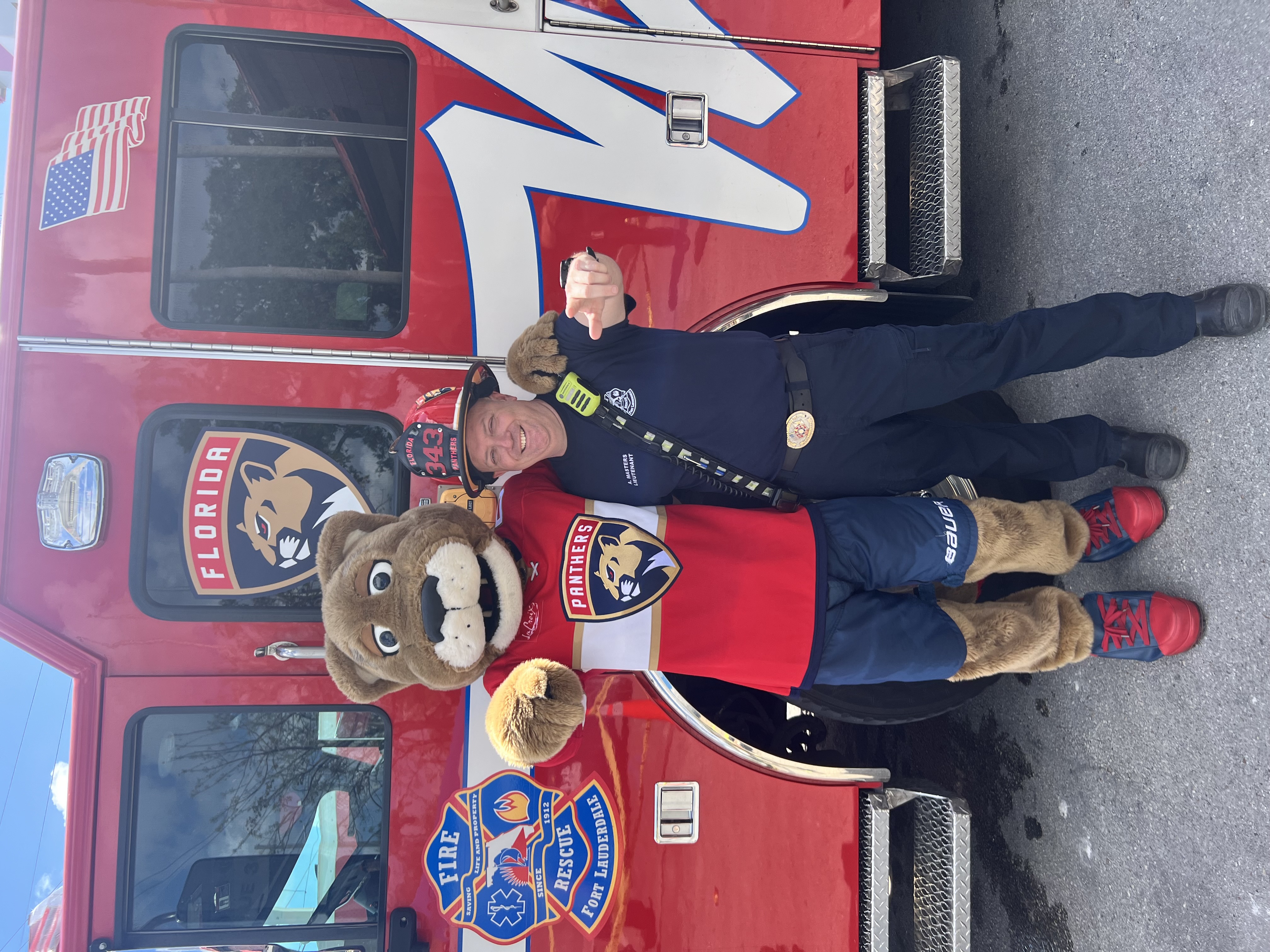
Fire Lieutenant | Paramedic | Instructor
Lieutenant Drew Masters has served with the Fort Lauderdale Fire Department since 2012 and in the fire service since 2008. As Peer Support Team Coordinator since 2013 and former Broward County CISM Coordinator, he has led efforts to support firefighter mental wellness. Lt. Masters has responded to major incidents, including the Marjory Stoneman Douglas shooting, the Surfside collapse, and Hurricane Ian. Having overcome his own near-suicide experience, he uses his journey of resilience to inspire others. A passionate advocate for first responder mental health, Lt. Masters continues to lead with compassion, strength, and dedication to those who serve.