WEBVTT
00:00:00.160 --> 00:00:02.640
I had to redefine my purpose.
00:00:02.879 --> 00:00:08.720
When you're responding in a fire engine to emergencies, your purpose is pretty clear, right?
00:00:09.039 --> 00:00:20.960
The change was significant enough for me that it really became a mental health crisis for me to have to transition into a role where I wasn't on the line doing the things with people that I love the most.
00:00:21.280 --> 00:00:31.120
Firefighters and other first responders, when they make that brave decision to say, hey, I need help, it's sometimes a very private and a very difficult decision to make.
00:01:04.000 --> 00:01:07.200
What tangible daily actions must command staff take?
00:01:07.280 --> 00:01:12.560
And we'll dig into the secret sauce of camaraderie in a department, the art of listening and empowering others.
00:01:12.640 --> 00:01:13.840
Just how critical is that?
00:01:14.079 --> 00:01:18.719
There's a new app built by Firefighters for Firefighters, and it's called Crackle.
00:01:18.879 --> 00:01:25.280
Download the app now for free as a legacy member and get early access to exclusive content, tools, and updates as they drop.
00:01:25.439 --> 00:01:28.799
Get the free app at crackle.responderTV.com.
00:01:29.920 --> 00:01:40.319
We invite you to like and subscribe, YouTube responder resilience, Facebook, Responder TV, LinkedIn, Apple Podcasts, Spotify, and our website is respondertv.com for past episodes and guest information.
00:01:40.560 --> 00:01:43.840
We'll be right back to speak with Chief Marstan after this.
00:01:44.879 --> 00:01:50.159
Ask a first responder who they are, and you're likely to hear I am a police officer.
00:01:50.319 --> 00:01:51.519
I am a firefighter.
00:01:51.680 --> 00:01:52.640
I am a perfect.
00:01:53.200 --> 00:01:55.519
I am a 911 communications operator.
00:01:55.920 --> 00:01:59.040
Not I do this work, but I am this job.
00:01:59.359 --> 00:02:02.239
Ask a clinician why they work with first responders.
00:02:02.400 --> 00:02:06.560
And they may say, There's no higher quality than helping helpers.
00:02:06.879 --> 00:02:12.879
Join us in shaping a culture where mental health, wellness, and leadership are prioritized, not whispered.
00:02:13.280 --> 00:02:18.719
Where support is a sign of strength, not failure, and where no one has to carry the weight alone.
00:02:19.280 --> 00:02:21.520
Welcome to Responder Resilience.
00:02:21.680 --> 00:02:25.759
We shine a spotlight on the unseen battles of first responder reality.
00:02:26.080 --> 00:02:30.639
And celebrate the powerful wins that come from the grit of post-traumatic growth.
00:02:30.800 --> 00:02:38.400
We understand the culture, honor the trust, and bring you conversations from the change makers, passionate about helping first responders come home whole.
00:02:38.719 --> 00:02:42.240
With your hosts, retired Lieutenant David Dashinger, Dr.
00:02:42.319 --> 00:02:46.960
Stacy Raymond, and Bonnie Roomley, LCSW EMT.
00:02:53.280 --> 00:02:56.240
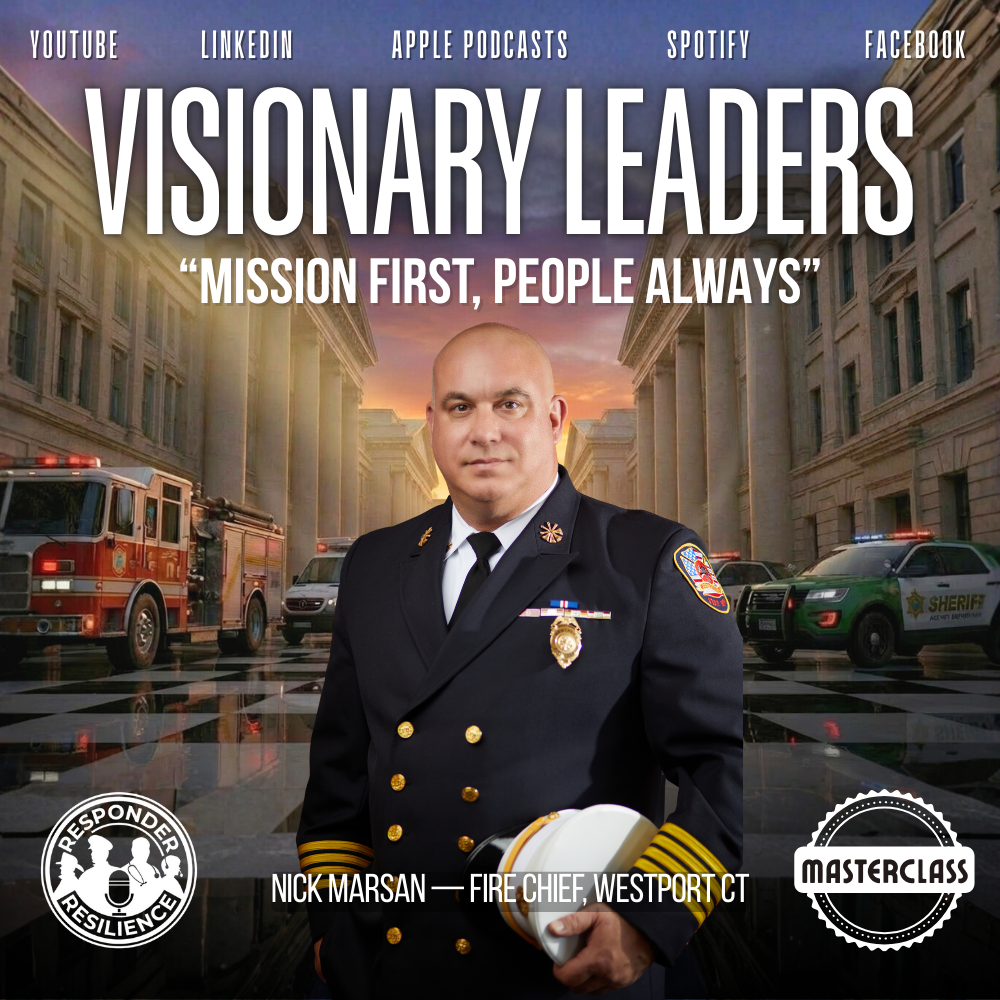
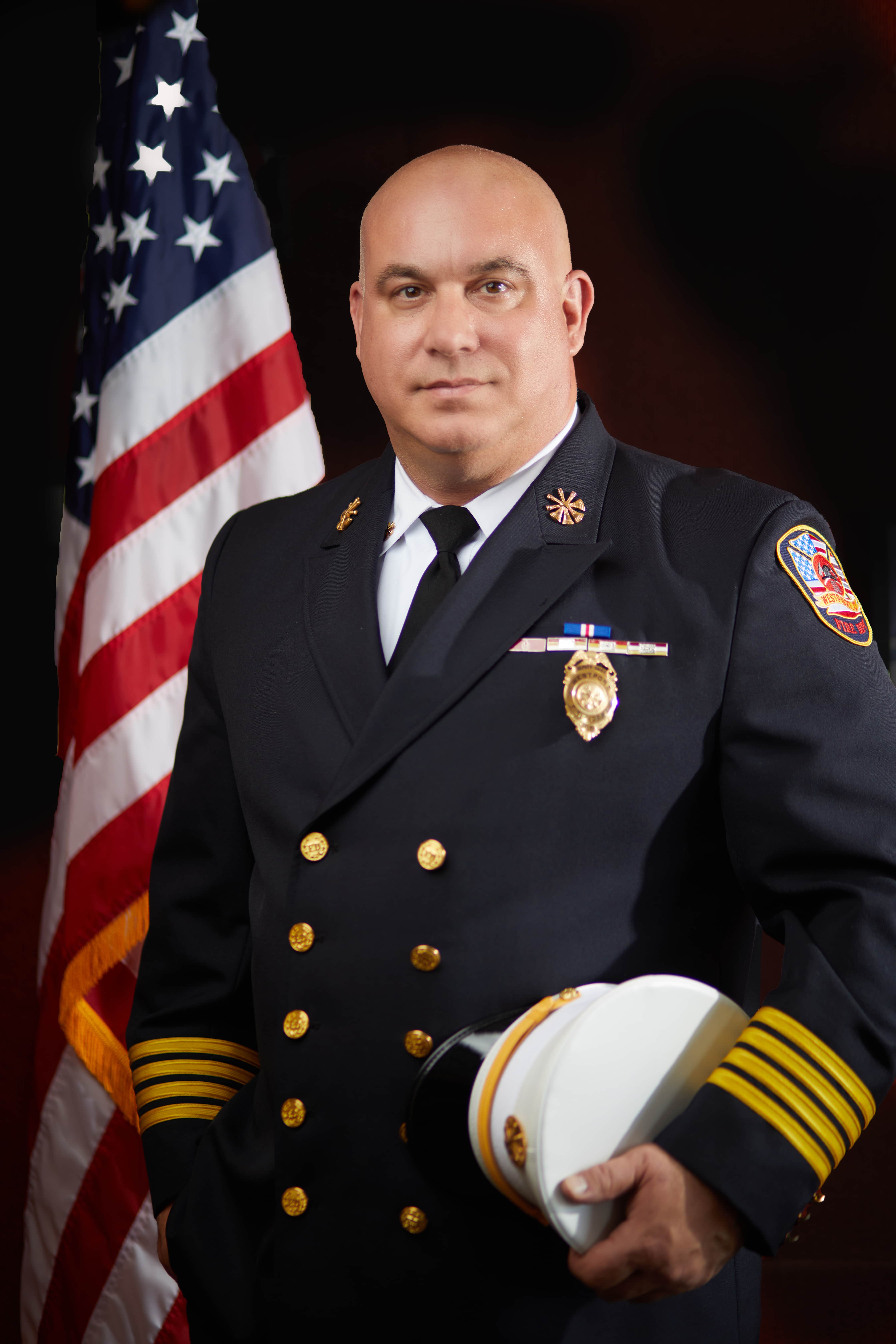
We want to welcome Fire Chief Nick Marsan.
00:02:56.319 --> 00:03:01.680
He's a public safety professional and veteran serving the Westport Fire Department since 2007.
00:03:01.840 --> 00:03:09.599
He's a state certified fire marshal and EMT and nationally certified at the Fire Service Instructor 3 and Fire Officer 3.
00:03:09.840 --> 00:03:19.520
His career includes assignments as Lieutenant and Fire Inspector and 10 years as the union president of the Westport Uniformed Firefighters Local 1081.
00:03:19.840 --> 00:03:25.120
Marsan holds two master's degrees in history and public administration, emergency management.
00:03:25.280 --> 00:03:26.400
He's a veteran of U.S.
00:03:26.479 --> 00:03:27.919
Army and the National Guard.
00:03:28.159 --> 00:03:31.919
He deployed in support of Operation Enduring Freedom in 2010.
00:03:32.080 --> 00:03:34.240
Chief, welcome to Respond to Resilience.
00:03:34.719 --> 00:03:35.520
Great to be here.
00:03:35.680 --> 00:03:36.479
Thank you.
00:03:37.360 --> 00:03:44.560
Chief, we've been blessed, David and I both to know you in the first responder world locally here in Fairfield County.
00:03:45.120 --> 00:03:54.159
And now we feel really, really fortunate to have you on the show to be able to talk about leadership and psychology and all the things that we want to tackle with you.
00:03:54.319 --> 00:03:56.879
So thank you for your service in the military.
00:03:57.280 --> 00:04:02.800
Thank you for being our brother, um, not only in the first responder world, but in this work too.
00:04:03.680 --> 00:04:04.479
Thank you.
00:04:05.360 --> 00:04:06.240
You're welcome.
00:04:06.479 --> 00:04:06.879
Right.
00:04:06.960 --> 00:04:08.560
So I'm I'm always eager.
00:04:08.719 --> 00:04:10.000
I want to jump back in.
00:04:10.240 --> 00:04:13.840
So it looks like you got hired back in 2007.
00:04:14.080 --> 00:04:14.639
Is that right?
00:04:15.039 --> 00:04:15.439
Yes.
00:04:15.599 --> 00:04:18.319
I uh joined the fire service in 2007.
00:04:19.040 --> 00:04:19.439
Great.
00:04:19.600 --> 00:04:23.680
And from our understanding, you rose to the ranks pretty quickly.
00:04:23.920 --> 00:04:26.399
Um so walk us through that.
00:04:26.560 --> 00:04:31.920
Walk us through the beginning of your career and then jumping up into that leadership role.
00:04:32.639 --> 00:04:33.199
Absolutely.
00:04:33.360 --> 00:04:39.680
I, you know, I when I joined in 2007, I um I found the fire service, or the fire service found me.
00:04:39.759 --> 00:04:46.800
And I was I was kind of uh a rudderless ship for a little while when I got out of the military because there was there was something about it that I was missing.
00:04:46.879 --> 00:05:03.439
And at the time I probably couldn't articulate what it was, but it's certainly the the the family, the family environment of the fire service that you know the camaraderie, the um putting others before self um is really what what found me and I found it.
00:05:03.680 --> 00:05:21.759
So I started in 2007, and um I think probably my you know my my most important and the most informal leadership role was um being elected union president um very very early on in my career.
00:05:22.000 --> 00:05:27.519
Um I started as a treasurer and then I was actually nominated by the outgoing president to take over.
00:05:28.079 --> 00:05:51.279
And that gave me great opportunities to to really be a uh a voice for my brother and sister firefighters um and able to say things that they probably couldn't say, um, and to to get to people that they couldn't get to to talk about um the things that that the resources they would need to be able to do their job well and safely.
00:05:51.600 --> 00:05:54.879
So I did that for uh for 10 years, as you mentioned.
00:05:54.959 --> 00:05:58.480
Um in the seventh year of that, I actually got promoted to lieutenant.
00:05:58.560 --> 00:06:08.000
Um, excuse me, first I was in the fire marshal's office, and then um realized that coming to work Monday through Friday wasn't the wasn't the most fun.
00:06:08.079 --> 00:06:11.199
So I went back on the line and I got promoted to lieutenant.
00:06:11.439 --> 00:06:15.680
Um and lieutenants was a role I really loved.
00:06:15.839 --> 00:06:18.160
Um, David, I you know what I'm talking about, right?
00:06:18.240 --> 00:06:20.079
You're you're you're there, you're a working boss.
00:06:20.160 --> 00:06:21.759
You're the best job in the department.
00:06:22.079 --> 00:06:23.759
Absolutely, absolutely.
00:06:24.160 --> 00:06:34.319
And then um I very unexpectedly and very rapidly was was offered the position of deputy chief of the department, um, the number two spot.
00:06:34.720 --> 00:06:45.839
And I I did what was best for my myself and my family, and I took that position, but I wasn't something I was prepared for or working towards at that moment.
00:06:46.160 --> 00:06:54.319
And um, so there was there was definitely some uh challenges uh that I had to to to work through with that, and we can talk about that in a minute.
00:06:54.720 --> 00:07:03.600
But um after that, there was another rapid and unexpected change within the department, and I found myself now as uh fire chief.
00:07:04.000 --> 00:07:09.759
So here I am back to working Monday through Friday, as well as nights and weekends.
00:07:09.839 --> 00:07:34.639
So I'm doing a little bit of both, but um, you know, it's as I mentioned, it was a it was a tough transition for me because the same thing that that uh you know made the fire service attractive, the the ability to put others before self and do things that not everybody would be willing to do to help people in their times of need, um, that was what got me up every day, right?
00:07:34.720 --> 00:07:39.120
And it also was something that kept me one step ahead of some of the things that I was dealing with, right?
00:07:39.199 --> 00:07:48.319
That almost full bucket um from the military, from my childhood, from you know what I've seen and done in the fire service.
00:07:48.480 --> 00:07:56.560
Um, being on the line, I think sometimes gives you an opportunity to be one step ahead of some of those things, but they're there, they don't go away, right?
00:07:56.639 --> 00:08:02.800
They're there and they they linger, and that one drop that you don't know is gonna tip that bucket over is really the thing.
00:08:03.360 --> 00:08:18.800
Um when I came, this the change was significant enough for me that it really became a mental health crisis for me to um to have to transition into a role where you know I wasn't on the line doing the things with the people that I love the most.
00:08:19.040 --> 00:08:25.199
Um and it was it was a tough transition, but I've got to a point where I am still helping people.
00:08:25.279 --> 00:08:36.399
I'm just doing it kind of vicariously through the people that I work with and work for, and make sure that you know I'm really their advocate to fight for what they need to do their job successfully.
00:08:36.639 --> 00:08:45.840
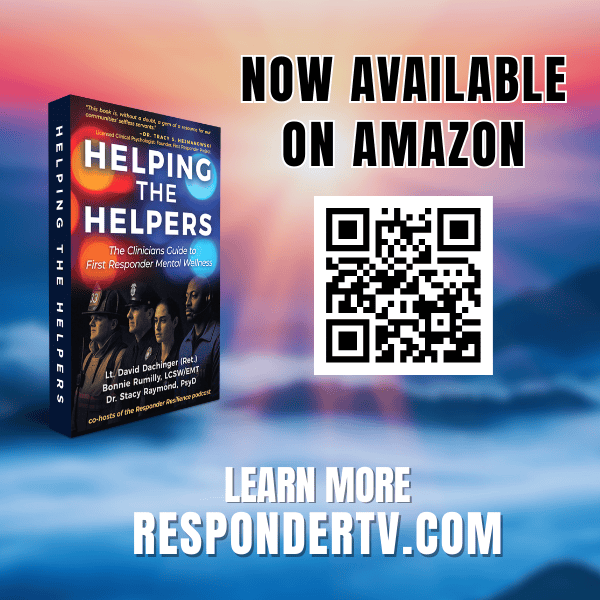
You're trained to help people heal, but first responders, they carry trauma that's buried under silence, stigma, and stress.
00:08:46.159 --> 00:08:54.159
Helping the helpers gives you the framework to connect, to speak their language, earn their trust, and actually make an impact.
00:08:55.039 --> 00:09:01.200
From the experienced team and clinicians behind the Responder Resilience podcast, this isn't theory.
00:09:01.360 --> 00:09:04.639
It's real-world support for the ones who need you most.
00:09:04.799 --> 00:09:07.120
And this book isn't just for clinicians.
00:09:07.279 --> 00:09:19.440
If you're an agency leader, peer support team, chaplain, EAP, wellness program coordinator, or family member, helping the helpers will equip you with the tools, language, and insight to make a difference.
00:09:19.759 --> 00:09:22.240
Be the resource they can count on.
00:09:22.639 --> 00:09:26.399
Order your copy of Helping the Helpers on Amazon today.
00:09:35.039 --> 00:09:38.399
Yeah, Chief, uh, there's a lot to unpack in what you just talked about.
00:09:38.639 --> 00:10:00.720
I think it's so important because there can be this huge disconnect or maybe misunderstanding of what it's like to be up in that, you know, Ivory Tower as the white shirt now, um, for the people who are still boots on the ground and understanding what you may have gone through uh making that transition, as we were saying earlier before we started recording, it's almost like a retirement of sorts, right?
00:10:00.799 --> 00:10:07.919
There's a loss of that um of that tribe and mission that we have when we're running the calls and doing the 24-hour shifts.
00:10:08.159 --> 00:10:10.720
So for you, um what was that like?
00:10:10.879 --> 00:10:18.399
How did you, you know, how'd you find your path once you um you're up in that office now, not running out on every 911 call?
00:10:18.480 --> 00:10:19.440
What was that like for you?
00:10:19.759 --> 00:10:22.960
Well, I I had to redefine my purpose.
00:10:23.200 --> 00:10:31.200
Um you know, when you're when you're responding in a fire engine to to emergencies, your purpose is pretty clear, right?
00:10:31.759 --> 00:10:44.639
So I had to I had to really reflect and and and and define what purpose was for me now and and and how do I make sure that it's profound enough to to satisfy my need to serve.
00:10:45.120 --> 00:10:52.320
Um you know, as I mentioned, it was a it really it was like a a rapid and unexpected retirement in a lot of ways.
00:10:52.559 --> 00:10:58.480
And a lot of the things that I was staying one step ahead of really kind of came to the surface during that time.
00:10:59.360 --> 00:11:13.600
And it was a very well I'll shout out to the Fairfield County trauma response team that it was really um, you know, the people I work with there that that helped me kind of flatten the curve of that of that transition.
00:11:14.480 --> 00:11:38.240
Um you know, and I uh I as I had mentioned to you, David, before, and I think that it's worth mentioning, this is kind of segue into like why I think leadership has such an awesome opportunity to like really take care of their people when it comes to mental health, is when I first used to go to my therapist, I'd ask for really early morning hours and I would park up the street and text her first, is it all all clear?
00:11:39.120 --> 00:11:48.159
And it wasn't because I was ashamed or embarrassed of seeking mental, you know, mental health, um, you know, therapy.
00:11:48.480 --> 00:12:05.279
It was more that I didn't want, and I was very cognizant of the fact that you know firefighters and and and other first responders when when they when they make that brave decision to say, hey, I need help, um, it it's it could sometimes be a very private and a very difficult decision to make.
00:12:05.679 --> 00:12:12.159
And the last thing I would want a brother or sister firefighter to see is a white shirt walking through the door of their therapist's office.
00:12:12.720 --> 00:12:17.919
Because I that's their that's their place to go to to unpack some of this stuff.
00:12:18.000 --> 00:12:21.600
That's their place to really do the work, right?
00:12:22.320 --> 00:12:26.080
Um, so that was that was my thing, and I I I was okay with that, right?
00:12:26.240 --> 00:12:36.480
In my mind, I say, all right, I'm not embarrassed, I'm okay to be here, I'm not, I would never deny that I go, but I really want to, you know, make sure that there's boundaries for the people that that would be uncomfortable with that.
00:12:37.279 --> 00:12:57.919
Probably about six months into my my therapy and uh working with the MDR and unpacking stuff from long before I was in the fire service, unpacking stuff that I did and had to do in the military and unpacking the stuff that I was helpless to change the outcome in the fire service.
00:12:59.200 --> 00:13:06.240
One day I was walking out of my therapist's office and there was a young firefighter um in the lobby.
00:13:06.879 --> 00:13:12.879
And you know, I would always take my shirt off and go in my t-shirt, you know, so I could at least have some type of.
00:13:13.519 --> 00:13:16.159
I mean, you see this big dogging around, you know, you know who I am.
00:13:16.240 --> 00:13:31.840
It's not like I can hide that well, but and I I was getting ready to walk by this young guy, and I stopped and I just I looked at him and said, hey brother, it's really good that you're here.
00:13:36.639 --> 00:13:58.799
And as I walked out of the office that day, they hit me that part of my purpose is to really prioritize um my people's mental health as much as I prioritize the equipment that they they uh drive around and the equipment they put on their their bodies to protect themselves.
00:13:59.039 --> 00:14:08.080
So that was a really really eye-opening and and and and wonderful moment that my purpose could be chiseled away just a little bit more and a little bit more specifically.
00:14:08.240 --> 00:14:09.120
So yeah.
00:14:09.279 --> 00:14:10.080
So here we are.
00:14:10.559 --> 00:14:11.519
Thanks for sharing that.
00:14:11.600 --> 00:14:24.240
I think that is uh so important and impactful for people here, especially um you know, administration who uh are you know wondering why should I buy into uh mental health for my people?
00:14:24.399 --> 00:14:26.159
Like, you know, how do I do that?
00:14:26.320 --> 00:14:31.120
How do I navigate being the leader and in advocating for mental health?
00:14:31.200 --> 00:14:37.279
Like, and you have modeled that in an incredible way for uh anybody that's you know under your leadership.
00:14:37.360 --> 00:14:38.720
So thank you for that.
00:14:39.440 --> 00:14:40.399
Thank you.
00:14:41.120 --> 00:14:47.759
Well, I've had the pleasure of getting to know you through the team that you were speaking of, the Fairfield County Trauma Response Team.
00:14:48.080 --> 00:14:58.159
And from the day I first met you, I could see that you were living the example that we want to set forth for all of our brothers and sisters.
00:14:58.399 --> 00:15:04.639
And that's obviously our goal with every first responder we see and that we help.
00:15:04.960 --> 00:15:16.080
But when we see chiefs, leaders getting comfortable with doing what you just did here, which is ultimately sharing your story and showing vulnerability.
00:15:16.399 --> 00:15:22.480
You give so many people permission to do that, and we can't even measure how many people.
00:15:22.720 --> 00:15:31.679
It's not the one guy in the office that day, it's every single person that listens to this podcast, and you can't measure that ripple.
00:15:32.240 --> 00:15:48.879
And I think that's what we all love about our work is that when we see someone like you call in to do all the right things, it doesn't mean that we're perfect, but you're always putting them first, and that's what David and I want to see more of leadership.
00:15:49.039 --> 00:15:58.240
We want to see that yes, we want leaders to take care of themselves like you're also illustrating, because um, in order to take care of everyone else, you have to be able to take care of yourself too.
00:15:58.480 --> 00:16:07.120
And it sounds like that was part of your lesson that you had to bump up against that within yourself a hundred percent, a hundred percent.
00:16:07.279 --> 00:16:25.679
And I you know, how could I how can I grant permission, so to speak, for people to be comfortable with reaching out for for you know to to work on their mental health and their healing if I'm not willing to show that I prioritize it as well, and and it's just not you can't just fake the funk, right?
00:16:26.320 --> 00:16:34.639
If you know I want my vulnerability to be a source of strength for my people, you know.
00:16:35.120 --> 00:16:38.559
Um that's you know, I I could set an example.
00:16:38.879 --> 00:16:50.799
My there's no policy I could ever write that's gonna change the culture um that we're we're we're evolving from in the first responder world, but behavior could change culture, attitude could change culture.
00:16:51.120 --> 00:17:00.799
So I want to model my own vulnerability because if I don't, how could I expect that young man in the office to be able to show it, you know?
00:17:01.120 --> 00:17:02.559
So definitely.
00:17:03.039 --> 00:17:08.400
She fulfilled a promise that was made to her husband and donated his organs so others could live.
00:17:08.559 --> 00:17:11.200
Five lives were saved in the process.
00:17:11.839 --> 00:17:15.759
He always did what was better for other people instead of himself.
00:17:16.000 --> 00:17:18.160
I would definitely consider my dad a hero.
00:17:18.480 --> 00:17:20.799
Getting the word out there, you're saving lives.
00:17:21.039 --> 00:17:26.000
Actually, their help helped my parents to be able to get me a car so I could definitely get to dialysis.
00:17:26.319 --> 00:17:28.240
I heard about you, and I'm gonna help you.
00:17:28.400 --> 00:17:30.000
They saved my life.
00:17:30.319 --> 00:17:32.880
Be a forever hero, donate life.
00:17:33.759 --> 00:17:43.759
Let's uh circle back to that whole transition piece about you know now finding yourself in that uh chief's office after serving on the line for you know quite a long time.
00:17:43.920 --> 00:17:55.759
Um, how do you kind of recalibrate and channel that helping um you know, the helping desire and urge and you know motivation that we have to help people on those 24-hour shifts on all the 911 calls?
00:17:55.839 --> 00:18:07.759
And now being in the administrative role, but also now you are, as you've alluded to, serving the people within your agency, but also the community that the fire department serves.
00:18:07.920 --> 00:18:10.240
What is that, what did that look like for you?
00:18:10.799 --> 00:18:11.839
It's well, it's funny.
00:18:11.920 --> 00:18:16.880
I I was just thinking of a moment where you know, we used to joke because you know, gallows humor, right?
00:18:17.039 --> 00:18:29.519
And uh even in the military, this was a joke from the military, but we're like, wow, maybe a good proportion of PTSD is just realizing it'll never be this cool again, you know, as we're all in our battle rattle and everything else.
00:18:29.599 --> 00:18:38.799
And I I think that you know that that that transition kind of you know, it was that same kind of thing, like, oh my god, like there's that sense of purpose, that sense of belonging.
00:18:39.200 --> 00:18:58.559
What I kind of do to really kind of you know, um really kind of push forward with the narrative and the story that hey, it's okay um to to seek help, it's okay to say you're feeling vulnerable, or you know, or the bravest thing that we can do sometimes in this brave world we live in is to ask for help.
00:18:59.039 --> 00:19:10.480
Um I remember reading a book on on leadership from Abraham Lincoln, and um one of his his uh components was leadership by wandering around, right?
00:19:10.640 --> 00:19:20.079
Like, really like get out of this tower and get downstairs and have a cup of coffee and ask how people are doing and look them in the eye when you ask them.
00:19:20.559 --> 00:19:24.559
You know, get to know their family, ask about their family, how are they doing?
00:19:24.799 --> 00:19:38.160
Um whenever I have the opportunity to discuss that it's okay to not be okay, and that there's things we could do to help address that, whenever I get the opportunity to discuss it, I do.
00:19:38.640 --> 00:19:45.440
Um whether it's an email to the department because it's Christmas time and I want to let them know I'm thinking about them.
00:19:45.759 --> 00:19:52.079
When it's if I if I show up with with cookies on Christmas morning, it's you know another opportunity.
00:19:52.400 --> 00:20:01.279
I look at the call list from the night before, and you know, you you do it long enough, you know which calls, you know, that it might be worth a phone call.
00:20:01.359 --> 00:20:02.640
Hey, how you guys doing?
00:20:03.279 --> 00:20:12.960
Another way I do it, um, and I'm really, really proud of this, is um our peer support team here at the fire, uh, Westport Fire Department.
00:20:13.200 --> 00:20:21.839
Um, first of all, the the the the people who are actively involved in that are some of some of my heroes.
00:20:22.079 --> 00:20:25.279
Um and wow, what a great opportunity.
00:20:25.519 --> 00:20:27.039
All of a sudden I have the I have the pen.
00:20:27.119 --> 00:20:34.079
I get I get the like magic control of the budget, which is whoa, I don't know if they want to do that because I haven't balanced my checkbook in 25 years.
00:20:34.400 --> 00:20:42.559
But but you know, when the peer support team came up to me as we were developing, like, hey, what are you know what what's our policies?
00:20:42.720 --> 00:21:03.440
What could we do um to you know to to like help this this team grow and and make it attractive for people to either join or to you know ask for help through well you know what I have a I have a dive rescue team, I have a technical rescue team, I have you know confined space technicians.
00:21:03.920 --> 00:21:06.640
My peer support team is a specialized team.
00:21:06.960 --> 00:21:17.920
And if they get deployed, whether it's in-house or with others in the first responder community, I I treat it as a deployment of my special team.
00:21:18.240 --> 00:21:22.160
And I make sure that they're protected, you know, uh workers comp-wise.
00:21:22.240 --> 00:21:29.119
I make sure they're compensated, um, and and that that that's that's I'll hire back for them if that they get called to that.
00:21:29.200 --> 00:21:42.880
Like there's I don't I don't differentiate, you know, uh other than the fact that you know it's just another type of injury that's being addressed and and and you know the rescue efforts are beginning.
00:21:43.200 --> 00:21:56.799
It's just a it's an invisible injury, but it's an injury, and it needs to be it needs the you know, the people that are willing to put in the work to learn how to help help those those people, you know, find the right support networks and resources.
00:21:57.359 --> 00:21:58.000
Absolutely.
00:21:58.240 --> 00:21:59.759
So I I love that I'm able to.
00:22:00.160 --> 00:22:00.720
to to do that.
00:22:00.799 --> 00:22:05.759
I'm you know again that that's the uh one of the perks of of being in this position.
00:22:05.839 --> 00:22:19.359
I can make those calls and I stand by that call and I I talk about that whenever I can when I'm in circles with other people with controller checkbook and hopefully hopefully that's a positive influence on them as well.
00:22:19.759 --> 00:22:29.759
You've said a couple things um that I want to highlight and for our listeners I think it's important for them to understand the possibilities of leadership.
00:22:30.000 --> 00:23:02.960
If a leader is up to the task a chief is up to the task of doing two things that you've said one of them is checking on the people checking the people before you check the gear okay there's a habit we have you know no one wants to go on that call when the tones drop and we're missing a piece of equipment nobody but if my head isn't in the right place I'm not gonna use anything in that medical bag properly and just like your guys aren't gonna use any piece of their fire apparatus properly if their head is not in the right space.
00:23:03.200 --> 00:23:12.480
So what you're saying about checking on each other before we check equipment it's really important and it's really good that you're highlighting that.
00:23:12.640 --> 00:23:57.599
And the second thing is treating those peer support treating the people that are going to respond to the mental health that is a fire so to speak it's a different kind of fire and I I love this idea that you're sending out a specialized team to focus on that too and I'm blessed to know some of those peer support team members they work closely with our team uh to get people help and I can't say enough all the things you're saying are absolutely true and right um and these examples I hope that listeners can listen to and say you know what one day even those people that have little thoughts of promoting one day one day I'm gonna remember what that chief said and I'm gonna do that.
00:23:58.160 --> 00:24:11.440
And I think our fire service our EMS world our police world all of our branches will look better one day if everyone heats that advice I I would I hope that that's the direction that we're going in.
00:24:11.599 --> 00:25:36.720
Um I I was talking to David earlier that I stole a uh a little mantra that I learned in the military um mission first people always and people have asked me for years like what does that actually mean right and uh to your point Bonnie like it means that you know we come we come here because we're here to respond to to people's worst days right and to help them through that um sometimes we do that um well sometimes the outcome is outside of our control but that's our mission right we're here to to put out fires all types we're here to help people in their time of need the people always part is I need my people to to be as you mentioned where they need to be to be able to accomplish their mission right um so if I can't be on the engine actually responding to the calls I can make sure that my people have what they need so they can be on that engine responding to those calls in a way that's going to help the person that they responded to and in a way that's going to help them get back home to their loved ones all in one piece mentally emotionally spiritually physically as firefighters and first responders we're brilliant at the basics we master the art of stretching the line and we excel at being there for those who need us most yet even the best of us can be caught off guard.
00:25:36.880 --> 00:26:18.960
We sometimes face unexpected challenges like injury cancer or post-traumatic stress attacks but you're not alone the first responder center for expectative resources you need to stay prepared optimized your performance information medical evaluation medical health awareness at cardiac health we've got you covered remember we're stronger together discover more at firstrespondercenter.org and connect with us on X, Facebook, LinkedIn Instagram and YouTube.
00:26:19.440 --> 00:26:53.680
The First Responder Center for Exploits equip yourself with Exploits for every call let's talk a little bit about the practical realities of this um because as we know just to deliver the services that our communities need we need to be fully trained in so many different areas um whether it's fire EMS, both rescue as you've mentioned some of the specialties confined space um it could be any number of things which takes a huge chunk of time in our time at at work when we're not running calls.
00:26:53.920 --> 00:27:01.519
And it costs money right to equip the apparatus and to train everybody and do what we need to do to be fully operationally ready.
00:27:01.759 --> 00:27:22.000
So how do you accomplish the mission of adding mental health into that piece into the the budget and the time you know the the time that we have to train how do you work that piece out I'm I firmly believe David that to not make that part of your day is irresponsible.
00:27:22.319 --> 00:27:37.839
I think that um it it's it's got to be a priority because those other things are not going to get touched on in you know with a with a full and clear head um you know be able to retain to be able to to do all those things to be specialized in our field.
00:27:39.039 --> 00:27:53.519
I think that I'm you know it's at a point where if you don't have some type of focus and prioritization of our firefighters mental health then we are we're we're not acting as responsibly as possible.
00:27:55.039 --> 00:28:08.880
And that's it it's it's it would be counterproductive for our mission if we weren't able to to make sure that they have all the tools they needed to succeed on the fire ground and and and within themselves.
00:28:09.200 --> 00:28:13.680
So it costs a lot more to not have those things.
00:28:14.400 --> 00:28:52.000
And we talked about that too right what what's it you know if if the if someone down the street you know the elected officials want to know what's what something's gonna cost what's it going to cost to make sure that your people are are given the tools they need to to to be emotionally and and mentally resilient well then my question to them is what do you think it's gonna cost if we don't I think it's a good question to put back and you're one of those people that pays attention to statistics and trends I think in your field and you see the suicide rates that we're facing among first responders.
00:28:52.160 --> 00:28:59.599
I think for the first time recently we're seeing that number starting to turn around thankfully what do you think about that?
00:28:59.839 --> 00:29:56.079
What what can you say to some of the people listening about those stats and what that means to us on the day-to-day basis well I think that you know any type of traumatic experience has has a has a really heavy effect on us and if it's one of our brothers and sisters who how somehow we we we didn't see the signs right we're what we're gonna what are we gonna do first Bonnie is we're gonna see all we're gonna reflect on all the ways that we failed our brother or sister and that has a that has a um and not in a good way kind of a negative ripple effect where you know when you we start to question ourselves on outcomes and you know we're we're we're the toughest people on ourselves there's no there's no politician out there that's gonna be tougher on a firefighter and what they bring to the table than that firefighter is going to be to themselves.
00:29:56.160 --> 00:30:09.920
And if and if one of our brothers or sisters figured out a way to complete something so tragic in our in our midst um you know it it's gonna it's gonna be something that's gonna be very difficult to heal.
00:30:10.000 --> 00:30:34.480
It's gonna be a you know schism that's gonna be hard to get across um so you know you know again I mean it's a very real thing right we could we could talk about numbers and sometimes there's people I have to deal with in my line my part of the job that they they want to hear the numbers right they want to know the facts and there's nothing that we're saying here that's so anecdotal that I could not make it concrete with with the facts.
00:30:34.720 --> 00:31:17.279
And you know the the cost the mental and and and emotional cost of of not staying ahead of these things is uh is much more detrimental than any any type of capital or operating cost that that we need to make to sure that it it happens correctly piece that I'm always interested in is how do you uh communicate with and empower your company officers to kind of um work with the people that are under their command and supervision in a way that they're they've got a pulse they're able to recognize maybe when someone's struggling then how do you give them the resources to act when they have that situation?
00:31:17.920 --> 00:32:23.440
Well you know I as the chief am ultimately responsible right but I don't operate in a vacuum or on an island and my command staff and my officers and my firefighters know that checking on each other is a standing order right you that mission first people always that's whether they like it or not that's our driving mantra that's our driving thing and that's that's that's something that has to happen in my absence right it has to happen as a cultural kind of movement it has to it kind of has to move on its own and I I think that you know when when I meet with my leadership teams you know how are your people how are we taking care of our people how are they doing you know that they they know you know culturally they know the questions are coming so they're they're they're they're better served that be ahead of it with the answers and just by doing that and just by wanting to know right um you know I want you can't see my office but I I try to make it as comfortable as possible.
00:32:23.519 --> 00:32:25.599
First of all I spend way too much time in it.
00:32:25.759 --> 00:32:59.920
But second of all like I want I want my leadership team to come in here and my firefighters if they need to and sit down and be able to talk you know real talk real talk about this is what you know I'm struggling with as a leader or this is what my I think my my people are struggling with this this is a tough call they went on this is a family member that they lost you know anything that could give us opportunities to to pay them maybe just a little bit more attention or to make sure that we're we're kind of wrapping our arms around our people um you know that's that's the standing order.
00:33:00.880 --> 00:33:06.480
And that's where that you know people always right so I I want to see that and I expect it.
00:33:06.720 --> 00:33:18.319
I've as a as a chief I think I do a fairly good job of making sure my expectations are very well articulated and very well understood and and the first one's always about our people.
00:33:20.160 --> 00:33:25.039
Great mantra it's just amazing and I think everyone should follow it.
00:33:25.119 --> 00:33:37.759
Obviously David and I are biased we're pushing this message every day but we have more people pushing that message and buying into it the way you are um it really will make the future better for all those people learning now.
00:33:38.400 --> 00:33:43.119
You had mentioned before about the book Tribe by Sebastian Unger.
00:33:43.519 --> 00:34:45.440
For those listeners and viewers who haven't read it I've read it it's a phenomenal book um that idea that we all need to belong to a tribe can you share why that book and why that concept really touches you as an individual and then how you apply it at work absolutely how things all kind of happen in a in a way you can look back at it one day go, wow the universe really kind of brought all these things together right you know I knew Sebastian Younger from um a book he wrote about his time as an embedded journalist in Afghanistan um uh movie Restrepo's based on it so I was familiar with him and it just turned out that very shortly after I became a department administrator he was on a book tour for tribe and he was talking about it in Hartford and and I I went and just just because more when I'm not doing all this fire fight and stuff I also write so for you know to go to hear an author talk is great.
00:34:46.800 --> 00:35:34.880
But the message of the book is that this this sense of belonging this sense of of tribe the sense that you know a lot of these these challenges we face these mental health challenges these injuries that we we try to heal um are almost um magnified by when you're outside of the your tribe right and I and I think to that point like maybe that had a lot to do with my crisis my existential crisis moving away from my tribe um so the the the the timing of the book is was spot on right the universe but you know that message that you know these things that we we try to heal from um w without without our without the people around us is is really really difficult.
00:35:35.039 --> 00:37:45.360
And I you know he talks about um people being more bonded and and and more you know um able to kind of work in in a in a way that is you know is during times of crisis right when and it's when you're when you're not in that moment and you're and you're you got a lot of time on your own it's where these things really start to kind of you know pop up and you don't have that you don't have that that sense of uh purpose and belonging that you have inside of a group and I think that you know in our line of work that's such an important part of it and I you know and I and I and I hope that my hope is that you know our brothers and sisters in the police and EMS world you know are are you know take take that into account I know sometimes they don't have the they might have a little bit more isolation uh from others that than we do in the firehouse um but and I tell them all the time our door is always open and the coffee's always on and our we have the cleanest bathrooms in town so stop by um you know but I I think that that idea that um there's nothing out there that we need to kind of face on our own and you know the more that we realize that the bravest thing we could do is ask for help and we could we could participate in in discussions that are normalized um that you know this idea of mental health is normalized and and it it becomes part of our tactical athlete mindset right we talk about making sure we're physically ready but what about you know what are we doing to be to to make sure that our brain is is ready uh our mental conditioning is ready right because if we have that faulty equipment it's gonna it's gonna kind of bleed over into other other things we do and you know the idea of our you know maintaining our equipment well then how are we maintaining our ourselves is it through you know you know what what's the what's the story that we want told inside this firehouse that's gonna be able to stay with someone when they're not here to know that they're never alone and that it's okay to not be okay and we are here for our people and for each other.
00:37:46.559 --> 00:39:20.400
Well chief we have covered a lot in uh this last 30 minutes or so is there anything we haven't talked about that you'd like to dive into well I think yes I think one of the things that I want to mention and I think I you know again I I'm spoiled with the Fairfield County trauma response team and I'm spoiled with this great peer support team you know right here in inside these four walls but you know we're not Westport's not on an island right we're not a siloed kind of venture here um trauma doesn't know town boundaries you know it's important that us chiefs realize that you know this is not something that has to be addressed alone right I think that there's a there's a certain unity in and in strength and some type of community based you know resilience uh that goes beyond just our the municipalities we work for right there's there's plenty of other places where we could bring all those resources together and it just helps everybody um so I want to say that and then I also encourage I mentioned before that I write I want to encourage my brothers and sisters out there to to don't be afraid to find some creative outlet for processing their grief or their trauma.
00:39:21.360 --> 00:41:04.639
There's there's so many ways to like get that out and you don't even realize you're doing it and it's once it's out there again it becomes something that you know you can look at and reflect on and realize that hey you know this is a good time for me to to get some help and you know I think that's therapeutic and I always encourage people to to tap into their creative selves um as an outlet for some of the things that you know we we try to be so stoic about um sometimes stubbornly so and then there's that one drop that makes it all pour out so great yeah great great strategies and wisdom I love what you said about trauma knows no town lines um where we are for our listeners and viewers where we all work in Fairfield County Connecticut it is very siloed you know we we are very much you know town based and every town's a little bit different in what the first responder landscape is and I really love you spotlighting that because if one chief could help another chief with resources why wouldn't we do that when we're having chief meetings or town to town we have regional meetings we have state level meetings these conversations need to be had at that level because what you're doing can be replicated and we could all help each other just make it easier no one like you said that's a tribe too and no one has to try to figure that out alone so I love knowing that you're a resource there also for chiefs who may want to reach out and say hey I'm really struggling with this what do I do and I think it's it's just another way that you are evolved in your thinking and I I really appreciate it.
00:41:04.719 --> 00:41:22.719
I almost said mic drop before when you finished that because what you said it was just it was like here it is here's the truth here's how it should be end of story and and honestly um that's why my hat is off to you and I I'm so inspired whenever I speak to you.
00:41:22.800 --> 00:41:23.840
So thanks for that.
00:41:24.159 --> 00:42:05.840
Thank you Bonnie and if you have to you know production headed want to put a little mic job on here you go let's get on it David we got it uh chief this is uh I can't express how amazing it is to have this conversation with you um partially because you know sometimes we we do this job under suboptimal conditions and sometimes that's our leadership and um when we talk to someone like you who is changing the game who's completely open to doing it different than we've traditionally done it before um I can't tell you how inspiring that is and how impactful that's going to be to people who listen to this.
00:42:06.639 --> 00:43:47.360
It's so exciting we're kind of entering a new era with this type of thing where uh the chiefs who are now coming up are pro-mental health um willing to share their own personal journey in a way that's gonna help other people feel more comfortable um seeking help themselves so thank you so much for being here and sharing your story with us thank you for giving me this opportunity to talk about it um it's important thank you thanks for your friendship and thanks for your leadership same same thanks you for what you guys are doing and I have uh I have my book at home my my mom gifted me a copy of your book so uh I look forward to uh diving into that okay well um I was thinking of something we put in that book when you were speaking and um I wanted to make sure it was in there and that is um anecdotally a fire chief who I think maybe it was a police chief who told us on the podcast that they put their therapy appointment on the calendar where everybody could see it and I thought we have to have that in the book because that really embodies what leaders need to do in order to normalize mental health uh conversations so um if you're rocking it up thank you very much this has been great guys thank you remember like and subscribe YouTube responder resilience Facebook responder tv linkedin apple podcast spotify go to our website responder tv.com for past episodes and guest information until the next time stay safe be kind to yourself take care