Apple Podcasts
 Spotify
 YouTube
 RSS Feed
 The New Playbook for Increasing Resilience with Dr. Stephanie Conn | S5 E42
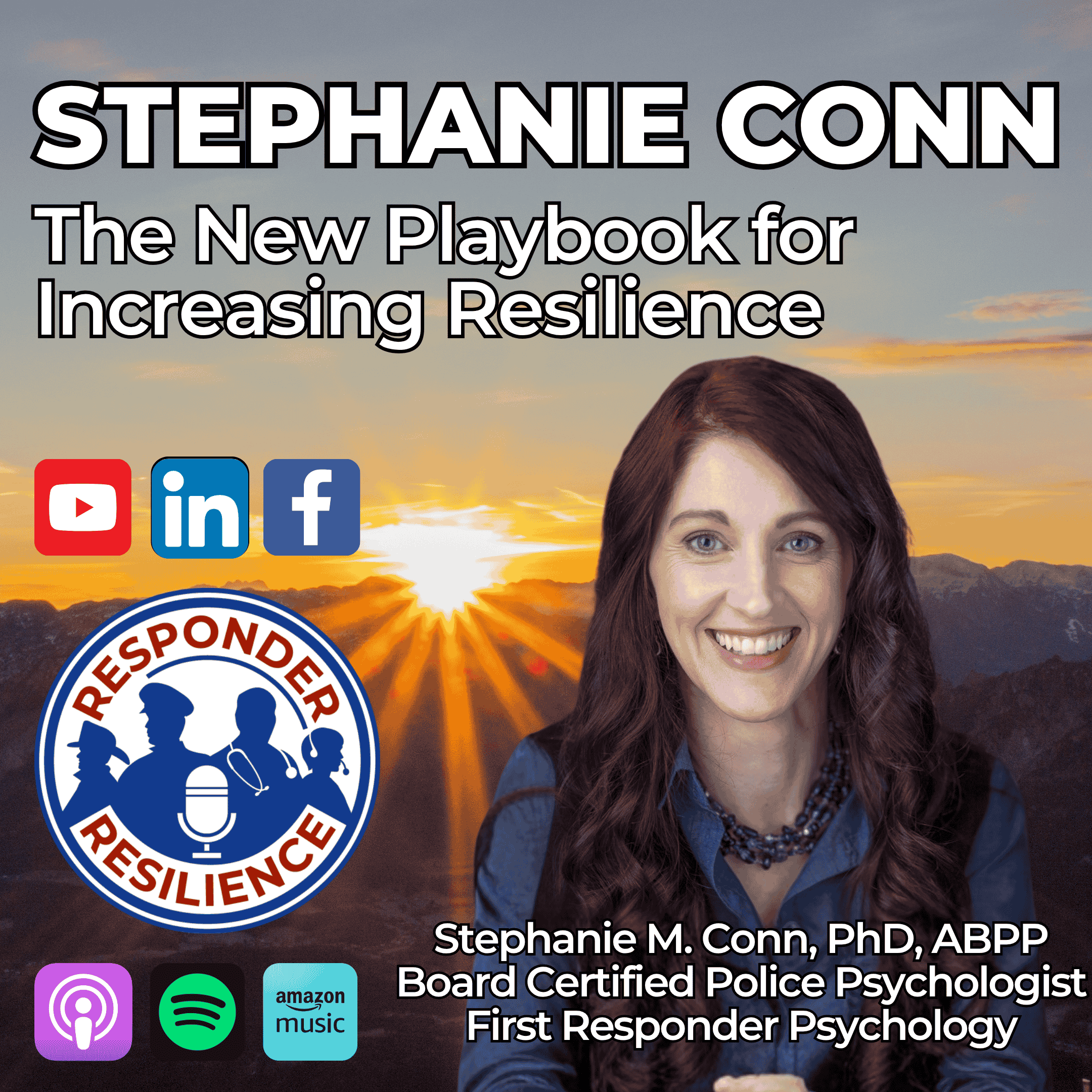
In this episode, we converse with Dr. Stephanie Conn, a leading expert in police psychology and resilience training for first responders. With nearly three decades of experience, Dr. Conn brings a wealth of knowledge to the table, especially from her newly updated book, "Increasing Resilience in Police & Emergency Personnel."
In this episode, we converse with Dr. Stephanie Conn, a leading expert in police psychology and resilience training for first responders. With nearly three decades of experience, Dr. Conn brings a wealth of knowledge to the table, especially from her newly updated book, "Increasing Resilience in Police & Emergency Personnel."
We explore groundbreaking topics like nervous system regulation, innovative peer support practices, biohacks, and the latest in sleep science—all aimed at enhancing performance under pressure. Discover how first responders can combat trauma, burnout, and moral injury in an ever-demanding environment.
Plus, we tackle the stigmas around wellness in the first responder community. How can we transform perceptions of meditation, breath work, and yoga from "woo-woo" to transformative? Buckle up for an enlightening conversation that blends science, practical strategies, and a unique perspective on the mental battles rescuers face every day.
Now available! Helping the Helpers: A Clinician’s Guide to First Responder Mental Wellness, our new book that equips you to build a First Responder-Centered Practice that works. Get your copy here: https://www.amazon.com/dp/1969267003
Go to https://www.respondertv.com/p/helpingthehelpers/ for more book info.
Thanks to our resource partner, First Responder Project, whose no-cost first responder retreats offer you a chance to reclaim connection and learn vital skills. Take a stand for your well-being and the connections that matter most. Learn more and register at FirstResponderProject.org
Thanks to our resource partner, CRACKYL. Download the FREE CRACKYL App: http://crackyl.respondertv.com
Thanks also to our resource partner, FightCamp. Harness the strength of boxing to release stress, build resilience, and connect with a supportive community. For free shipping and a free month of membership, go to https://joinfightcamp.com/shop/ and use the code RRPONE.
Contact STEPHANIE CONN:
Website: https://firstresponderpsychology.com
Facebook: https://www.facebook.com/FirstResponderPsych
LinkedIn: https://www.linkedin.com/in/dr-stephanie-conn/
Contact Responder Resilience:
Phone: +1 844-344-6655
Email: info@respondertv.com
Our website with past episodes and more: https://www.respondertv.com/
YouTube: https://www.youtube.com/c/ResponderResilience
LinkedIn: https://www.linkedin.com/company/responder-resilience-podcast/
Instagram: https://www.instagram.com/responder.tv/
Facebook: https://www.facebook.com/responderTV/
I'm going to do a training, a full-day training on resilience in leadership, resilience in supervision. How do you care for other people? How do you care for yourself so you can better care for other people? I know a lot of peer supporters that are like, oh yeah, I took this course on somatic experiencing, or I took this course on mindfulness, or I took this course on that. And they want to be able to share that with their peers, and I want them to. I continue to be satisfied with the research that shows that if peer supporters stay in their lane, use appropriate consultation with a licensed clinician, and have that supervision, that they're able to help their peers.
SPEAKER_02Thanks to our resource partner, First Responder Project, whose no-cost First Responder Retreats offer you a chance to reclaim connection and learn vital skills. This isn't just a retreat, it's a lifeline to keep you mentally strong at work and emotionally present at home. Take a stand for your well-being and the connections that matter most. Sign up now for your FRP retreat. Learn more and register at firstresponderproject.org.
SPEAKER_05There's a new app built by Firefighters for Firefighters, and it's called Crackle. Download the app now for free as a legacy member and get early access to exclusive content, tools, and updates as they drop. Get the free app at crackle.responderTV.com.
SPEAKER_02Thanks also to our resource partner, Fight Camp. For free shipping and a free month of membership. Go to joinfightcamp.comslash shop and use the code R R P O N E.
SPEAKER_04We invite you to like and subscribe, YouTube, Responder Resilience, Facebook, Responder TV, or on LinkedIn, Apple Podcasts, Spotify. Go to our website, responderTV.com for past episodes and guest information. We'll be right back to speak with Dr. Khan after this.
SPEAKER_00In this family, more of us die by our own hands and by the hazards of the job.
SPEAKER_06In this family, up to a quarter of 911 telecommunicators have symptoms of post-traumatic stress. In this family, our mental health and wellness are in crisis, while responders are quietly suffering.
SPEAKER_00In this family, many struggle with job-related stress, burnout, injury, sleep disruption, substance abuse, and relationship problems. In this family, we can help the helpers. With vital information and resources, resilience strategies, and success stories of overcoming the obstacles.
SPEAKER_03Welcome to Responder Resilience. We co-host retired Lieutenant David Dashinger, Dr. Stacy Raymond, and Bonnie Rumley, LCSW EMTV.
SPEAKER_04We'd like to welcome back Dr. Stephanie Kahn. She is a board-certified police and public safety psychologist with a unique perspective shaped by her background as a former police officer and the daughter and wife of law enforcement professionals. She started her career as a dispatcher with the Fort Worth Police Department and then transitioned to policing before earning her doctorate in counseling psychology. With 28 years of combined experience in the first responder field, Dr. Kahn specializes in providing counseling, peer support, and resilience training to agencies dedicated to keeping our community safe. She's also the author of a newly expanded book, Increasing Resilience in Police and Emergency Personnel, which has garnered acclaim for its practical insights and readability, making it an invaluable resource for first responders, public safety, emergency services, and beyond. Dr. Kahn, welcome back to Respond Resilience.
SPEAKER_06Thanks for having me. I'm excited. So, Stephanie, I'd like to start by um asking you about, you know, this second edition of your book. Why expand on a book from seven years ago?
SPEAKER_07Yeah, I the book came out in 2018, which means I wrote it 2016, 2017. And if we think about what all has happened uh in the years between then and 2025, quite a bit. COVID, a lot of the moral injury that came in the first responder field with individuals not being able to do their job without fear for their own safety, having to make difficult choices. Do I work with this person or that person? You know, the moral injury is uh real in regards to COVID. Uh, then all of the civil unrest of the George Floyd and uh just you know the riots that occurred for nights and sometimes months on end after that, and then culminating in what has been referred to as the great resignation, where a lot of people either because of COVID or the civil unrest or the one-two punch of both of those just said, enough's enough. This, you know, job's hard enough, and they either left their department or left the profession. And then, you know, compounding that, then the dwindling pool of people that were applying for a profession that we used to have to stand in line and fight with each other to get into, you know, just a handful of of job openings. Now they have tons of job openings with not enough qualified applicants. And so all those things taken together changed the landscape of first responder um work and changed the landscape of a lot of the um challenges that they're they were facing. So that's the negative side of it, right? We know that it was important to me to address those pieces, but then on the positive side of the house, there have been a lot of advances in the neuroscience of sleep. Maybe there's not advances as much as there is the publication of it of these things, right? The uh the the widespread knowledge of some of these uh changes in what's available to help first responders, what's available to help them with sleep, what's available to help them with keyed up nervous systems. And so I think some of it has to do with more of that stuff is available. And then I am a learner, a lifelong learner. And so I learned a lot more through reading or podcast or talking with first responders that are just like, hey, did you know about TRE? This is something that we're using. I was like, no, tell me what's TRE, right? So I'm constantly learning from what's out there or from my clients or my agencies. And so it was important to me to update and and expand the addition to reflect both those added challenges and those added means to address those challenges.
SPEAKER_04I love the fact that you're out there um kind of learning about resources and then sharing them back through your book and and your work. Um sometimes we focus a lot on the rank and file, kind of the boots on the ground folks, but there's also the people that are in the supervisor positions and the agency leaders. Um how is it for them? Like, are their challenges similar, different, better or worse than the people that you know we associate with law enforcement fire EMS 911?
SPEAKER_07Yeah, it's it's interesting because I take um I have always uh paid attention to how supervisors, to how leaders, to how executive, um first responder executives, what they have to deal with. And it's because my dad was a chief for almost um, or he was an officer for almost 40 years, but he was a chief for well over half his career. And so at a very young age, being the first bedroom in the hallway down the hall, and my dad's sitting at the kitchen table talking to his captain or um, you know, uh someone else uh, you know, immediately underneath him, and he's just talking about how the officers don't understand he's trying to go to bat for them for this, and the council doesn't understand, you know, what his officers need and why he's making you know certain recommendations or asking for certain things. And so he they're in that um really difficult position. And I've had a lot of uh executives say, hey, the air's pretty thin up here, right? We not only have you know our own work history, right? Whether, you know, because you don't just get hired, you know, you don't just go to school and just get hired at the executive level, they have their work history where they've worked up the ranks. So they may have their own call history, they may have their own sleep um difficulties or their own stressors that have been mounting over time. And then now they have this added responsibility of trying to make sure everybody gets what they need, but they don't push too hard because then that means someone's gonna say, gosh, no, we're not, we can't have that budget. Let's replace you with someone that works better with us at this level. And so they're trying, you know, they are damned if you do, damned if you don't. And what's interesting for the people that have moved up is they have been where someone else was, but those at the line level have never been where they are. So they can't it it's harder for the line folks, no slight to them individually, but it's harder for them to understand um a role and and the push and pull that the executive or the supervisors have because they've not had that experience. And I don't think any of us know what something's like unless we've had that experience. And so I'm actually writing an article for the FOP newsletter because I've seen supervisors just be shredded and administrators shredded in in public media public discourse recently, where in the article is titled Leaders Are People Too, right? Um, because we sometimes the line folks, and understandably so, in their own frustration of always being asked to do more with less, are looking for the person or persons that they feel have the power to change that. And so they're just attacking them and saying they don't care about us, they don't understand us. And I'm not saying there aren't some leaders or some supervisors that don't care or that, you know, uh because they're too busy trying to uh preserve for themselves. Um, but I think that's an oversimplification of a very complex issue. And so I want to ask people in general, line folks, family members who also get the same story that the line folks are saying. I want them to to complexify the situation to understand, huh? Maybe this person didn't get what they need, needed to be a supervisor, or maybe they're working with information I'm not working with to make these decisions, and they could probably do a better job of communicating it, but maybe they actually can't. Maybe there's prohibitions against them communicating it. And instead of them saying, hey, I want to tell you all the reasons why you can or can't have or why we're doing it a certain way, I can't, but please trust that there's reasons why I'm making these choices. I'm thinking about your issues, but supervisors don't always have those um conversations that might smooth things over. Even if people don't get what they want, they know that the leader cares enough that they're considering it. They just know that they can't necessarily give it to them.
SPEAKER_05All units stand by for a confirmed structure fire with report of person's trade. In a world where first responders save lives, this book could help save theirs by preparing you to answer when they call for help. Based on over 200 conversations and the trusted team behind the Responder Resilience podcast, helping the helpers gives you the tools to understand their world, speak their language, and earn their trust. This work is challenging, but deeply needed and profoundly rewarding. Their stories don't start with trauma, but too often they end there. Infused with real-life experiences, this guide reveals the human behind the badge and equips you to build a first responder-centered practice that works. From understanding their culture to the practical realities of working with first responders and chapters across the spectrum of first responder professions, you'll gain insight into the hidden struggles that shape their reality and the steps you can take to help them heal. When trust is shattered, the stakes are high. This book helps you build it before it's too late. Are you ready to make a difference? Be the resource they can count on.
SPEAKER_04Order your copy of Helping the Helpers, the Clinician's Guide to First Responder Mental Wellness, today are you seeing any trends in terms of executives and leaders um being more receptive or more proactive reaching out for help when they're struggling? Oh god, yeah.
SPEAKER_07Yeah, I I didn't come up with that quote that um phrase, the air's thin up here on my own, that came from others who were just like, I want you to support our our line folks, I want you to take care of them and and support our peer teams so that they can support their peers. But where are our where are our peer support teams? Where are the people that specialize in the challenges that we have? And so I, you know, unless there's some ethical conflict where it would be inappropriate for me to support them because like they're the person that signs my check or something like that, um, I try to make sure that I have plenty of space or people in my practice have plenty of space for them as um to receive like uh clinical support. But I'm also getting more requests for, and I'm actually doing one in December where I'm going to do a training, a full-day training on resilience in leadership, resilience in supervision. How do you care for other people? Um, and they get a lot of training on how to care for other people, but how do you care for yourself so you can better care for other people, which I'm getting more and more requests for that. Um, and and we're it's we're gonna call it training because that's what it is, but it's going to be some form of this is gonna be support for you. We're gonna do it in a training setting so you're better, so the people you serve are and that you support are better or that you supervise.
SPEAKER_04That's so great.
SPEAKER_07Yeah.
SPEAKER_06So, Stephanie, you had mentioned the uh the great resignation, you know, following COVID and people just feeling frustrated with um the civil unrest and the challenges that they faced now that were new and different. What are some of the practical uh strategies uh that you offer for um specifically police employees and their families dealing with you know the traumatic stress and the burnout, the staff shortages, all of that that has changed since the the writing of your your first book?
SPEAKER_07Yeah, yeah. And it's um, you know, uh towards the I think want to say it's about chapter six of the original one was here, or maybe it was eight or nine, I can't remember. Um it was here are the the here's the resilience tips on how to handle a whole host of issues. And when I went to write the new version of it, there was so much information that I had to splinter it off into different chapters. Here's the physical, like here's how you need to care for yourself. There's there's so many interesting explosions in resilience, um, where you know, nutritional uh psychiatry. Didn't I never heard of nutritional psychiatry in 2016, 2017, 2018. I was like, this is a thing, right? So how mood and anxiety and depression and sleep and libido and energy and all that kind of stuff is affected by foods that you eat or foods that you don't eat, you know, and that whole kind of inflammation response and gut gut biome and those types of things, and how um, you know, the serotonin in your in your gut biome signals to the for the serotonin production in your brain, which is gonna have some some effects. And so, so there's a chapter that, and I talk about those types of things. It seems silly, and I say this when I do my resilience training. You're not gonna eat leafy greens and then just go, man, life is great. The call load, who cares, right? Everything's good, nothing, it's nothing a salad won't fix, right? You know, so I make a little bit of fun of um some of the, you know, how someone might look at that in a cheeky kind of way. But just to say, if all these things are gonna stack up on the one side and say, here's all the problems, you've been asked asked to do more with less and call volume and disgruntled public and this and that, and everybody's got their cell phones, if we're gonna stack everything up over there and life's gonna do that, let's just stack up everything else on the good side over here. And if um having your side salad instead of French fries is one thing that just puts just adds something on this side of the equation, cool. Um, you know, so part of it, you know, or if you sleeping better the night before uh because you used things like um you knew to change the dimmer on your phone to red light uh when you're starting to approach the end of your shift or you're getting a few hours into it. So you're starting to reduce that uh blue light and those things that inhibit uh melatonin production and things like that. So using some of the science for those things, um, you know, if you're super tired and you're changing shifts and you're like, oh my gosh, you know, my body just is still on this old shift, or I it's never been able to go to this shift, um how do you use um uh light therapy to start increasing wakefulness to start? Um how do you use uh the timing of um exercise? Because if you exercise, you've got about a 90-minute window where your your body has secreted a lot of growth hormones, because that's what you would expect from exercise, one of which is brain-derived neurotrophic factor, BDNF, they call it miracle growth for the brain. So about 90 minutes after that, you've got these growth hormones in your system. And if you can then study for a promotional exam or you're trying to do something, you're working on something that really like uh you're investigating investigating a case and you need to have kind of your brain best brain power, if you immediately use that 90 minutes after that, you're gonna be more productive, more creative. And the the neurons that are produced from the exercise are more apt to survive because you've immediately put them to use. And so you're increasing, you know, your brain power and reducing some of the brain fog that might have occurred. So I'm using a lot of the hacks from the neuroscience on those types of things, and I've I've kind of slanted. Now, towards the physiological aspects of it with nutrition and sleep and exercise. But then there's other things like your mindset. So then I want to get over more to like the mental cognitive, is saying, gosh, I see these calls are mounting, but I need to focus on one call at a time. No other call exists, no other problem exists, except for the one that I'm doing right here and now. And then I'm using some of the performance psych recommendations, which is instead of sitting and thinking to yourself, well, shit, how am I supposed to do this? Or I shouldn't be having to do this and all this kind of negative self-talk. Instead, to use, and I'm borrowing from Dr. Michael Askin's work, um, he calls it step up, self-talk for enhanced performance under pressure. And I get people laughing at me. I said, What's our stereotype if we have self-talk and are just like, I'm having a great hair day, I'm a good piece person and people like me, you know, this kind of cheesy, cheesy stuff, you know, I'm a, you know, um, I'm everybody's favorite. My mom says so. You know, we get these kind of goofy notions of what that is, but we know elite performers uh in athletics and military and in first responder world, that if instead our internal coach is saying to us uh either one of two things, either affirmative or instructive or both. Affirmative, I've trained for this, I've got this, I do hard things, right? That is far more motivating to be able to handle the stress of a situation or instructive, breathe, work the problem one step at a time. So it's there's a mindset that goes with that. And and I tell people don't just think this is limited to how to handle the call like a hot call. You know, it's a self-talk for enhanced performance under pressure, but it could be you got to talk to your kid about something that's stressful or your significant other, you're getting into the holidays, your in-laws. You may have to sit and say to yourself internally, I do hard things. Think of the hard things I can do. I can have this conversation with them, right? I can I can do this. And that's gonna put you in the right head um space to be able to do that more so than I don't want to talk to my mother-in-law, or I don't want to talk to my kid about this, or I'm afraid they're gonna hate me for that. Those things actually make the problem, which is already stressful in its own right, um worse, right? You're just sprinkling salt in a in a in a wound that's that's opening up.
SPEAKER_01Boxing has the power to change lives, especially for first responders. Fight Camp embraces your journey, whether you're stepping into the ring for the first time, returning after a break, or aiming to elevate your fitness. Harness the strength of boxing to release stress, build resilience, and connect with a supportive community one punch at a time. For free shipping and a free month of membership, go to joinfightcamp.com slash shop and use the code RRP1. That's R-R-P-O-N-E.
SPEAKER_04I love the reframe on that and flipping the script. Um, it probably all just feeds back into some of the issues like sleep. Uh I can speak from experience that you know, just laying there ruminating about what I could have done and should have done um, you know, would keep me awake for hours. And um, but but I would try to replace that with a positive statement, like, you know, I know what to do when I do it. And that kind of give me a little bit of you know boost going into whatever the next call was, the you know, the unknown that we face uh on a daily basis. So glad you're including that information.
SPEAKER_07Yeah, yeah. And I almost would have just read um done my book to add this one trauma um recommendation because I was so mad that I found out about it after the last edition because it was shortly after the last edition. I was like, I just is there any way to do an addendum to add this one little trick? And I I don't want to say I'm not just uh I'm not a witch, I'm not just pulling tricks out of my bag to you know to use things, these things are are supported by the research. Tetris for trauma. Um, and so the research has shown that playing Tetris immediately after, like within a five, six hour window after um having a traumatic experience and seeing something uh traumatic, that playing that for 10 to 20 minutes, kind of depending on which research study you um uh have read, reduces the chances of having nightmares and flashbacks by about 50 to 60 percent, because that working memory is too busy working on moving blocks in space, right? In this tetra same, um, that it isn't going to be storing these visual images in such a way that they come back involuntarily. Um, because it and they call it competitive neuroplasticity, because it's too busy doing this other thing over here. It can't be doing this thing that it that the survival brain would do, which is let's hold on to these images because this seems pretty important and pretty um uh like a pretty big threat to your survival, even though if it's someone else being hurt, that survival brain won't necessarily make a distinction. That's someone else's hurt versus that's your hurt. So it'll it'll hold on to that, giving you nightmares or flashbacks. But I do have folks that are just like, but wait, I have to write a report, I have to testify, I have to do my chart notes, I have to be able to do my interviews that follow. I can't like not have this stuff like present in my mind. And so I say it's okay. Um, you can voluntarily recall these things if you need them for any of those reasons. It's just you're not gonna have that involuntary recall because you pass by that intersection or you're asleep and it pops up. And so is it a end-all, be-all, no, but it does significantly reduce it by playing Tetris in that five to six hour window when that memory hasn't been moved into a different section of the brain, because that's about how long it's you have that kind of playtime, about five hours before um that window of opportunity closes up. But the good news is the research shows that if um you're like, ah, snap, I wish I would have known that. That was a year ago, that was a week ago, that was yesterday, that if you go back and recall that memory and you say, okay, they had veterans write down, here's the trauma, here's what it was, and here's what I noticed. They recalled the memory, that five to six hour window started all over again. And so then they could play Tetris. And so I have people clients that, and I had had this yesterday. Um, I tell clients, after we do EMDR, I need you to play Tetris before you even leave the parking lot, right? Just because you're gonna go home and you're gonna forget, go ahead and play Tetris because it other research has found EMDR plus Tetris reduced both post-traumatic stress symptoms and anxiety symptoms, whereas EMDR alone was only PTSD symptoms. And so putting those two together is a neat um way of boosting the effects. And what first responder doesn't like being told to play a video game for 20 minutes? And it's really funny because I have it on my work phone and I was in one of my agencies one late one night, and someone came in and said something about a horrific um uh murder that they had just left. It was kind of the it was the worst that they'd seen in their decades of service. And I went to just draw a breath to say Tetris. And before I could even say anything, one of my peer supporters that was across the room said, Hey, you need to play Tetris. Tell him he needs to play Tetris. And I'm like, I'm on it. Right. And he's like, What? I said, I know it's weird, just I'll explain just here, you know, uh that this is why you want to do that.
SPEAKER_04So I could see a new addition to the waiting room.
SPEAKER_07Totally. Yeah, that's right. Oh, I thought about this. Those Game Boys is just putting them in the Game Boys in the lobby. Yeah, and um, but I've had many agencies say, Stephanie, can you send me the research? We're gonna ask for it, but people are gonna be questioning why we're asking for that and think it's not real. And I was like, Yeah, so I send that those articles because there's several again and again and again. And um, yeah, that's part part of the protocol for some of my agencies is they know to have them walk 10 or 15 minutes post-trauma to start getting some of that. Um, I mean, adrenaline's gone in 20 minutes, but the cortisol lasts much longer to start moving some of that energy out of their body, play Tetris. I say don't walk on the treadmill and play Tetris at the same time, separate those two. Um, but then other things that they can do to start kind of moving some of that trauma out of um their body so that they can better participate in interviews or better go home to their people or whatever that looks like.
SPEAKER_04So great stuff. From recruit to retiree, we're wired for readiness. Always ready to respond. The grind can be relentless. Every season first responder knows eventually the weight of horror and heartbreak becomes heavier than we expected. The weight is not just carried by first responders, our loved ones who step up, hold down the fort, and fill the gaps. They are the underappreciated support system, keeping it all together through the chaos. And the reality, those who stand by the first responder are living their own right alone. The traumas their first responder absorbs reverberate through their relationships, sometimes leaving partners feeling reactive or even resentful, struggling under the weight of what their loved one brings home. First responders don't get the clock out, so finding a way to decompress isn't just a luxury, it's a necessity. That's why First Responder Project No Cost Retreats are crucial. They are tailored specifically for you, the public safety professional, and your spouse, partner, family member, or close friend. We provide you and your support person with a chance to reset, regroup, and recalibrate, and finally reclaim the quality of life you deserve. Nestled in the heart of North Florida. This 520-acre camp isn't just a nature-based getaway, it's a battlefield reset, an escape from the tempo of work and home to soak in the calm of nature, a chance to reclaim connection and learn vital skills, all while enjoying great food, private accommodations, and camaraderie around nightly bonfires. Recalibrate and restore with team building activities, decompression strategies, expert instruction, and all the materials and resources you need. This isn't just a retreat, it's a lifeline. To keep you mentally strong at work and emotionally present at home. Take a stand for your well-being and the connections that matter most. Spaces are limited. Sign up now for your no-cost First Responder Project retreat. Your resiliency strengthens here. Learn more and register at firstresponderproject.org.
SPEAKER_06So let's just switch gears and talk a little bit about um peer support. So how do you um how does peer support level up to address the lack of um first responder clinicians? And we wrote a book to educate you know um clinicians on working with first responders, but there still is a paucity of uh clinicians that that have that um cultural competence. So how can how can peer support step up?
SPEAKER_07Yeah, it's a it's a real issue. And there are there's just across the board, there's a shortage of mental health people, period. And then when you narrow like this down to first responder, like people that clinicians that like first responders, clinicians that are culturally competent with first responders, to clinicians that are available to first responders, you know, and for anyone that's listening, not not seeing this uh podcast, that it's just a funnel. It gets smaller and smaller. It's a it's an upside-down triangle, uh, very few. And as much as um I have done training and your your book um is trying to increase that competency, um, we're not going to fix the problem through increasing the cultural competency of clinicians um enough to meet the need of first responders. And then the the straight truth is some will, for any number of reasons, stigma, um insurance purposes, access in terms of certain areas and you know, rural areas and things like that, they're just not going to seek support from a clinician. And so clinicians and agencies and uh just really need to recognize that as a truth and say, so what do we do? We we fortify our peer supporters to be resilience ninjas, to understand um what we understand to the degree that makes sense for those that have um uh the insight and the capacity to be able to learn certain things. Um, and some of the things that I'm uh taking to agencies, and I'm doing one on Friday, and then I have one here in about two weeks, is uh is I teach a course called Acute Stress Adaptive Protocol. Um it's a it's a 32-hour course, and it is based upon the principles of EMDR, which is um eye movement desensitization and reprocessing, which is reserved and should be reserved for licensed mental health providers who have you know training in ethics and all those types of things to be able to provide a um uh therapeutic intervention. So ASAP is built upon the principles of that, and um, but it is a highly scripted, safe for peer supporters to use protocol that helps them to help their peers deal with the acute stress. So if they go on a um a very difficult call, and I had this request uh two days ago, people went on a horrific uh death accident and they said we'd like an ASAP. And I said, absolutely, let's get one on uh get one on the books. They didn't happen to have peer supporters trained in it, but if they did, then peer supporters would be able to mobilize three days later and say, okay, some of you may be here for this nasty accident, some of you may be here for something that you went on individually that didn't relate to other people in the room, what everybody's here for is between them and them. And so what we're gonna do is we're gonna take you through some mindfulness exercises so that you can manage that nervous system so that they can really start to um uh soothe that distress that that from this frazzled nervous system. Because the next thing you're gonna do is you're going to be focusing on what it is about this call or what it is about this event, you know, whatever your event is um troubling you. And we're gonna take some, we're gonna desensitize, we're gonna take some of the heaviness off of that. And so they take them through three sets of, you know, what's the worst part? Broaden out, look at any kind of other information or details you didn't bring in, and then let's go back what's kind of left, what kind of lingers that bothers you in this particular call, and then more grounding and closing exercises to end. And this makes some clinicians nervous. And I was very nervous when I first heard about it too, and I did a lot of research on it and interviewed people and said, How is this safe? And um was satisfied with the answers. And I continue to be satisfied with the research that shows that if peer supporters stay in their lane, use appropriate consultation with a with a licensed clinician and have that supervision, that they're able to help their peers. Um, even just using the first half of it, where they're just teaching them these grounding exercises, where they're waiting to get in to see a clinician a few days later. Um, I've had that be the case where they've they called me on a Thursday night, a peer supporter called me on Thursday night and said, Bob, fake name, is really struggling. And they're using the language of suds, their distress scale. They're said, they're they're an eight right now. Like they're just telling me on this 10-point scale they're an eight. And I said, Okay, suicidality, nope, nope, they're safe. But gosh, I don't know if they got a text message and things went, you know, the other direction. But they're safe. I said, okay, run them through the first half of the ASAP, run them through the grounding exercises, get them to learn a skill they can use for themselves until they can be seen here in a few days. And they said, Okay, good idea. I'm gonna run them through it. They run them through it and their numbers come down, they run them through it again, their numbers come down, then they come in and see a clinician like the following Tuesday. Um, and they're better able to engage with the clinician because they've had a week, instead of having a weekend of staying spun up and being one text message away from you know, uh two bad decisions, which is turns into other bad stuff, they spent the weekend regulating themselves because the peer supporter taught them how to do it. So even if you don't want them to do the second half because you're nervous about them doing the second half of them kind of working through the traumatic event or desensitizing through it, not working through it. But um gosh, if they just were if peer support was just taught that first half, they're they're using it with such regularity that and they understand trauma and they understand why they're why it works and why they should be using it as a tool for people to um sleep better, to perform better, to uh uh manage their like intense distress better. I uh it's that kind of stuff that I think peer supporters um are many of them are just they're just thirsty for that. They're just like being a powerful uh presence, powerful meaning. I'm I'm there for that person, I'm listening to that person, I care about that person is great. But sometimes they're just like, but the person's looking at me going, so how do I make this feel like better? And they're because I'm not gonna talk to her, or I'm not gonna talk to him, or they're they're not available for five days. Now what? And so we can keep you know doing this and pretending that that you know, well, they can wait until the following week, or we can empower peer supporters who are um itching to increase their capacity to support people by give them giving them those tools. And one of them is what ASAP is one of them, and again, heavy on the mindfulness um strategies and the grounding strategies. We teach them a lot of grounding. Um, but then there's other things like tension and trauma releasing exercises, which I learned about from a firefighter um in 2018, same year's my book. Seemed like everybody wanted to tell me something once my book was in print. Um, and so I just go and I did this Monday and I'm gonna do it again on Friday, where I'm just like, hey, I'm gonna take you through some physical exercises that's gonna activate your body and assert your your muscles. And and then um this is gonna actually help your body to release the tension that it's holding, and you're gonna feel better, you're gonna sleep better, you're gonna um not just kind of be holding all that on or in. And here's the beauty of it, is I'm going to come teach that to you. And then you're going to do that for yourself anytime you need to or anything you think you might want to use it um prophylacally. It's it's almost like teaching a person how to how to get to those spots in between their teeth without always having to have the dental hygienist come and scrape it off. I'm going to show you how to do this in a safe, responsible way, for you to do this for yourself when it comes time to, you know, go to the dental hygienist. Um, they're gonna go, man, you've done a really good job of keeping everything in good good condition here. There's not much for me to do. Why wouldn't we empower peers and peer supporters to do a lot of that stuff for themselves?
SPEAKER_04Um so that's that's a powerful um comparison. Um and and I think that it it's an essential life skill to be able to do that and an essential job skill, so so important that it's now becoming available. Um, just obviously never taught in academies, or at least traditionally wasn't taught. Um, it just wasn't part of the package. And I like you, I see people who are exposed to these new mindfulness, present moment awareness tools, grounding tools, and they you like you said, they are thirsty for it. They're so happy to have something that they can use, and it's it's a game changer.
SPEAKER_07Yeah, yeah. Yeah, I don't I don't believe, um, and again, this is why I wrote the expansion of the book. And then I'm I mentioned to you off camera, I'm about 70, 75% through writing a peer support book, which is how to level up peer support based upon, you know, what do you need to understand about um trauma? What do you need to understand about resilience? Not trying to make you um want to be clinicians or quasi-clinicians, but rather there is that thirst, there is that capacity, that mental capacity to be able to um, I know a lot of peer supporters that are like, oh yeah, I took this course on somatic experiencing, or I took this course on mindfulness, or I took this course on that, and they want to be able to share that with their peers, and I want them to. Um, it's not a threat to clinicians. There's plenty of work, there's plenty of stuff to go around. I think it's a hand-in-hand um, let's all work together um to address not just the suicides in the first responder field. That's, you know, that's bad enough in its own right, but just the suffering that seems uh and I won't say it's optional, but um, that seems unnecessarily um uh unchecked.
SPEAKER_04Yeah, I would say it's uh epidemic proportions um based on conversations I've had with first responders. It really seems to be steeped in the culture steeped in suffering. Um that is I would say it's optional, and people do have a choice, but sometimes they are not taking that other, you know, route to uh relieve their suffering. And I would like to take that and kind of shift gears a little bit and talk about some of the professionals who are out there doing the job, but they're not able to um break away from, say it's a 911 dispatcher who can't break away from their workstation. What kind of uh resources are there for them to be able to get a little bit of a stress relief in the course of a busy shift?
SPEAKER_07Yeah, yeah, and I I love um talking about this because having been a dispatcher and then an officer, and then myself and my colleague did a debriefing. And in the debriefing, it was officers and dispatchers, and the officers were talking about their post-critical incident protocol that they used that I had uh given them before. And they were just like, Yeah, it was so nice to be able to do this afterwards and go back to the station. And the dispatchers were like, You did what? What what did you what do you guys get to do? And how did like and they point blank asked uh Craig, who who works with me and was there with me, they asked us point blank, they said, What what do we do? Right? Because we can't just go out and then like what do we do? And so I created um a protocol based again on the research uh in neuroscience and trauma is what can a person do if they are sitting and they cannot go off and walk on the treadmill for a while, or they can't go off and play Tetris, or they can't do something else, what can we do? Um and I actually did the did a course on that this this summer, and um, it's in the book, and so I'll I'll give you some of the recommendations is I tell people that uh sometimes even just um putting the dispatchers putting their hands on the the console in front of them, and they can put one hand above and one hand underneath the console, push down with the hand above, push up with the hand below, these isometric contractions, um, just pushing in that way, and then doing what's called cyclic sigh or or physiological sigh. And they can do that and then you know, stop if they need to respond to a radio transmission or stop if they need to say something on the phone or something like that. But as they're doing that, they can take that long inhale through the nose, an extra burst of an inhale, um, and then a long exhale through the mouth as if they're blowing through a straw, because when you narrow your lips so that it looks like you're blowing through a straw, it slows that breath down. And what's fascinating, the last time I trained a group of dispatchers and I said, we're gonna do some breathing that you should be able to do, still be able to do the radio traffic, still be able to do uh the phone call uh in between. And um I had people say they did breathing exercises, and then when we actually did the breathing exercises, they said, Oh, I'm actually, I actually thought I was doing breathing exercises because I was breathing a little bit deeper. But when I breathed as deep as you said to, um, I actually got lightheaded because they were so used to not having their brain oxygenated properly that they were taking, they're like, I thought I was actually breathing deep. Now you're actually demonstrating to me I was not. And so it's those, you know, that cyclic sigh is most helpful. And other times I tell people, just even um closing the back of the throat, like you're gonna fog a mirror and exhaling in that way. And I do it in an exaggerated way, and I'll do it here because it kind of you sound like a prank caller, and it would be bad to do it on 911. But you if you do that long inhale and then you go, right, um, then that again is gonna activate that vagus nerve and that's gonna have a calming effect on your body. Um, and it doesn't take a whole lot of those to do that, and you can do, you know, and I did it again in an exaggerated way for just demonstration purposes, but you can do it in a very discreet way where no one's thinking that you're having an asthma attack or a prank call or something. But yeah.
SPEAKER_04Great stuff, great stuff.
SPEAKER_07Yeah, yeah. I I it's cheeky and pun in is intended. I've told them even if you your hands are full because you're busy because you're sitting there typing, you you can actually alternate squeezing the muscles in your right leg, and I say your right butt cheek, your left butt cheek, your right butt cheek, your left butt cheek, and that seems goofy. And they make they laughed at me as I'm standing there demonstrating that. And I said, obviously, you don't do that if you're standing up, you know, instructing a course, it looks bad. But if you're a person that stresses, you can actually do that, and it's a form of bilateral stimulation with those isometric contractions, which we know that um you know, contracting and releasing can have a calming effect.
SPEAKER_04And so as we wrap up, um Stephanie, where can people find your book? Any other information you want to share, website, social media, links?
SPEAKER_07Yeah, yeah, and my um my book is on Amazon. I mean, that's the easiest uh place to find it, Amazon.com, and if people are listening, it's Amazon.ca and other places around the world. Um, but my publisher is doing a 30% discount right now at routledge.com. Um and the the code is A is in Adam, D is in David, C is in Charlie 25. It's a 30% off discount. And so uh, but that information is at my website, uh firstresponderpsychology.com, and you can also get books there. I um personalize them. It's it's actually um really heartwarming when people send me a message and said, Hey, this person has been a great resource to us. Will you send an inspirational message or will you say this to them, sign this and and ship it to them? I'm happy to do that. So that uh can be found at firstresponderpsychology.com.
SPEAKER_06Um, I just appreciate how you focus on um, you know, resilience and these biohacks or neurohacks instead of talking about mental health or mental wellness or whatever, because I think that people shy away from those words, you know, because of the psychology of it. Um so I appreciate the you know the verbiage that you use.
SPEAKER_07Yeah, and most people when they want to visit with me for like a wellness visit at an agency or they contact me in a class, I do want to use more of the positive psychology um language where it's like, and I tell peer supporters, please don't ever let me hear you tell someone that they need help, that they need support, because it implies there's a deficit, it implies a lack of self-sufficiency, it implies um uh many things that go contrary to the first responder um personality and mindset. So instead, tell them that they deserve to be happy and that they don't seem to be happy and to talk to someone that can help them rediscover what that means for them or give them some tips uh to be able to find that for themselves again or create that for themselves again. That's the language that we need to be using. Um and so that we honor their self-sufficiency and intelligence, um, but also recognize they um they shouldn't have to go go it alone.
SPEAKER_04Well, Stephanie, thank you so much. Uh, we covered a lot today from you know the ivory tower down to the people uh you know rank and file on the street and uh 911 telecommunicators. And also uh thank you so much for sharing all these practical takeaways because I think that's something that is super valuable. That we know that you know it's great to have the time to read a book, but there's also things that you can do on the job in the moment between calls, going responding to a call. Um super valuable to know that we don't have to be in that state of um hypervigilance and stress 24-7. Wishing you massive success with the book and all your all your great work, and thanks for being with us again.
SPEAKER_07Thanks for having me, and thanks for what you do. I'm so uh loving what I've read uh thus far from your book, and so I'm I'm eager to to get through that as well.
SPEAKER_04Thank you so much. Remember to like and subscribe, YouTube, responder resilience, Facebook, responder TV, LinkedIn, Apple Podcasts, Spotify, and our website is respondertv.com for past episodes and guest information. Till the next time, stay safe, be kind to yourself. Take care of the

Licensed Psychologist | Author | Speaker | Trainer
Dr. Conn is a former police officer, as well as the daughter and wife of police officers, and currently works as a Licensed Psychologist, specializing in first responder stress, trauma, and resilience. She supports first responder agencies with peer support, and mental health training. She contributes her expertise to national policy development relating to peer support and clinician cultural competency. She has presented widely to first responders, sharing wisdom gained from her police experience, her research, and her therapy practice. She is the author of Increasing Resilience in Police and Emergency Personnel.