


 Apple Podcasts
 Spotify
 YouTube
 RSS Feed
 Jason Patton—Saving Lives Through Connection and Comedy | S5 E12
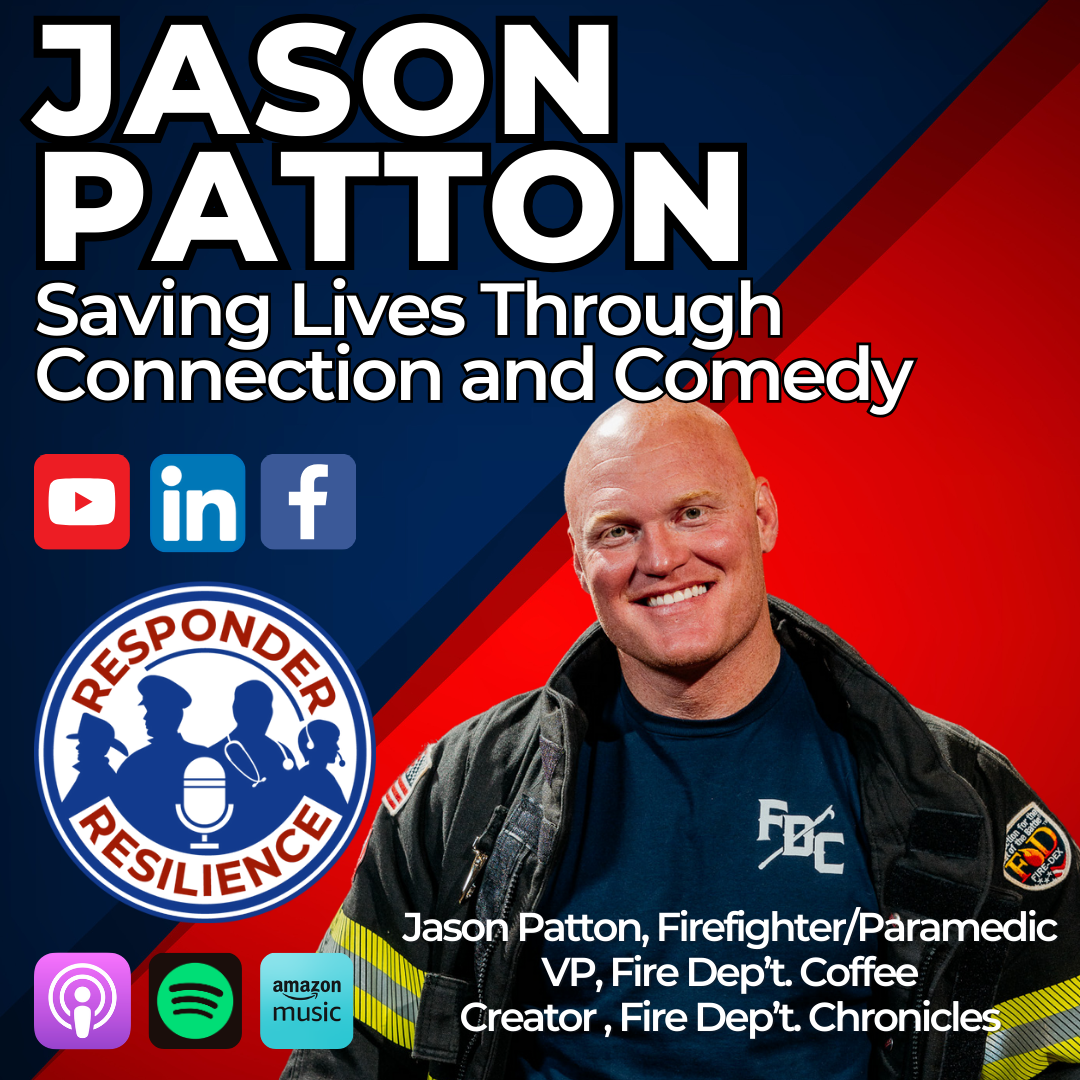
In this encore episode, get ready to meet charismatic firefighter/paramedic Jason Patton, the creative force behind Fire Department Chronicles.
In this encore episode, get ready to meet charismatic firefighter/paramedic Jason Patton, the creative force behind Fire Department Chronicles. In this episode, we dive into crucial conversations about mental health and wellness for first responders while enjoying Jason's signature humor. Discover how a good laugh can enhance firefighter retention and gain Jason’s insights on tackling tough issues like suicide and cancer prevention within the fire service. Prepare for an episode filled with laughter, inspiration, and essential takeaways. Whether you’re on duty or off, this chat is fully loaded with the camaraderie and practical tips that every first responder needs.
This episode is made possible by Fight Camp:
FITNESS DEAL: For a limited time, Responder Resilience viewers can get a FREE FightCamp package that includes punch trackers, quick wraps, and a 45-day membership trial, valued at $238! To get your free package, email us at info@respondertv.com with the subject line: FightCamp.
Website: https://joinfightcamp.com/
This episode is also made possible by the First Responder Center for Excellence: Equip Yourself with Excellence for Every Call.
Discover more at: https://firstrespondercenter.org/
Contact Jason Patton:
Website: http://firedeptcoffee.com/
Contact Responder Resilience:
Phone: +1 844-344-6655
Email: info@respondertv.com
Our website with past episodes and more: https://www.respondertv.com/
YouTube: https://www.youtube.com/c/ResponderResilience
LinkedIn: https://www.linkedin.com/company/responder-resilience-podcast/
Instagram: https://www.instagram.com/respondertv/
Facebook: https://www.facebook.com/responderTV/
One of the big things is I've seen a lot of bad stuff in my career, but what my mental health issues were coming from were like seated in my childhood, and it was something I tried to ignore and push back and I compensated and ended up creating this whole second human that was not healthy in any way, shape, or form. Talking about mental health and talking about feelings is just as normal as talking about the crazy call that you ran yesterday. Like those are all normal conversations to us and they all need to stay on that same baseline. I've had a lot of people reach out and say that they got into the fire service or became EMTs of paramedics because of the videos, which I think is incredible. Oh, I want to do that. Like I want to see that patient. Like, that's incredible. It's so, so cool.
VoiceoverWelcome to Respond to Resilience. Hello, and my co-host Bonnie Rimley, LCSW EMT, and Dr. Stacey Raymond. I'm David Dashinger. In this episode, we'll be speaking with Jason Patton. He's a firefighter paramedic. He's the vice president of Fire Department Coffee, and he's the creator of Fire Department Chronicles. We'll be talking about firefighter and first responder mental health and wellness. We invite you to like and subscribe our YouTube channel, Responder Resilience, Facebook with Responder TV, LinkedIn, Apple Podcasts, and Spotify. And check out our website, responderTV.com. This episode is made possible by the First Responder Center for Excellence. Discover more at First ResponderCenter.org and connect with us on X, Facebook, LinkedIn, Instagram, and YouTube. Our resource partner, Fight Camp, is offering an exclusive deal for viewers of Responder Resilience. For a limited time, you can get an amazing free package valued at $238, which includes punch trackers, quick wraps, and a free 45-day membership trial. Don't miss out. Email us at info at respondertv.com with the subject line Fight Camp to claim your free package today. We'll be right back to speak with Jason after this.
SPEAKER_01In this family, more of us die by our own hands and by the hazards of the job.
SPEAKER_09In this family, up to a quarter of 911 telecommunicators have symptoms of post-traumatic stress. In this family, our mental health and wellness are in crisis, while responders are quietly suffering.
SPEAKER_01In this family, many struggle with job-related stress, burnout, moral injury, sleep disruption, substance abuse, and relationship problems. In this family, we can help the helpers.
VoiceoverWith vital information and resources, resilience strategies, and success stories of overcoming the obstacles. Welcome to Responder Resilience. We co-host retired Lieutenant David Dashinger, Dr. Stacey Raymond, and Bonnie Rumoli, LCSW EMTV. And today we're joined by Jason Patton. He's a 15-year firefighter paramedic at South Florida Bay's Fire Department. He's also the creator and star of the popular social media series Fire Department Chronicles, which has amassed a combined following of 8 million followers and 55 million total monthly views. Jason's also the vice president of and co-owner of Fire Department Coffee, and he's traveled the United States extensively for keynote addresses in front of thousands of first responders, talking about subjects ranging from mental health, resiliency, and adapting humor to increase firefighter retention. Jason, a warm welcome to Responder Resilience. Thank you for having me. I appreciate it.
Bonnie RumillyIt's great to have you. I know we're in the amongst those followers.
SPEAKER_05So that's perfect. I appreciate it.
SPEAKER_10Absolutely. Now I've been watching those videos for a couple of years now. So yeah.
SPEAKER_05Anyway, yeah, when I think of where it came from, uh, I don't even understand how I'm right here. So it all started like 2016 or something like that. It's been it's been a journey. Every once in a while, like one of my old videos will pop up. It'll be like, all right, that was that's that's how this began. All right, cool.
VoiceoverIt's amazing that you're you're still able to um do all the things you're doing, including working you know on the job full time and um and yeah, the fact also that it circulates, um Bonnie and Stacy being therapists, how it circulates in terms of supporting mental health is uh I think it's a beautiful thing.
SPEAKER_05I appreciate it. I think that was it kind of fell into that over time, literally from the beginning. Uh, I'd say probably about three months into making videos. I got a I was more on Snapchat at the time, and a guy reached out and he said he was in a uh department just north of me, said that he and his guys went on this really, really bad car accident, like uh multiple dead people, like a family, that kind of thing, and they get back to the station. Like, how do you process that? I mean, that's incredibly hard to process. So uh they said it was kind of like uh they're just sitting around the table and somebody popped up a video, just happened to be mine. They chuckled for a second and it kind of kind of lifted a little bit of the fog and they were kind of able to move forward. Whether it's my videos or a firefighter fan or somebody else, I think it's just good to sometimes break that uh little bit of silence there to hopefully move forward.
SPEAKER_10So I wanted to start off by asking you have did you always want to be a fire medic?
SPEAKER_05So I had zero, I didn't even understand firefighting or EMS or anything when I got into it. I was a mechanic. Um, many people have heard this a horrific mechanic. I was not good at it at all. My father was a mechanic, so that's why I got into it. My dad was incredible, he was so detail oriented. He uh ended up becoming a general contractor and doing incredible work. Like he was good at uh uh like crown molding, which if anyone knows anything about that, it's detail-oriented. So um, but uh a buddy of mine came, he's like, Hey man, I should finish EMT school. You should you should try it out. And I was like, All right, you know, I'll try it out. And went there and just I fell in love with it. It was just so cool. This is the first time I was in school where I genuinely loved learning the information. Uh I dropped out in high school in ninth grade, and um, so I got my GED, I ended up graduating or get my GD before my class graduated and it all worked out. But it's the first time I was actually inspired by school, and it was it's just been an incredible journey since then.
Bonnie RumillyWell, also a few years ago, you became an advocate for first responder mental health. Can you talk a little bit about that journey and what led you there?
SPEAKER_05Yeah. Yeah, like I said, when the videos first started coming out, people were reaching out saying it helped. Um, and then just over time, I I felt more of a draw, pulled to kind of address it directly. And I wanted to, my first video that I wanted to do it with, I wanted to I wanted it to be really raw, like about as raw as you could get. Um, and I and I was happy being the comedian that actually talked about it because it's so difficult for a lot of people. And most people that are talking about it, that's kind of what their platform's about. So I wanted to kind of switch gears and and uh address it. And I uh, you know, one of the big things is you know, I've seen a lot of bad stuff in my career, but what my mental health issues were coming from were like seated in my childhood, and it was something I tried to ignore and push back, and I compensated and ended up creating this whole second human that was not healthy in any way, shape, or form. And um, it I finally got to a head, it was really bad, you know, uh fantasizing about suicide, that kind of thing. I went and saw a therapist, and it was amazing. And I wanted to tell people about that. My life was impacted by suicide very young. My uh my dad's best friend killed himself. And uh I talked about it and the response was incredible. It was it was so cool.
VoiceoverYeah, I think uh having seen it, um, one of your videos where you're talking about what you just described, one of the things that makes it so powerful is that you know you're known as being you know a comedian and showing the lighter side of of life and and a first responder community, and to hear you talk about those things um makes it that much more powerful because it shows that we're all human beings and we all have struggles and um and and also that there's there's tools out there that can help us to overcome them. Uh so speaking about those tools, Jason, uh what do you think? I mean, we have things out there, pure support, CISD, CISM, even seeing embedded clinicians now. What do you think we can be doing better moving forward with mental health in uh in the world of firefighting?
SPEAKER_05Yeah, I mean, that that's such a like a broad question, just because mental health outside of the fire service is still so stigmatized. Like when people talk about mental health, there's this like they immediately picture people that are like hugging trees and stuff like that. And it's like, that's not like when I when I speak on mental health, I'm like everybody at some point in time has to focus on their mental health. Uh, in fact, I believe that mental health is the baseline of any other health, whether it's physical health, intellectual health, all that like you a good solid baseline of of you know feeding into your own mental health, um, whether it's working out, whether it's talking to a therapist. I love that you said tools. I say therapists don't fix your problems, they give you the tools to be able to work on it yourself, right? Um, and I and I just think it's it's a really big thing. And then I think in the field itself, it can just it just has to be talked about. I don't think it's an immediate fix. I think it's like the cancer initiatives. No one could walk out and say, start what wash your gear right now. Because in the beginning we didn't want to do it. It was like, no, my gear is like black now. It was tan before, but now it's black and it's cool, right? So it shows that I fight more fires. And it just took more time and uh knowledge and education to be able to get guys to buy into it, guys and girls. Um, and I think that's kind of it. It's just it's just a slow burn, but eventually we'll understand that talking about mental health and talking about feelings is just as normal as talking about the crazy call that you ran yesterday. Like those are all normal conversations to us, and they all need to stay on that same baseline.
SPEAKER_06Right. Calling all mental health professionals. Join us for the Clinician Masterclass series, working with first responders and empower your practice with expert insights and actionable strategies. Brought to you by the Responder Resilience Podcast. Dive deep on working with EMS and 911 personnel with seasoned therapists Dr. Nicole Navega and Bonnie Rumili. Sonny Provetto shares specific knowledge and tools to support police. Dr. Stacy Raymond offers professional insights on working with veterans, and Dr. Robbie Adler Tapia covers working with firefighters in a clinical setting. Subject expert Elizabeth Paul covers suicide and psychological autopsies. Patrick Fitzgibbons does a deep dive on inpatient treatment facilities, and Dr. John Violanti covers law enforcement mental wellness. Get ready to transform your practice. Subscribe and stream anytime on our channels. YouTube, Facebook, LinkedIn, Apple Podcasts, and Spotify. Stay in the loop and sign up now at responderTV.com.
SPEAKER_10So, Jason, when you're having a bad day, like what's your go-to as far as uh self-help? Cocaine.
SPEAKER_05Uh don't do cocaine, kids. Don't do cocaine.
SPEAKER_10Yeah, it's a pick-me-up, right?
SPEAKER_05I feel great. I feel great for at least 20 minutes. Uh I think uh for me, it just depends on the day. Like it's it's it's really, and I think that is the hardest struggle with anything, but especially mental health. A lot of people they want their go-to. Like they I work out and I feel better. And that's because they get that appropriate hormone response or dopamine response or whatever it is, and they always feel better. But then that one day they can't do that because of whatever. Well, now I don't have my picking up. So for me, it's different. It's some days I want to work out. Some days the music that I listen to is uh the other day I was listening to Adele, like squatting, like it was awesome, man. She was she was grooving to me, man. Uh so uh uh some days it's talking to my wife, uh, you know, some days it's just going for a walk, being in the sun, uh reading. Like I try to find different things. I would say exercise is my number one, but sleeping, dude, giving myself grace. Like if I don't feel like being 100% that day, dude, it's okay. I don't have to be 100% that day. Um, I try to keep a baseline of just being appropriate and nice to people. Um, but in general, man, it's just it just it varies so heavily on a on a daily basis. The one thing I try to absolutely never do is drink. I like I don't I don't want to drink if I'm not feeling good. Now obviously you know that is so um those that might like I don't do those things.
VoiceoverSo yeah, I love that you use the word sleep and baseline together because um probably you know working a 24-hour schedule, um, 2472, 2448, whatever it is. Sleep is probably the one thing that we never have enough of, but uh we do have some control over you know on our off days to to give ourselves that. Yeah. A nap, dude, a nap.
SPEAKER_05Like people are so against naps. They're like, you're lazy if you nab. I'm like, okay, I'm gonna go to sleep. Uh you know, and I mean again, 30-minute naps, 45 minutes nap, whatever you can get in is is is so great. Um, but that man, that that's so resetting to the brain. It makes me feel better. It's you know, if I had a bad night, if I if I ran uh you know two or three after midnight, I only got four hours of sleep. I think there's this um there is this drive in there's this this this gross like miscommunication when it comes to when you're on calls that you have to be on point and when you're off calls. Yes, we have to be the person in the room at all times that is ready to go if we're in an emergency call. Like we need to be on point uh because we're saving someone's life. But when we leave there, we don't have to be that person anymore. Like we don't have to be the strongest person in the room. We can talk about something. And a lot of times identifying our own thought processes can kind of spiral into other people's thought processes, and we realize we're all on the same uh page. We can get through it, validate some thought processes and feelings, and then I can actually move on.
Bonnie RumillyWell, to your point, the more that we talk about it and the more you know you're saying all the things that help you, but the more we give people permission to just do basic care of themselves, we're not even talking about anything elaborate or expensive. We're talking about getting good sleep, getting good nutrition, taking care of your mental health. It's the more we normalize all of it, I think that's where the change happens. And I think that's why I love you know, you're known for the comedy stuff, but I think using that platform to get these messages out is such a no-brainer. And I'm really grateful that you're doing that because I think people will listen. And the more of us that are saying these things, the more people will have to listen to us. Um you had an interesting presentation called How to Hug 101. Um, and I'll tell you a funny story about the Fiery MS expo up in Connecticut with hugs, but tell us about that.
SPEAKER_05So I started uh traveling around, going to different conferences, watching people speak, uh, and it was incredible to watch. Like I'm into mental health, so I like hearing about this stuff. And um, and I think most people are, they're just they're just unaware of the subject or they don't know how to approach it. It's the first time walking into EMT class for them, or going first time walking into fire school. Like, what am I walking out of with this? And excuse me. Um, I kept going to all these conferences, and it just seemed to be that there was really two types of presenters. There was the clinicians that were presenting incredible, like database stuff that was really saying, like, hey, listen, a lot of guys that are killing themselves are not doing it because they want to. Their frontal lobe has actually been like shrinking over time, and you know, their like their judgment center is gone, they don't understand that X equals Y, you know, that kind of thing. So, and then you have guys that are telling their stories and their incredible stories, but they are so powerful, so emotionally draining. So, you know, by the time they're done with that, you're like, holy crap, this is like wow. And you see 10 of those in a row, and you you know, you kind of leave there like, oh, okay, so I am gonna kill myself. This is an inevitability, I might as well start making plans, like uh that kind of thing. So I I think I you know, I saw that and I was like, there's gotta be something in between, just a just a real like you are human, this is a normal expression of of human emotions, and it doesn't mean you have to continue down. Like, like you feel this, you say I feel this, and sometimes that can rectify it, you know, or at least put you on a better path. So that's kind of how I formed How to Hug 101. It's literally, it's it's uh 35 to 45 minutes uh speech about how uh extreme anger. I always say that firefighters are comfortable with expressing two emotions, uh, extreme anger and extreme happiness. Like they're extremely pissed at that dude from farting around the station, they're extremely happy because they punched him in the face, you know. Uh so uh but it's everything in between we hate, man. We hate expressing you know jealousy and and and and uh you know uh being upset or or whatever it is, and we don't like those because they're all in the vulnerability zone that we don't want to feel vulnerable, jealousy, none of those things. Um, when I've always said that uh if I'm feeling upset or jealous about something, I just say it to the person, hey man, I'm really jealous that you got that. I'm gonna be honest, you that you got that promotional for me. And they're like, I mean, they could be a complete jerk, like, well, it's because you suck, that's probably why you feel like damn it. Uh but you know, sometimes just verbalizing the words. That's why therapy is so great, man. You can take a therapist and you just vomit emotions onto them for an hour and you walk out, you're like, all right.
Bonnie RumillyYeah, we're vomited on multiple. Uh-huh.
SPEAKER_05Yeah. So that was kind of what I formed it. I was like, man, there's got there's got to be just something in between where humor, and obviously, there's just a metric ton of humor laced within it, just to kind of laugh throughout it. But uh, it's been received very well so far, and I've gotten to I've gotten to be able to travel and talk about it, and it's it's really fun.
SPEAKER_01Super cool.
Bonnie RumillyOur group, our trauma team, was up at the Fire EMS Expo in Connecticut, and um, every person in the booth next to us, all these firemen, all the EMS providers, we'd go up and introduce ourselves, and there was a hug ending up happening in there. So one of the fire guys got a piece of paper and he wrote free hugs with a Sharpie and he put it on our booth because he said, You know what? You made my day. He smiled the entire day. Um, and it just reminds you, especially to your point of your talk, it reminds you that little things really do matter. You know, to laugh for 10 seconds, to hug someone, to smile, to say something nice. It can last for hours. Um it's a good point. Thank you for that.
VoiceoverOf course. Thank you. Well, and um one of your many initiatives that I came across, um, it also kind of crosses over what we like to talk about, and it's important to us as well, and that's uh cancer. Um, did a couple of pieces that I saw that had to do with uh early detection and again infused with comedy, so it's really you know and easy to digest. Um can you speak a little bit about that piece and and sort of where where your thoughts are in terms of how we can be um doing a better job detecting?
SPEAKER_05Yeah, so it's funny you say detecting because Detect Together is the name of the uh the organization that I happen to come across. They're uh a nonprofit organization based out of uh Marlboro, Massachusetts, I believe, or it's in Massachusetts. But uh they are incredible. It's uh I believe it's uh three people that formed it, uh three or four people that formed it, and the the women that are really kind of running the whole thing, they are unbelievable. Trisha and her team, they the the whole purpose of this was just simply to raise awareness on detecting cancer earlier and how you know it's much easier to treat uh, you know, stage one than it is stage four, that kind of thing. And they immediately knew the types of videos that I would want to be involved with. Um and they even allowed me to like edit the scripts, which is not common for most uh people. And it was the the early detection of cancer is just so difficult. And I'm listening I am one of these people that will like my throat will hurt and it'll be hurting for three weeks. And I'm like, God, my throat still hurts. And my wife's like, see, come on, really? Like, just go to the doctor. Yeah, it's probably smart. So, um, you know, that is the that is one of their big things is that if a symptom lasts longer than a certain period of time, then you should go to your doctor and get checked out. Like, it's normal to have changes, physiological changes in your body, but when they last for a certain period uh longer than a period of time, then you need to go to the doctor. So it's just a really, really cool thing, man. It's like it's uh I always say like we always focus on men when it comes to mental health and cancer stuff. Uh, but my first true experience with someone like actively audibly suppressing their pre their feelings and thought processes was a woman. Uh it was a girl that I was uh precepting, she failed a test. It was very simple test. There's she just failed it because she went too fast. And uh we were driving back to the station to start crying, and I look over and she looks at me and she looks back down, she's like, No, we don't cry, we don't do this. And I was like, All right, that let's just stop. Uh, because that's how you murder kittens. Uh but it was it was incredible to watch someone audibly try to or stop themselves stop themselves from feeling a very normal feeling. Um, and I and we talked through it, and you know, I was like, this is all normal stuff, man. Like, I listen, I uh was talking to my wife the other day, and just my dad died of cancer about eight years ago, and we started talking about stuff that happened right before he died, and I started crying and going through it, and it felt really good. I I think crying's a an incredible, hard, very hard feeling, but it's an incredible feeling.
SPEAKER_02Right, yeah.
SPEAKER_00Introducing Fight Camp. Thousands of workouts led by expert trainers, they meet you on your time. Live punch stats motivate you to push harder and help you map out your progress. Knock out achievements or go head-to-head against other rivals from across the country or across the living room. Learn the basics and sharpen your skills over time through tailored paths. Join the biggest boxing community in the world without leaving your home. Fight camp.
VoiceoverHey everyone, if you're looking to elevate your fitness journey, listen up. Fight Camp is rolling out an incredible offer just for respond to resilience listeners, an absolutely free package that includes punchcrackers, quick grabs, and a 45-day membership trial valued at $238. This isn't just a workout, it's a way to track your progress in real time with advanced technology. You'll have access to over 3,000 on-demand workouts tailored for all fitness levels, so you'll never run out of options. Kickstart your fitness journey and follow these simple steps to get your free package. Just email us today at info at respondertv.com with the subject line fight camp, and we'll send you everything you need to sign up and claim your free offer. That's info at respondertb.com. I just had to ask you this question. So in one of those videos, you have what looked to be FDNY firefighters singing and rapping. Those what was that like to do that scene?
SPEAKER_05So this is the second time I've uh uh kind of worked with FDNY. Um and it's very intimidating, man. Let me tell you, you you walk into a you walk into a place where the rock is huge, it is a massive training center. If you ever get the chance to walk through it, you should. Like they have an actual subway train car. I think it's multiple of them set up so they can practice going in and getting people out. Like it's it's unbelievable, it's very, very cool. But um, you know, I think they have 10,000 active duty firefighters, which is psychotic. We have 70 in my department. Uh so it was very cool. It was very cool to deal with it. But the coolest thing was to watch, you know, I believe they are the the besides London, I believe they're the second largest fire department in the world. Uh I could be wrong about that, but they are just massive. And they bought into this wholeheartedly. What do you need? Like they had a bunch of their firefighters and paramedics and EMS personnel in their singing and we're having a good time, and we're walking, it was free reign around their entire place to just walk around and do whatever we need to to uh help with cancer prevention. It was, man, it was it was very like the guy, one of the guys that was acting with me in the videos was an assistant chief. And if I mean think about how high that is with 10,000 people, so 12,000. So that's crazy.
Bonnie RumillyWow. What a great experience.
SPEAKER_05Yeah, it was very cool.
SPEAKER_10Let me ask you this. Uh, what's the most important lesson that you've learned over your career thus far?
SPEAKER_05Moderation. That's that moderation is the uh which I believe is probably one of the hardest traits to actually take in and subscribe to personally. I have, and I say that with every aspect of my life. I am a firefighter, bless you. Uh I'm I'm a firefighter, I'm a paramedic, I love my job. I will I have literally swam to the bottom of of uh lakes trying to pull people out of cars. I have um, you know, assisted pulling out infants out of burning buildings and and I love it and I believe in it and I will I would I could never imagine do anything else. But when I get off shift, I try not to be that guy. Like I try to, if I need to go on a vacation with my wife and and not talk about the job, then I try to do that. Um if I'm out with the guys that I work with, we try to talk about something besides firefighting or paramedics or whatever it is. So finding moderation within that, but even like like I said, with my own um personal life, if I try not, if I can't work out one day because I have to go take my daughter somewhere or do whatever, then I try not to beat myself up for that. Um and I think you can find uh you can find discipline within moderation, but the moderation is so important all the way across the board.
Bonnie RumillyYou know, just knowing how far you've come and all the achievements you've gotten to at this point, you know, I can't wait to see what's to come. But I'm curious if you could go back to your 18-year-old self, what would you say to self?
SPEAKER_05I don't even know. I don't, yeah. I'd be like, please don't screw this up, man. Uh so mine's like it's funny because we always say like we'd we'd love to go in the past and change something.
SPEAKER_02Right.
SPEAKER_05Um, which I mine is just very specific to my dad. Like, I would just go back and be like, Dad, uh, you know, your back's hurting. You should probably go get that checked out a little bit earlier. Uh yeah. So, but um I I believe uh if I went back and talked to my 18-year-old self, I would I would be proud of myself and I would even say that because uh I'd uh I was I kind of was at a crossroad at 17. 17 I'd already dropped out of high school. I was, you know, get my GED. I was, you know, and I had a choice. I was either gonna keep doing stupid stuff or I was gonna actually, you know, invest in myself, which I did. I became a mechanic and kind of went from there. But I would, I would just uh I would probably say uh go talk to a therapist now because I suffered for whatever it was 17 years and and you know, eventually, this is like four or five years ago, finally, you know, talk to somebody about what was going on in my head. Um and I I think I wouldn't probably I probably wouldn't change anything because I'm I'm not sure if I'd be where I was at if I didn't have that kind of driving factor within me to be better, that kind of thing. So I'd probably give myself a high five. Tell me not to date that one girl when I was 22.
SPEAKER_10Yeah, would you say you say nice hair?
SPEAKER_05I haven't had hair since I was 16. So I know.
Bonnie RumillyWell, look at this way. If you hadn't dated that one, you wouldn't know how wonderful your wife is. Um my god, yeah.
SPEAKER_05And that's I swear, I think uh it's so hard. Sometimes you look back at your past decisions, you're like, oh, I wish I didn't, but I don't know where I would be today. Do you ever see Butterfly effect? Yes. Butterfly, he was such that is like the probably the best example of change one thing and a lot of other things are gonna change too.
SPEAKER_09Definitely.
VoiceoverAnd on that on that thread in terms of changing things, um, I love your story about the uh woman you were precepting and then having that moment. Uh it was really, you know, much broader than just becoming a paramedic, but you know, becoming uh a kind of well, a wellness moment, really. Yeah and um so when you're when you're interacting with probies or if you were standing in front of a class of probies, what what would you tell them? What kind of advice would you impart?
SPEAKER_05Yeah, so I I get the I get the uh luck of every time we bring in a new probationary class, I sit down with them and I talk to them about mental health, I talk to them about taking care of themselves, that kind of thing. And and I I kind of always try to um I try to depart the the final piece of the conversation with you know, you are important, you are important, you know. That when you show up on calls, they are important, they need to be taken care of. Don't kill yourself, you know, trying to save someone's life, you know, the whole like risk versus reward stuff. But at the end of the day, if you need to go into your bunk room and sit down for 20 minutes and and you know think about what's going on, then you are important. When you get off shift, you're important. Um, and I think that's something that I really try because we when from the day we walk in to being a firefighter or paramedic or ENT, whatever it is, it is always about patients, it's always about other people, which I agree with. Um, but you before you became a firefighter, paramedic and ENT, whatever it is, you were a human. You started off as a human, that human's got to be taken care of, and then we can take care of other people.
Bonnie RumillyYeah. Well, to your point, when I was on duty, I used to check in with all my crew before we touched a bag because all the stuff in the bag is absolutely useless if my head's not in the right space to use the bag.
SPEAKER_05I agree. And I'm telling you, validation is the number one thing I talk to people about because there's just there's something about like something sitting in your head and like you know, that that baby, I'm not, I don't know if I was okay with that, and someone going, Yeah, dude, I would feel that's normal, man. Like you've seen dead kids or seeing someone who looked just like your father, it's normal to be upset about that and be like, oh, okay. Like there's something about that that kind of lets people move forward with life, they're not you know, stuck on that thing. Am I weak? Am I not able to problem? No, dude, that's normal. Oh, okay, cool. Let's go for it.
Bonnie RumillyGood for you for just putting it all out there, you know. Uh we love we love talking to people who can do that, and you're definitely one of them. Um, switching gears again. There's so many gears, which is great. How did fire department coffee come along? We all know how crucial coffee is in the fireworld, but um, tell us a little bit, what happened?
SPEAKER_05Yeah. Um, so we so funny enough, I make fire department chronicles and start making some fun videos talking about fire and EMS, and we're we're having a great time. And then um I put this video out about uh, so we're about to get hit by a hurricane. We got 35 firefighters, uh, paramedics, uh, you know, punch of uh other city workers, all stuffed into one station together. It is gonna be a very interesting next couple days. Uh and uh so we're all getting in there, and I uh bring up it was Cafe Bustellos, who it was, and I was and I had we had a bunch of stacks of these things, and I was like, this is the only thing that's gonna stop us from murdering each other. So let's see how this goes. Uh so we put it, I put it out on the internet, we have a great time with it. And then um Luke Schneider, CEO of Fire Department Coffee. Someone tags him in the video. He reaches out, he's like, let's work together. Um, excuse me. I fly out to Illinois, meet him, and uh kind of moves from there. There was about six months in. They'd already opened up a little uh it was a storefront, but we didn't have people coming in and buying purchasing coffee. Started off as an online company. Now uh we are in uh about 6,000 retail stores. Uh we just got into Walmart next uh we'll be in Walmart early next year. So that's very yeah, it's been it's it's been a journey, and it made me uh really, really appreciate business, people who uh create uh businesses, and it is not easy, man. Not easy at all.
VoiceoverSo much goes into it, and and as as you said, it's such an essential part of um fire department culture. And um, we interviewed Paul Combs, who um one of his cartoons is about uh the power of the coffee pot and all the problems that get solved around the kitchen table or over a cup of coffee, so it's vital. Absolutely, absolutely couldn't agree more.
SPEAKER_07As firefighters and first responders, we're brilliant at the basics. We master the art of stretching the line and we excel at being there for those who need us most. Yet, even the best of us can be caught off guard. We sometimes face unexpected challenges like injury, cancer, or post-traumatic stress symptoms. But you're not alone. The First Responder Center for Excellence is here to equip you with the tools and resources you need to stay informed and prepared. We help you focus on staying strong, safe, fit, and resilient. Optimize your performance with cutting-edge health, wellness, and science information. From fitness to nutrition, medical evaluation to digital health, cancer awareness to cardiac health. We've got you covered. Remember, we're stronger together. Discover more at firstrespondercenter.org and connect with us on X, Facebook, LinkedIn, Instagram, and YouTube. The First Responder Center for Excellence. Equip yourself with excellence for every call.
VoiceoverWell, speaking of um all the things you've accomplished and up to this point, um, what's next for you? What do you have kind of uh in the wings uh coming coming in 2024? That's a great question, David. I have no clue.
SPEAKER_05I wake up every day with what are we gonna try to do today? So uh I think I'm I think we're just gonna continue expanding. I think um I'm gonna continue making chronicles. I've actually I am dabbling with the idea of so I love imparting knowledge, is probably my favorite thing. That's I like the baseline of all my videos is uh, you know, having a laugh, uh, a lot of times at my own expense, uh, but kind of imparting knowledge within uh whether it's diabetes or heart attacks or CPR. Um and uh some of my favorite ones are fire safety videos or the CPR video that I did. And I I I really want to impact the younger, um, the younger uh groups. So I am dabbling with the idea of making a fun uh children's book about fire safety. I think it'd be really, really fun. Something that I that parents, it is very hard to talk to your kids about fire safety. It just is, you know, because they're like, I don't, I don't care what you're saying to me right now. Uh so I would love to make, at least that's my experience with my daughter. Uh uh, I would love to make a children's book that reads uh like a children's book in a fun way with some of the humor that I love to put in there, but it also kind of gets the fire safety pieces, and then at the end, actually saying, like, how do we build this plan together? Let's know what to do. So that's fantastic. Thank you.
Bonnie RumillyWell, if you ever want to do fun some funny mental health spoofs, you could do a hybrid event with us and you and talk with some neat materials because we're going over our goals for the year trying to figure it out what's next.
VoiceoverAbsolutely. Absolutely. Have you gotten any like direct feedback about somebody's life you've changed in terms of recruitment or retention? Like someone saw something you did and they're like, Well, you know, I want to the light bulb went off, I want to do this, or you know, maybe maybe I can sustain myself in this career a little bit longer.
SPEAKER_05I've had a lot of people reach out and say that they got into the fire service or became emptyes or paramedics because of the videos, which I think is incredible. Whether it's me or you know, uh Firefighter Fenton or Fireman Lance or there's a bunch of nurse influencers, or like I just think that's great, man. Like, like watch the videos, laugh. Oh, I want to do that. Like, I want to see that patient. Like, that's incredible. That's so, so cool. Um, and I and I think that's so cool that there's a bunch of different people out there. So yeah, I've gotten that recently. And this is two of them referencing the same video, which I thought was awesome. Um, I made a video about uh how to unchoke yourself. And um uh not in a but like BDSM way. Uh so like uh but uh I so I make this video and I two people reach out. One of them said that they uh were choking in their house and remembered the video and fell on their couch and was actually able to uh get the uh piece of shrimp or steak, whatever it was. And another woman said that she was uh she was at like Disney World or Disneyland and her kids started to choke and she remembered how to do it from a video that I had posted before and remembered how to to do the hymn lake and got it out. I mean, I was like that wow, that's insane. She said she said, My daughter is literally here today because of your video.
SPEAKER_01So I'm like, dude, that's crazy.
SPEAKER_05Yeah, that's crazy. I save that one for my chief in case he's like, Well, we gotta stop this stuff.
VoiceoverDo you do stuff on shift, or how do you work out your schedule of filming with uh with your work schedule?
SPEAKER_05So I I do I do everything off shift. I uh I try not to ever do anything when I'm there. I mean, I'll answer some emails here and there, but um yeah, I try not to do anything while I'm on shift. It's uh A, I work at a station that averages uh 16 to 24 calls a shift. So try that would just my anxiety levels would go through the roof. Um, but uh it it just makes life easier if I can plan when I get off shift and kind of working in between things.
Bonnie RumillyI think we have a lot of great take homes today, and one of them for me at least is definitely thinking about how small things really matter. You know, you thought you made that video about choking and it saved somebody. So you just never know the impact of the work that we all do in the world.
SPEAKER_05One sentence, uh one sentence changed my life. It was uh my therapist at the end of uh one of our sessions. Just you ever think of it like this? Like maybe this is why it happened because of you know this thing when you were younger. And I was like, oh my god. And that was like it was like it was that massive light bulb moment, and then we still did more sessions after that, but uh it was like such a cool I was like, oh my god, that's it. It's like I don't have to be this person to everybody at all times. Like I can just be me. And it was it was such a cool, incredible moment, and it it changed the trajectory of my life.
SPEAKER_02Wow.
VoiceoverWell, this is um I shouldn't have to ask this question, but we do anyway. Um, where can people find you out there, Jason?
SPEAKER_05Uh all the channels, YouTube, uh uh Facebook, TikTok, uh Twitter, all the fun stuff. I'm I'm out there. Just whatever you're on, you can uh come say hi.
VoiceoverAbsolutely. Um, we so appreciate you spending the time with us today and everything you're doing out there and the the change that you're helping to make in the the culture of the fire service, EMS, and I'm sure beyond that. So uh thank you so much for being with us and sharing your your insights. Thank you guys. I appreciate you having me on.
Bonnie RumillyThank you, Jason.
SPEAKER_05Thank you.
Bonnie RumillyThank you.
SPEAKER_05I was hoping Stacy would say thank you. Start again.
Bonnie RumillyWhen she gets quiet, it gets scary.
VoiceoverWe'd like to invite you to like and subscribe, YouTube, respond resilience, Facebook, responder TV, LinkedIn, Apple Podcast, and Spotify. And check out our website, responderTV.com for past episodes and guest information. Till the next time, stay safe, be kind to yourself. Take care of the episode.

Firefighter/Paramedic | Fire Department Chronicles | VP Fire Department Coffee
Jason Patton is a 15 year Firefighter/Paramedic at a South Florida based fire department. Jason is also the creator and star of the popular social media series Fire Department Chronicles which has amassed a combined following of 8 million followers and 55 million total monthly views.
Jason is also the Vice President, Co-owner of Fire Department Coffee. Additionally, Jason has traveled the United States for Keynote addresses in front of thousands of First Responders on subjects ranging from Mental Health, Resiliency, and adopting humor to increase firefighter retention.


