Apple Podcasts
 Spotify
 YouTube
 RSS Feed
 Clinician’s Guide to Living the Embedded Clinician Role with Dr. Nicole Navega | S5 E36
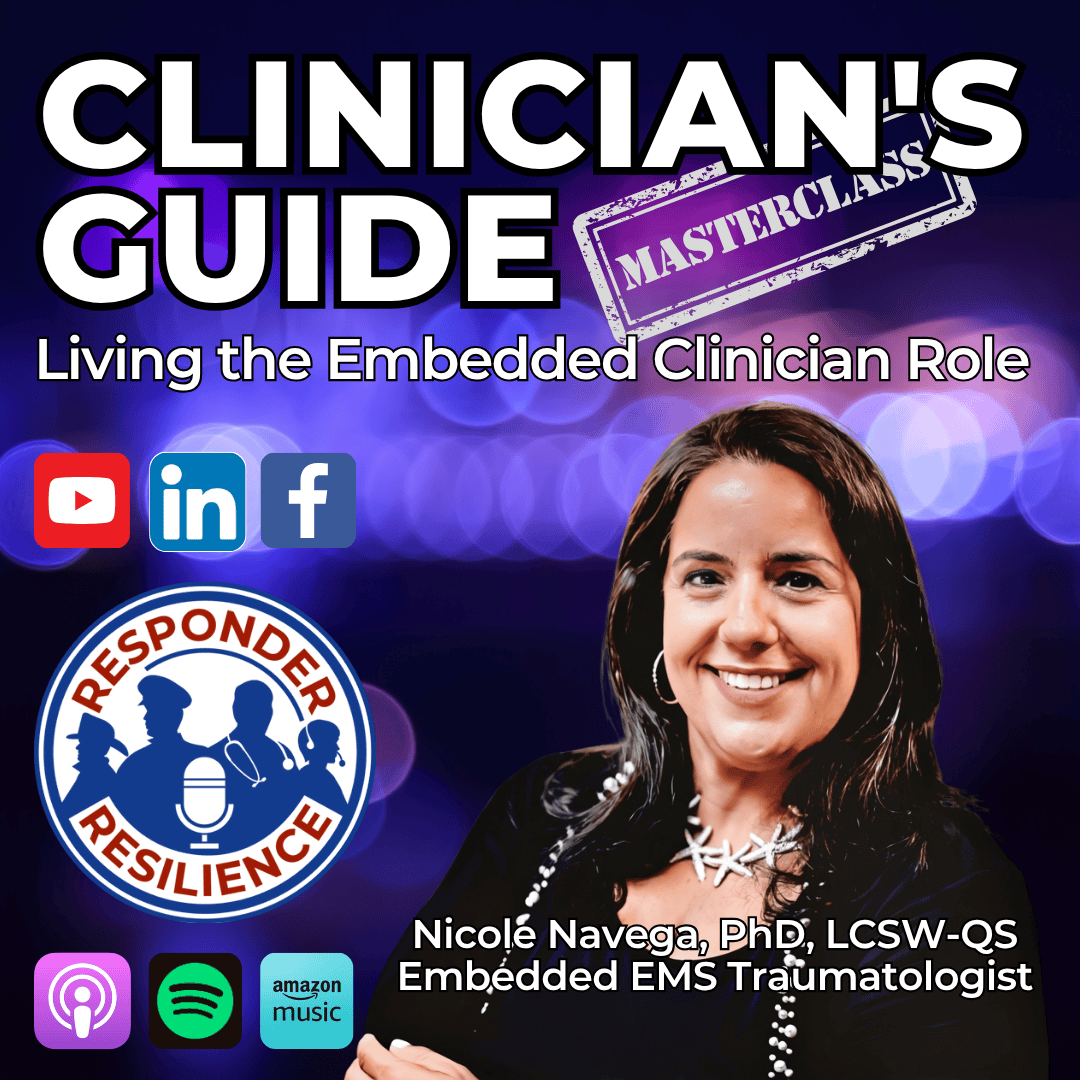
Join us on this Clinician’s Guide masterclass as we speak with Dr. Nicole Navega, a pioneer in embedded EMS trauma care.
Join us on this Clinician’s Guide masterclass as we speak with Dr. Nicole Navega, a pioneer in embedded EMS trauma care. When it comes to supporting first responders, there’s no one-size-fits-all approach for clinicians. Through her insights into various clinical models, Dr. Navega reveals how the embedded clinician model stands out as the most impactful as it fosters unparalleled access, trust, and cultural comprehension.
As we unpack the essential mindset required to effectively support first responders, we will examine the importance of genuine connection, understanding the unique challenges they face, and meeting them where they are—both in their work and in their emotional journeys. This episode promises to provide valuable strategies for clinicians seeking to enhance their impact and bring about meaningful change within this vital community.
Coming September 2025!! Helping the Helpers: A Clinician’s Guide to First Responder Mental Wellness, a new book that equips you to build a First Responder-Centered Practice that works. Get a FREE sample Chapter and Book Launch Invite!! Go to helpingthehelpers.me to get Early Access when you sign up!
Thanks to our resource partner, EMS & FIRE PRO EXPO. Join us for the largest gathering of EMS and fire professionals in New England, September 24 - 27, 2025, at the Mohegan Sun in Connecticut! Sign up at https://emspro.org/
Thanks also to our resource partner, FightCamp. Harness the strength of boxing to release stress, build resilience, and connect with a supportive community. For free shipping and a free month of membership, go to https://joinfightcamp.com/shop/ and use the code RRPONE.
Thanks to our resource partner, CRACKYL. Download the FREE CRACKYL App: http://crackyl.respondertv.com
Contact Dr. Nicole Navega:
LinkedIn: https://www.linkedin.com/in/nicole-navega-phd-lcsw-qs-18703a8/
Contact Responder Resilience:
Phone: +1 844-344-6655
Email: info@respondertv.com
Our website with past episodes and more: https://www.respondertv.com/
YouTube: https://www.youtube.com/c/ResponderResilience
LinkedIn: https://www.linkedin.com/company/responder-resilience-podcast/
Instagram: https://www.instagram.com/responder.tv/
Facebook: https://www.facebook.com/responderTV/
I personally love the embedded model. Having a good reputation and having people know who you are requires you as a therapist to do some work that is outside of sort of a traditional private practice. I go into the ride time not thinking about how we're going to talk about mental health at all. You know, I go in as a pole and I'm just here to sort of hang out and see what you guys are up against tonight. I think my first priority was just getting out on the road, you know, and just doing the ride time. In therapy, it's a sacred relationship. Most of the time, these people are telling you things that they've never told anyone else.
David DachingerWelcome to Responder Resilience. I'm David Dashinger. On this Clinician's Guide Masterclass, we're speaking with Dr. Nicole Navega, a pioneer in embedded mental health care for first responders. And when it comes to supporting first responders, there is no one size fits all approach for clinicians. Through her insights into various clinical models, Dr. Novega reveals how the embedded clinician model stands out as the most impactful as it fosters unparalleled trust, access, and cultural comprehension.
VoiceoverThanks to our resource partner, EMS and Fire Pro Expo, the largest gathering of EMS and fire professionals in New England, September 24th through 27, 2025, at the Mohegan Sun in Connecticut. Sign up at EMSPro.org. There's a new app built by firefighters for firefighters, and it's called Crackle. Download the app now for free as a legacy member and get early access to exclusive content, tools, and updates as they drop. Get the free app at crackle.responderTV.com. This episode is made possible by the First Responder Center for Excellence. Discover more at FirstresponderCenter.org and connect with us on X, Facebook, LinkedIn, Instagram, and YouTube. Remember to like and subscribe YouTube Responder Resilience, Facebook, Responder TV, LinkedIn, Apple Podcasts, Spotify, and go to our website, respondertv.com for past episodes and guest information. We'll be right back to speak with Dr. Navega after this. In this family, more of us die by our own hands and by the hazards of the job. In this family, up to a quarter of 911 telecommunicators have symptoms of post-traumatic stress. In this family, our mental health and wellness are in high risk, while responders are quietly suffering. In this family, many struggle with job-related stress, burnout, moral injury, sleep disruptions, substance abuse, and relationship problems. In this family, we have helped the helpers. With vital information and resources, resilience strategies, and success stories of overcoming the obstacles. In this family, welcome to Responder Resilience. We co-host retired Lieutenant David Datchinger, Dr. Stacey Raymond, and Bonnie Rimley, LCSW EMTV.
David DachingerSo we're here with Nicole Novega, and we're going to talk about what clinicians need to know about embedding within an agency. So, Nicole, this is definitely your area of expertise, and so happy that you're here to share your knowledge and wisdom and experience. So let's start with a question about choosing a practice model. So, what would you advise a clinician to know about the various practice models out there that they can choose from?
Nicole NavegaWell, first of all, thank you so much for having me, David. I love having these conversations. I appreciate it. Um I think, you know, there's there's a multitude of models that you can use. As you know from other conversations that we've had, I am a um I'm a big fan of being embedded. I am embedded inside of County Public Safety, which is actually a standalone EMS agency. Um, and so we have about we have almost 500 employees here. So there are other models. I mean, you can be a private practice therapist where you know first responders can come to see you privately. Um, you can do consulting roles, um, which sometimes I do that also, um, which usually involves training. So sometimes I do consult by doing some training for for other folks. Um, and then there's also, you know, this idea of doing some sort of a mix where you can do some private practice, do some consulting, do some training, do a bunch of different things. Um, um, but I I personally love the embedded model. And I think the last time we talked, I was probably a little bit more um sort of rambunctious and over the top about how it's the greatest thing and it's the only thing. And um I don't think I don't think that's true. Um I think that you can do some really good work in all of those different areas if you get you pay attention to what I think are some of the important things about working with first responders. For me, I think one of the things that, you know, most of us know who who work with first responders is that, you know, it's really difficult for first responders to ask for help. They're very they're very reluctant to ask for help. And so I think, you know, the other thing is that they won't, they won't use anybody unless one of their other first responder buddies has told them that it's okay to use them. And that goes for everything, right? Like someone who's gonna fix your roof, somebody's gonna, you know, your pool guy, your electrician. And so I think having a good reputation and having people know who you are requires you as a therapist to do some work that is outside of sort of a traditional private practice because traditional private practice therapists don't really get to know the first responders and they don't get to um, therefore, the first responders don't get to know them and they're less likely to seek help from somebody that they don't know or they haven't seen before. And so one of my priorities when I first started doing this work, and it's been about, I mean, I've been indebted for about five years now. Um, so I think my first priority was just getting getting out on the road, you know, and just doing the ride time. And I think um just a side note, I also do um, I also have a contract with the city of four Myers. And so I also um I feel like I'm embedded there, even though it's not a full-time job, because I have the keys to the castle, to both the fire department and the police department. So I could walk in at two o'clock in the morning, you know, I got badges, I got keys, I got codes for everything. And so um, so I'll I prioritize the the ride time. And I think what ends up happening over time is that number one, I go into the ride time um not thinking about how we're gonna talk about mental health at all. You know, I go in as Nicole and I'm just here to sort of hang out and see what you guys are up against tonight, you know? And ultimately at the end of the day, when you spend time in an ambulance for hours and hours and hours, and I used to I try to do a whole shift. I'll try to do like a good 12 hours with folks. I mean, that's not the whole shift for lots of our fire and EMS folks who are doing 24s. Um, but I try to do a good chunk of time as much as much as I can. Right. And um and I think ultimately what ends up happening is that you, whether you're you're in the car or in the ambulance or in the fire station, sitting around the kitchen table, um, inevitably what happens is that people start talking about mental health. They start talking about the stress, they start talking about calls. And um, I don't really have to be there sort of prompting people to talk about it. They just they just ultimately do. And so I think sitting around in cars, in fire stations is the best thing that clinicians can do, whether you're embedded or whether you're in a private practice. I think private practice clinicians, in order to have cultural competence, really need to be doing that stuff and understanding um what our first responders are up against. Because you can read it in a book, you can watch it on TV, but um, there's nothing quite like being on scene when terrible things happen. And you get to watch the entire operation and you get to be there with them while they're uh going through it, and then you get to talk about it after you leave as well.
VoiceoverStand by for an important announcement about our book launch coming September 2025. All units, stand by for confirmed structure fire with important person's trade. In a world where first responders save lives, this book could help save theirs by preparing you to answer when they call for help. Based on over 200 conversations and the trusted team behind the Responder Resilience podcast, helping the helpers gives you the tools to understand their world, speak their language, and earn their trust. This work is challenging, but deeply needed and profoundly rewarding. Their stories don't start with trauma, but too often they end there. Infused with real-life experiences, this guide reveals the human behind the badge and equips you to build a first responder-centered practice that works from understanding their culture to the practical realities of working with first responders and chapters across the spectrum of first responder professions. You'll gain insight into the hidden struggles that shape their reality and the steps you can take to help them heal. When trust is shattered, the stakes are high. This book helps you build it before it's too late. Are you ready to make a difference? Be the resource they can count on. Get early access, including a free sample chapter and book launch invite. Go to helpingthehelpers.me to get your early access when you sign up. Helping the helpers book launches in September 2025.
David DachingerA clinician who has, you know, regular practice probably sets regular hours and says has appointments coming at regular times. Um, when you're embedded, are you um essentially on call, or how does that work in terms of you know responding to incidents that happened in the middle of the night or you know, a debriefing that might be um you know unscheduled or whatever it is? How do you handle that in terms of pro time management?
Nicole NavegaYeah. Well, I mean, I think first of all, my philosophy about working with first responders is that, and I this is gonna sound cliche and I know other people say it, but I really believe this a hundred percent. And that is when we as citizens call 911, somebody shows up for us. And based on the fact that we know that it's hard for first responders to ask for help when they call me, um, I'm gonna show up as best as I can, right? If I'm in session already and somebody calls me, I do the best that I can to get back to them as soon as possible. Um, but my philosophy is that we show up. And so, so yeah, to a certain extent, I'm pretty much on call 24-7. I'm the only clinician um embedded inside of the agency. And like I said, I have two other agencies as well. So I do um I do that. I try to answer, answer my phone as much as possible. And yeah, as you know, I might have just like any first responder, you don't know what's coming that day, right? You might have your day scheduled the way that you think it's gonna go, and then it gets hijacked, right? Because something happens. So it it requires a clinician to be very, very flexible in how they are going to manage the work that they do because all sorts of things come up all the time. And so you have to be adaptable to to that.
David DachingerSo how do you choose where and how to deliver care? And is that I know this is, you know, every situation is going to be different, but as a clinician, do you get to choose where and how? And if not, who do you have to kind of consult with or collaborate with to make those determinations?
Nicole NavegaYeah, and I think I think it's similar to this concept of um, you know, when people call, you show up as the therapist, right? And I think it's similar about the where and how. And I think it's as most of us therapists have been trained to this is the this is the therapist cliche, which is meet your client where they're at, right? And so the idea is that um sometimes I meet them, I drive across the county because we've been talking on the phone and I can't seem to get them to meet me somewhere and I'm concerned about them, or they're reluctant to drive, you know, 30 minutes. I live in a pr fairly big county, so um they're reluctant to drive 30, 40 minutes to get to my office. So I'll, I'll, I'll drive across town and as long as it's agreeable to them, we'll meet for breakfast and we'll we'll talk about whatever they want to talk about at that point, or or take a walk by the water, or um, you know, whatever, whatever it takes, you know, whatever it takes to meet them out and about. Sometimes it's Starbucks, you know. Um sometimes if I know that there's a critical incident that happened in the morning, uh, particularly if it's you know a pediatric arrest or something like that, if I have the ability to, I'll go jump on that that ambulance, right? And just see how people are doing and um just just have some FaceTime with folks and be able to kind of eyeball them and see how they are. I do, of course, have an office and I do have scheduled sessions throughout most of the day. But when I first got here five years ago, no one was no one was knocking down my door to come and see me. So so one of the things that I would do is just kind of pull the critical incident reports from the day before um and really just reach out and just see how people are doing. Um and that's that's one of the things that I would do originally is sort of um really pay attention to the critical incidents and following up on people about that. We do have a regional um critical incident stress management team as well that I'm a volunteer for. Um and certainly we educate our people to um to ask for that if they want to. And we have lots of people on the ground that will offer those things if they want to. Um, but I try to make every effort to check on people as best as we can or have our peer support team check on people as best as we can, because we have a pretty large peer support team as well. So I think it's a it's a combination of all of those things. There's a lot of people that that call me too, and they don't ever come in for session. There's a lot of people that will just, you know, live on the other coast. You know, I'm on the West Coast, but we have lots of people who commute from the East Coast, which I don't know how they do it, but they do. And, you know, they don't have they don't really have the ability. It might not be the other coast, it might just be an hour and a half north in Sarasota or something, you know? And um I don't really have that capacity to come and do an extra, you know, hour or hour and a half in my office after they've been on shift or before they've been on shift. So um as long as we're not doing heavy trauma work, right? Or you're not doing ENDR whether while they're driving, um we're doing the next best thing, right? It's just listening, just just hanging out with them on the phone, hearing about what's going on for them. And then and then eventually, if they do want to do something more in-depth, we can certainly do that on you know, Zoom or some other platform where we can do actual ENDR on Zoom if they live an hour and a half away. So I think it's a it's a it's a multitude of places and ways in which we can meet our clients where they're at. And I think that's very different than sort of the traditional outpatient clinician model where they have those scheduled hours, you know? And so the the shifts that our folks work, you know, sometimes they do want to talk at 7 a.m. when they get offs off, or they want to talk at 7 p.m. if they're a 12-hour person. Right. Um, so being flexible around that stuff is really, really important um to make sure that folks know that you're you're there when we need you.
VoiceoverAttention, all first responders. Join us for the largest gathering of EMS and fire professionals in New England. Get ready for the EMS and Fire Pro Expo happening September 24th to 27th, 2025, at the Mohegan Sun in Connecticut. Connect with over 2,500 fellow first responders. Learn from 90 plus world-class speakers, and explore 300-plus continuing education opportunities designed just for you. Dive into hands-on workshops that challenge your skills and elevate your career while enjoying fine dining and entertainment. This is your chance to gain insights that could change lives, yours included. Don't miss out. Register now at emspro.org and be part of this transformational experience. See you there.
David DachingerAs a clinician, how do you kind of stay in touch with all the different modes of communication, whether it's having a pager, um, reading the critical incident reports, like you said, you know, hanging out and hearing the you know, the rumor mill and the kitchen table. Um what what's your wisdom in terms of how clinicians can kind of really stay in the loop and know when somebody might be struggling or a shift or a crew might be struggling?
Nicole NavegaI think the best way for for embedded clinicians to do it is to number one, ensure that they get some time with all new employees. Um, and so that's one of the things that I do. I see all new employees um when they get here, and I have about two hours with them. So I do a little training on, you know, what's the impact of um cumulative stress um on the body, essentially. Uh try to really shift the conversation from it being, you know, mental illness or a mental health issue, and really talk more about it as being um this sort of inevitable thing that happens when your nervous system's nervous system gets, you know, spikes and crashes and spikes and crashes for 12 or 24 hours for days, weeks, months, years, um, and really try to change that, shift that conversation so people feel like, oh, this is normal, right? This this thing that I'm experiencing is normal, and we really just need to think about how to recalibrate the nervous system. Um, so getting in front of new employees and really communicating that message, the messaging of um, hey, call me if you need anything, but also call me if you think someone else needs something. You know, I will never, this is always my message to new employees. I will never tell anybody, oh, hey, you know, Johnny called me and said he's worried about you. No, I'm gonna, I'm gonna say, like, hey, I'm hearing that people are worried about. You. You know, I won't might not say someone in particular, but I might say I'm getting some calls about you. Or um people people saw some Facebook posts and they called me and said that they're worried about you. Um, so I make sure that all people know that please, please, please, that it's also their responsibility to take care of one another, right? It's all of our responsibilities to take care of one another, not just me, not just the peer support team, not just their lieutenants, supervisors, um, but all of us, right? We're we're all we're we're in it together. And so that's a priority for me, is making sure that I see all new employees and and as much as I can get in front of the larger body, like at in services and things like that, even if it's just for 10 minutes to um get that same messaging out all the time, which is let's be, let's talk to each other. Even if you're not calling me, call somebody on the peer support team. You know, let let ever let people know. Um, but we do train, I do trainings with the the supervisors as well. So we make sure that the lieutenants all know so that we try not to have any gaps. We also created um an internal system where our lieutenants can actually make a referral through a software system where they just um it's homegrown, it's a homegrown propriety, proprietary system that we've built, but they can, you know, put a little referral into me and then it pops right into my email and I'll get it. So there's a there's a lot of different ways that I do it. And sometimes I just call the shift commanders, you know, I'll be like, hey, how was how was how did it go yesterday or what's going on, you know, on the road today. And so we do a lot of lot of that kind of talking, you know, how are our people? How's it going? We have a peer support chat. We do the same thing in there. We're just like, hey, how how how's our people? Um, because when you have 20 peer supporters, uh, it's an it's it's a lot of eyes and ears on the ground that can can help us figure out who needs the help.
David DachingerWhat would you say are the risks and rewards of working inside agencies as an embedded clinician?
Nicole NavegaUm I'll start with the risks. I think the risks are um, and I and I'm still learning every day, right? Like I've been here five years, but I still learn major lessons all the time. Um, and so being humble enough to know that you don't know everything no matter how long you've been here, and um, there's always something different that pops up. So I think I think one of the risks is um I mentioned a little earlier that when I first got here, no one was knocking down my door to come have sessions with me. And so I was sort of I had to sort of drum up business by being out and about and getting people to know me. Um, but I think the the caveat is, and the thing for embedded clinicians to be careful of is that over time, as people do get to know you, I tend to get inundated now. Right. There's lots and lots of people who now want to come and see me, and I don't I don't have the bandwidth to do it. And so um creating you, I think we briefly talked about boundaries for a moment, but I think um starting to create boundaries around my focus is on work-related trauma only, right? I can't take on every single person for every single thing that's going on because we all have something that's going on. Um, and so really again trying to get the messaging out that his service that I provide in terms of in-session therapy, because I am an EMDR therapist, um, in session therapy is work-related trauma only. Um, so making sure that you can get yourself not have yourself inundated all day, every day in sessions. And I do find myself in that trap often because it just comes up. You know, there's just so many employees at our agency that it just comes up. So that's one of the things that I struggle with all the time. And it's one of those things where it's like, that's the advice I give to others, and it's the advice that I give to myself still every day. Um, and so that's that's number one. I think the other risk is, and this is a this is a pretty big risk. The other risk is um recognizing that over time, what ends up happening is that people are gonna be inside of your session and they are inevitably going to be talking about somebody else who's your client. It's just gonna happen inevitably in an agency this big. And so that's another, but that's another risk. And it becomes sort of this ethical issue of conflict, right? And so as the therapist, you have to really consider this issue of, you know, how much of a conflict is this that I know all of these people and a fraction of them, you know, come in to see me for session. And so you have to be really careful about making sure that you refer out people that it's a conflict for, because you know, lots of people are married to each other here in the department, lots of people are dating in the department, and so and lots of people are best friends in the department and enemies, right? And so there, there, there's a lot of um, there's a lot of moving parts that that an embedded therapist has to be cautious about for that stuff. So that's a that's another big um risk. Those are the two, those are the two big ones, I would say, along with, you know, having to set boundaries because you can be overwhelmed, right? Having to, uh, and I do get overwhelmed at times, but having to um turn your phone off sometimes, you know, not answer every single text message that comes in because it's not urgent, it's not important. And I too need to have my downtime and need to have my rest and a break from work. So I think being a good communicator with your people about those things to say, like, hey, I didn't ignore your text message this weekend, you know, when I see them again, or on Monday when I respond to them, and just re-re um reintroducing your boundaries and limits about I'm not gonna take calls on on the weekends um unless it's urgent, right? Unless you really need me because I need my downtime too. So I would say the rewards are um just I I think it's a sacred relationship, right? In therapy, it's a sacred relationship. Most of the time, these people are telling you things that they've never told anyone else. And so I treat that relationship very seriously as a sacred one. Um, and so the rewards are just A, the relationship in an in and of itself, right? Just the beauty of getting to know someone deeply and um and then seeing them flourish, right? Seeing them out and about. Like sometimes people get mandated to see me for various reasons, and they don't want to be there, you know, and they go through their sessions and ultimately we we build a good relationship. And the reward is, you know, being out on the road, you know, eight months later or a year later, and seeing that same person and seeing them thriving and seeing them get promoted, or seeing them, you know, come over and give me a hug and tell them show me pictures of their newborn that I knew that their you know wife was pregnant while we're in session together, things like that. Those that's super rewarding. And um I think the other thing that I love as an embedded clinician that would never happen in, well, maybe not never, but doesn't traditionally happen in in sort of traditional outpatient is that they'll they'll send me a text message, right? They'll send a text and say, um, you know, hey doc, I want to talk about this. I'm just sending you a text because I this thing's popping up for me right now and I want to talk about it next time we're in session. I know I'll forget if I don't write it down. Or um they'll send a meme that says, this really spoke to me. We talked about this thing, you know, a couple of weeks ago and it and it popped up and now it's it's really clicking for me. Um, or other times, well, they'll send a screenshot of, you know, a work email that says, um, you know, I'm I'm being I'm being promoted, or I'm I'm being moved to this other, you know, role. And so I think I gotta, I think I gotta schedule a session with you so we can talk about this stuff. So I love I love that the the reward is the sacred relationship, I think. And just see people do do really well.
VoiceoverAre you a clinician working with first responders? Or perhaps a first responder eager to enhance your mental health knowledge? We have something special just for you. Introducing the Clinician's Guide to Working with First Responders series exclusively on Responder TV. Join us as we explore vital topics that can transform your practice and boost your resilience. Dive into masterclass episodes like Clinician's Guide to Wellness Programs and Internships with Wendy Hummel, building trust with law enforcement with Dr. Medina Baumgart, Clinician's Guide to Peer Support and Officer Wellness with Captain Mike Fumiati, Mental Health Canines and Crisis Response with Brad Cole, Clinician's Guide to Inpatient Treatment Facilities with Pat Fitzgibbons, working with unique fire and law populations with Dr. Robbie Adler Tapia, and Clinician's Guide to Psychological Autopsies with Elizabeth Pol and more. Don't miss out. Tune in to elevate your practice and increase your cultural competency. Visit responderTV.com or find us on YouTube, Facebook, Apple Podcasts, and Spotify.
David DachingerIs there anything else you would add about setting boundaries as an embedded clinician?
Nicole NavegaI think just the just the idea that, you know, putting your putting your own self-care first, right? These are the things that we talk about with our first responders all the time. Because most of our first responders don't put themselves first. They put everybody else first. And um and we talk with them about not doing that. And so as a therapist, we have to model that same thing, which is that we're we're going to take care of ourselves and to understand that it isn't about, I don't want to help you or I don't want to talk to you or any of those things, but it's about this idea of we all have to take care of ourselves. And sometimes that means we don't have, we don't have our our cup is full, right? Or we've we're, yeah, our cup is full. And so today is not the day, you know, and so I'm not gonna take the call on a Sunday. And for the for the therapist, I think it's important to um not feel bad about it, you know, to know that like this is part of your own self-care. And I think that's a hard thing for for therapists to do. I think it's a hard thing for helpers to do in general. Yeah. And so I I think prioritizing your self-care as a therapist, especially an embedded therapist, is really important. I think, you know, I think one of the things too is that because this agency is so large, and and that's not true for every agency, it just happens to be my agency is large. But I think um really, really prioritizing training is is going to be a huge issue for the agency because I think um it's new to have the idea of having a therapist embedded inside of an agency. It's it's still very, very new because most of the therapists that were embedded in agencies were psychologists that were police psychologists that were there for um usually uh usually fitness for duty evaluations. Um, and so it's it's just a it's a pretty new concept. And so I think um I think really I I think you doing this is super helpful because it it allows that everybody to have this conversation about what it looks like to be an embedded therapist. And I think um creating policies around it is going to be important for the for the examples that we just talked about, right? Because there are conflicts, because it can become overwhelming, because um you need to have boundaries, you know, all those all of those reasons are really important for there to be good policy and for there to be good training for the therapists that are going to do it. Because you can you can you can easily get over your head in in an embedded position like this in in five seconds, you know. I think the real benefit of the embedded clinician for the first responders, and I hear this a lot, I get this feedback a lot, and it's that um people when you when you understand the system and you know the players and you know the jargon, and each agency is different, right? Each discipline is different to know police jargon versus EMS jargon versus fire jargon is is wildly different. And so if for for being able to sort of be inside of the agencies, you get to learn the system, which means you understand who how everything interconnects, right? You know the different departments, you know um who all the people are, and knowing the jargon makes a huge difference for the first responder so that when they come in, they don't have to spend that extra time explaining to the clinician what a battalion chief is, you know, or um explaining what in in police in in this particular department, they have something called a 600 unit, right? So if they if they're sitting there and they're saying, Oh yeah, you know, I was on the 600 unit tonight, I know what that means. You know, and I know that it's rare to be on a 600 unit, which just means you're you have you're a two-person car that night and you might be um you might be uh tasked with something specific that night, um, a a high risk area in a in a particular neighborhood. Um or or the medical medical jargon. I mean, medical jargon alone is a whole other thing. I have learned so much medical jargon that it's wild, right? And so now I can have these conversations with people and not feel like, A, I have to ask them what an IO is, or um, you know, or just or play stupid, right? Or sit there not knowing what they're talking about. And so I get a lot of feedback from people. Hi, actually, I see a lot of people of rank too. And so oftentimes those people will say to me, one of the things that I tell my people when I tell them to go see you is that I love the fact that I don't have to explain anything to you. I you know, you know who everybody is, you know how everything works. I don't have to spend one minute explaining any of it. And so it's it almost starts to feel to them like they're talking about like they're talking to one of their own, right? That's the idea is that you're part of the family and that they're talking to one of their own and they don't have to explain it. So to me, that's that's the biggest benefit for it.
David DachingerYeah, I can imagine um just knowing the players, the people, the dynamics, the the dramas, the relationships, the histories, to be able to have these conversations as a therapist and really see the full picture, um, not have to get into explaining who everybody is, what their roles are, how they how they got to where they are, how this situation evolved. It's um I'm sure that's huge. So yeah, thanks for illustrating that point.
Nicole NavegaYeah, it's I think it's the biggest benefit of it. I think it's a real disservice when the therapist can't do it because it's just there's so many pieces of the of the pie that's missing.
David DachingerUm yeah, unless you had anything else you wanted to add, this feels complete. And um yeah, we've had a great conversation, covered a lot of important uh points that I think any clinician who's wants to know more about being embedded or is embedded and kind of wants to get some more insights into what uh what you found works. Um this would be powerfully helpful. So thanks, Nicole.
Nicole NavegaYeah, thank you.
David DachingerRemember to like and subscribe, YouTube, respond to resilience, Facebook, responder TV, LinkedIn, Apple Podcasts, Spotify, and go to our website, respondertv.com for past episodes and guest information. Till the next time, stay safe, be kind to yourself. Take care of the

Embedded Trauma Therapist | Phd | EMDR Therapist
Dr. Navega has three decades of clinical experience with individuals who have experienced acute stress, secondary trauma and post-traumatic stress injuries. She is an EMDR trained therapist. She completed her Master of Social Work from Boston University and her PhD from Barry University’s School of Social Work. Her dissertation is titled The Impact of Organizational Stressors: A Grounded Theory Approach to Exploring Stress Injuries in Police Workers’ Compensation Evaluations. While teaching research at a college in Boston, she and her colleague conducted a study in 2016 on stress and coping in helping professionals. They published a peer-reviewed journal article in Best Practices in Mental Health titled, Pivotal Events: I’m Not a Normal Person Anymore. Understanding the Impact of Stress among Helping Professionals.
Dr. Navega is currently employed full-time by Lee County Public Safety as an embedded trauma therapist for EMS, Emergency Communications and Emergency Management. She helped initiate and serves as the Clinical Lead for Lee County Public Safety’s Peer Support Team. Dr. Navega is also embedded inside Fort Myers Police and Fire Departments part-time. She has consulted with Islamorada Fire Rescue. She volunteers to serve as one of five Mental Health Professionals on the Southwest Florida Critical Incident Stress Management Team. Dr. Navega is also the daughter of a former police officer.
In her free time, she enjoys scuba diving, the beach and anything related to Jocko Willink, Kings of Leon and Gary Vaynerchuk. She also enjoys editing, research… Read More