Apple Podcasts
 Spotify
 YouTube
 RSS Feed
 Lessons from the Leaders of FDNY | S5 E37
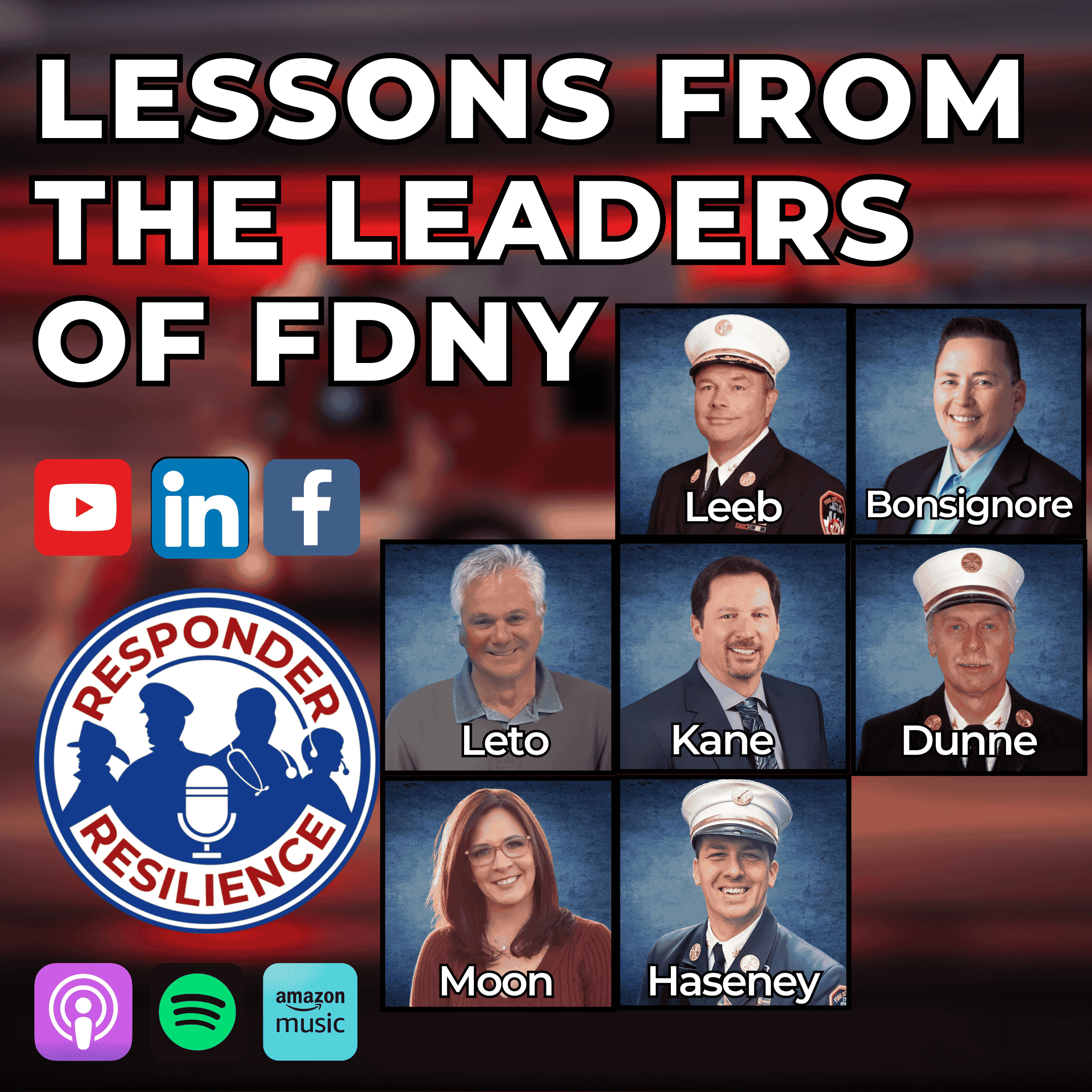
In this episode, we hear from seven influential FDNY leaders who share their insights on effective leadership, resilience, and wellness.
In this episode, we hear from seven influential FDNY leaders who share their insights on effective leadership, resilience, and wellness:
- Captain Frank Leto: Discusses the rapid formation of FDNY mental health resources after 9/11.
- Lieutenant Drew Kane: Offers insights into the support provided by the FDNY Counseling Services Unit to over 16,000 members and their families.
- Chief Frank Leeb: Highlights the importance of training and collaboration between FDNY leadership, unions, and peer support.
- Chief Lillian Bonsignore: Shares her experiences managing FDNY EMS operations during the challenges of COVID-19.
- Chief Thomas Dunne: Provides insights on maintaining composure as an incident commander at large emergencies.
- Kristina Moon: Advocates for organ donation and shares her wisdom on having the difficult conversations.
- Battalion Chief John Haseney: Discusses firefighter cancer awareness and the effectiveness of department sponsored health screenings.
Tune in for a powerful discussion that pays tribute to world-class leadership and highlights key topics important to your well-being.
Now available! Helping the Helpers: A Clinician’s Guide to First Responder Mental Wellness, our new book that equips you to build a First Responder-Centered Practice that works. Get your copy here: https://a.co/d/5rCAix0
Go to https://www.respondertv.com/p/helpingthehelpers/ for more book info.
Thanks to our resource partner, EMS & FIRE PRO EXPO. Join us for the largest gathering of EMS and fire professionals in New England, September 24 - 27, 2025, at the Mohegan Sun in Connecticut! Sign up at https://emspro.org/
Thanks also to our resource partner, FightCamp. Harness the strength of boxing to release stress, build resilience, and connect with a supportive community. For free shipping and a free month of membership, go to https://joinfightcamp.com/shop/ and use the code RRPONE.
Thanks to our resource partner, CRACKYL. Download the FREE CRACKYL App: http://crackyl.respondertv.com
Contact Responder Resilience:
Phone: +1 844-344-6655
Email: info@respondertv.com
Our website with past episodes and more: https://www.respondertv.com/
YouTube: https://www.youtube.com/c/ResponderResilience
LinkedIn: https://www.linkedin.com/company/responder-resilience-podcast/
Instagram: https://www.instagram.com/responder.tv/
Facebook: https://www.facebook.com/responderTV/
But we're about a thousand members on our job that were present on 9-11. There's not many of us left that are still active members.
SPEAKER_03We'll send peer counselors, retired firefighters, directly to the firehouse and make sure that we're checking up on those firefighters.
SPEAKER_08Myself, as well as the commissioner and the fire ops chief, we were out there doing station visits and talking to people, making sure everybody was okay.
SPEAKER_14Someone who's in charge of a large operation or even a small fire operation, you should feel a level of stress that's only natural.
SPEAKER_07Even though you don't want to talk about what happens when you die, it's just this one small piece that could make your loved one's lives a little bit easier.
VoiceoverWelcome to Respond Resilience. I'm David Dashinger. In this episode, we hear from seven influential FDNY leaders who share their insights on effective leadership, resilience, and wellness. Captain Frank Leto discusses the rapid formation of FDNY mental health resources after 9-11. Lieutenant Drew Kane offers insights into the support provided by the FDNY Counseling Services Unit to over 16,000 members and their families. Chief Frank Leap highlights the importance of training and collaboration between FDNY leadership, unions, and peer support. Chief Lillian Bon Signor shares her experiences managing FDNY EMS operations during the challenges of COVID-19. Chief Thomas Dunn provides insights on maintaining composure as an incident commander at large emergencies. Christina Moon advocates for organ donation and shares her wisdom on having the difficult conversations. And Battalion Chief John Hasney discusses firefighter cancer awareness and the effectiveness of department-sponsored health screenings. Stay tuned for a powerful discussion that pays tribute to world-class leadership and highlights key topics important for your well-being. Thanks to our resource partner, EMS and Fire Pro Expo, the largest gathering of EMS and fire professionals in New England, September 24th through 27, 2025, at the Mohegan Sun in Connecticut. Sign up at EMSPro.org. There's a new app built by firefighters for firefighters, and it's called Crackle. Download the app now for free as a legacy member and get early access to exclusive content, tools, and updates as they drop. Get the free app at crackle.responderTV.com. This episode is made possible by the First Responder Center for Excellence. Discover more at First ResponderCenter.org and connect with us on X, Facebook, LinkedIn, Instagram, and YouTube. We invite you to like and subscribe, YouTube Responder Resilience, Facebook, Responder TV, LinkedIn, Apple Podcasts, Spotify, and go to our website, respondertv.com for past episodes and guest information. We'll be right back with lessons from the leaders of FDNY right after this.
SPEAKER_09In this family, more of us die by our own hands and by the hazards of the job.
SPEAKER_00In this family, up to a quarter of 911 telecommunicators have symptoms of post-traumatic stress. In this family, our mental health and wellness are in crisis, while responders are quietly suffering.
SPEAKER_09In this family, many struggle with job-related stress, burnout, moral injury, sleep disruptions, substance abuse, and relationship problems. In this family, we can't help the helpers.
SPEAKER_00With vital information and resources, resilient strategies, and success stories of overcoming the obstacle.
VoiceoverIn this family, welcome to Responder Resilience. We co-host retired Lieutenant David Daschinger, Dr. Stacey Raymond, and Bonnie Rumoli, LCSW EMTV. Welcome to Responder Resilience. Today we're going to be speaking with Frank Leto. He's retired captain and deputy director of the Counseling Service Unit, the CSU of FDNY. We're going to be doing a deep dive into how 9-11 led to the shaping of the FDNY counseling service unit. And we'll also be talking about firefighter behavioral health. In terms of the counseling unit itself, like where was it before 9-11? And then what were like the what was the expansion like? How did you deal with the challenges of expanding to so quickly to deal with uh the aftermath of 9-11?
SPEAKER_12So I I I think the FDMY CSU was probably the most progressive uh counseling service unit in the country when it came to uh you know firefighters' mental health. But we were a small uh we were a small unit, one location, about 12 people working there. The director was Maliki Corgan, who was really a a progressive uh thinker. So when it became apparent the scope of of the tragedy, now we had 343 firefighters that were killed. The grief that that went throughout the department was was unbearable. Um the trauma that was still going on um was was really remarkable. Uh we had 600 uh kids that had lost their dads. It's just just even saying these things today, it's really even hard for me to uh to grasp uh the gravity of what what happened. And we we knew immediately um that we needed to uh to make some tremendous changes. And in in short order, we expanded to six different locations. Uh we had three or four clinical uh people to start with, and we went to 20 or 30 clinical uh support um you know in the in those in those uh those different locations. We we re we built our peer team um out, uh starting with our retirees because the active members were at the Trade Center. We we we threw so much stuff at the wall. Um many of it didn't work. Um and I think those are the lessons learned that that departments that go through these tragedies should hear. Um and uh some stuff worked, and and and we can you know we we built on that.
SPEAKER_00So um what had to be done to increase the buy-in, you know, to peer support or using the services um for the counseling center, since there was such a stronger stigma back then. Yeah.
SPEAKER_12So again, I I think what we came to realize, um, and it took us a while to realize it, um, but it was really sitting right in front of us is that the magic was us. That um that the buy-in was going to come through people that had the same lived experience, uh, that had credibility within the department. Um, and that if they needed that extra level of care, uh that we had to find culturally competent uh clinical support and other resources. So it was really you know sitting right in front of our faces, and it took us a while to realize that. We had 62 firehouses that had lost at least one member, um, and some, you know, many, many uh, you know, uh 10 and 12 members. So we um interviewed dozens of clinicians and you know, and psychologists and and many of them from NYU and that group. And we we vetted them and assigned them to the firehouses and said, go there 10 hours a week. And now we had funding, we could pay them. Go there 10 hours a week, you know, don't do therapy, but just let them become familiar with um with clinical, uh, you know, what what a clinical support looks like or what a clinician does um to answer their questions. And the program was basically a failure. Um and what we what we had to do, to my amazement now is now I understand it, um, we had to start doing support groups for the clinicians because they were not used to the level of grief and trauma um that we were and we were we were experiencing regularly, and not just from the trade center where for a pediatric call or whatever, we'd get back to the station and have these conversations, and now they became privy to the to our world. We realized there that that wasn't going to be the answer. That the first line of defense had to be us. Um, so we had to we had to educate uh members of the department that had a passion for this and um and keep educating them and and get them to knock on doors of the of the stations uh and spread the word. And it didn't happen overnight. It didn't. It ha it it it took it took years to to reduce and lift the stigma.
SPEAKER_02Our greatest asset is a thinking, knowledgeable, well-trained, physically fit, and healthy firefighter. It is the continual drive to be better, to improve, and to never be satisfied with the status quo. Success begins long before the alarm comes in or the tones go off. Success is nothing new in the FDNY. We did not suddenly wake up one day and become good at what we do. We need enthusiastic leadership and training that has a clear understanding of what's at stake. That is teamwork, that is dedication, that is well-trained firefighters ready to go to work on game day. The time to train is now, before the incident or game day. We've all seen the leader who's tactically proficient, but lacks the people skills for true inspirational leadership. Cornerstones of leadership on and off the fire ground discusses the soft skills necessary for success, both on and off the fire ground.
VoiceoverDrew Kane is a 30-year veteran of the New York City Fire Department. On September 11, 2001, he responded to the World Trade Center and participated in search and rescue efforts for months afterward. His experiences as a first responder, particularly during 9-11, inspired his passion for helping fellow firefighters and their families struggling with substance use and mental health disorders. In 2020, Lieutenant Kane took the baton from Frank Leto to advance the mission of FDNY's counseling service unit and became Deputy Director of the CSU, which operates six sites throughout the metropolitan area. The CSU provides support for the 16,000 active FDNY members, retirees, and their families, addressing behavioral health and substance use issues. How does that work if a member is seeking help? Is it like kind of a walk-in basis? A set of appointment, like how do you coordinate that with uh shift work and and all the other uh parameters that go into it?
SPEAKER_04Well, we try to be uh you know openly uh you know available to all different uh shifts, uh, but unfortunately right now we're limited, so we operate basically business hours, right? Eight to four. But if need be, if somebody outside that box needs to be served, we will take care of that. Um and we also provide referrals. We understand that some of our members may not want to see somebody that's because we are connected uh with the fire department. But basically the way I describe it is you you know we're kinda in the middle, the counseling unit, then you have our union, then you have our administration. The union you know is there for the for the members, right? Obviously, for their rights, and as employees, the administration kind of oversees, hey, you did something wrong, we need to uh you know enforce some code or discipline, and we're just how is that affecting the member? How is the member you know working in their environment? How is it you know part of uh social work? It's uh it's kind of like a biocycle social. They take the person in the environment, so that's where it's unique to have that education and look at it from that point of view because it's not just um you know, uh it's a different job, as we all know. They're first responders and they're bringing a lot of stuff home with them, but uh both physically and mentally. So we try to service the population by having appointments available, getting out referrals. Uh it's become a little bit more challenging now the further we move away from 9-11. A lot of our funding was related to 9-11. Uh and that's that's been waning lately. And quite frankly, I think I think we're about I I I might be misquoting this, but we're about a thousand members on our job that were present on 9-11. Myself included. There's not many of us left that are still active members. Uh so that that to be able to service that population, we do a lot with the retirees, and basically uh, like you you mentioned, Doctor, the retirees still come around, they go out, they go into the field, they they do the outreach, they outreach their voice, and they tell the members what what's available, and then we have to deliver. Rightfully so becoming a little a little more harder in these difficult times financially uh to deliver. You know, deliver the the product, to keep a good product going. But uh, you know, that's part of our job, right? To adapt and overcome. So uh it's a it's a daily struggle.
VoiceoverFrank Leib is the managing director of the First Responder Center for Excellence, FRCE. He previously served as a Deputy Assistant Chief in the Fire Department of New York, retiring in June 2024 after serving for over 31 years. During his tenure with the FDNY, he held several senior staff positions, including the Chief of the Fire Academy, Chief of Training, and Chief of Safety. Frank has also been a member of the East Farmingdale Fire Department since 1983. Frank Lieb's career has been defined by his unwavering commitment to fostering growth through training and development, a central tenet of his leadership philosophy. He is also the author of the best-selling books, Cornerstones of Leadership, On and Off the Fireground, and 30 Fires You Must Know. Ties back to what we were talking about in terms of how leaders can influence firefighters at the beginning of their career and create that culture of wellness and that they're being looked after, like that their welfare and their well-being is an important asset to the department and to the leader. I just love that story that you guys brought the uh you know, the screening to the academy. That's just a great thing.
SPEAKER_03Yeah, and years ago when I came on the fire department, our unions, so our unions play a huge part in the success of everything we do, right? They are um they really are partners with us. Both our UFA are firefighters union and our UFOA are fire officers unions. Um, but they used to have a mobile Medmobile that would go to firehouses and draw blood. Um but that was 100% funded by the unions. And so all of these different programs are steps in the right direction and making sure that we do that. Uh, you know, on a from a mental health standpoint, we have we have peer counselors that we could deploy. Um, the night of the twin parks fire, where seven there were 17 fatalities. You know, we had peer counselors on scene, and these are retired firefighters that are willing to give back. Um and if if I'm working a citywide tour um or or I hear of an incident or someone else that's worked in the citywide tour, we hear of an incident, and it could be that they know that there was um a child abuse and the child didn't didn't make it, right? We'll send peer counselors, retired firefighters, directly to the firehouse and make sure that we're checking up on those firefighters. And that's something that was, you know, before September 11th. Um I'm not really aware of that happening anywhere. But we now have a robust cadre of people that do that on a regular basis. And I'm proud of my organization for for them to really expand and make sure that we're taking care of our firefighters, because you could lose a firefighter and he, you know, and lose him even though he's still alive. And we need to make sure that we prevent that. But we also don't want these firefighters going home and thinking that the the coping mechanism you know is drinking or drugs or taking it out on your family. Because then we wind up, you know, we're winding up with higher divorce rates, or we wind up with suicide. And we these are these are all preventable, especially if we have peer councils that go out and actually and also do more to preload before an incident where firefighters are able to, and uh you know, EMTs and parameters are able to um have coping mechanisms beforehand. So that way when after they see something they shouldn't have seen, they don't go home and just start drinking, and that's their way of handling it that we've preloaded. And next thing you know, instead of drinking, they went for a they went for a walk or they went for a jog, or they they did something else to relieve the stress um you know of the job. And it's not only the job, right? The stress is at home um as well. So it's all of these different things, and I'm proud of my organization for the things that we do to help to help our firefighters and you know, EMTs and paramedics as well.
VoiceoverChief Lillian Bonsignor, paramedic, CIC, is a retired 31-year veteran of the New York City Fire Department. She served as the chief of EMS operations from 2019 to 2022, becoming the highest-ranking officer in EMS command and the first female in FDNY history to achieve a four-star rank. Chief Bonsignor led over 4,300 EMS providers in responding to approximately 1.5 million calls annually during her tenure, particularly through the challenges of the COVID pandemic. With a strong background in EMS training, she previously held the position of Chief of the EMS Academy, overseeing the EMS probationary school and EMS officer training while managing the certification of more than 13,000 FDNY members. Chief Bonsignor retired in December 2022. You answered my question, but I did want to find out, you know, how did you deal with the dynamically fluid changing information that we were receiving on a daily basis, more than once a day sometimes on you know, protocols, uh PPE isolation. Um it sounds like you know it's a moving target, right? But you had to keep everybody up to speed and keep everybody feeling like you know you were looking out for them and giving them the best information available at that point in time.
SPEAKER_08Again, it took it took a lot of work from a lot of people. And we what we end up doing is having a target time each day, a target time to release the the orders and try to consolidate them. Because we we got it, that it was just too much. And we got it also because myself, as well as the commissioner and and you know, the fire ops chief were all going around to the station. We were also making, we were out there doing station visits and talking to people and making sure everybody was okay. Um, and this was a 24-hour operation. This was not something you went home and like, you know, wake me up tomorrow. You know, this was like once it started, you didn't know how long this thing was gonna go for. Uh, but we we ended up trying to consolidate as much as we could. And then, you know, we had one target time during the day that if anything came out, you know, this was gonna be released. If anything came out after that, it was waiting until tomorrow, unless it was critical. And to be honest, there were so many organizations making these these rules and changes that nothing was really critical, you know, and and what we started to see is by the time we were getting it ready to go out, somebody else had already said, that's not critical, that we're not doing that, we're doing something else, you know. So so I think that helped us by trying to consolidate. The other thing we were able to do, which I think, you know, in the long run, like out of every great tragedy is you know, progress, uh, we were able to get all our EMS members issued cell phones. So so and emails. So you know, so at that point, if we had to, you know, get something out, we could go directly, you know, we could go directly to them, which was the you know the idea. Like, let's just put it in their hands. We need to bypass the entire rank structure and get it all out at once. Because honestly, with that call volume, they're not back at their stations till the end of their shift. You know, they're like they're running all day long.
SPEAKER_09Yeah.
SPEAKER_08Um, so and or if they're going back to clean up or restock, they're not looking for orders in the middle of the day. So uh we were able to kind of just try to streamline things as went as it went. But March, you know, March, uh March was the worst, and then April started to uh, you know, kind of ease up a little. And then it was around for quite some time. I mean, you know, standing in the middle of 42nd Street, nobody out there, nobody, no, no car, no anything, you know, very, very eerie. Very reminded me very much of 9-11, how it was back then.
VoiceoverAll units stand by for confirmed structure fire with important person's crazy in a world where first responders save lives, this book could help save theirs by preparing you to answer when they call for help. Based on over 200 conversations and the trusted team behind the Responder Resilience podcast, helping the helpers gives you the tools to understand their world, speak their language, and earn their trust. This work is challenging, but deeply needed and profoundly rewarding. Their stories don't start with trauma, but too often they end there. Infused with real-life experiences, this guide reveals the human behind the badge and equips you to build a first responder-centered practice that works, from understanding responder culture to establishing a foundation of wellness and chapters across the spectrum of first responder professions. You'll gain insight into the hidden struggles that shape their reality and the steps you can take to help them heal. When trust is shattered, the stakes are high. This book helps you build it before it's too late. Are you ready to make a difference? Be the resource they can count on. Order your copy of Helping the Helpers Today. Thomas Dunn is a retired deputy chief and 33-year veteran of the New York City Fire Department with extensive experience working in Mid-Manhattan and the Bronx. He has been the incident commander at hundreds of fires and emergencies in the city. Chief Dunn lectures on incident command, fire safety, and human behavior in disaster at conferences and colleges across the country through his third alarm fire training seminars. He has written numerous articles for fire service publications and serves as an adjunct instructor for both the National Fire Academy and Keene University. What are some takeaways you could share with us from your experience on how to handle that intense stress and pressure on arrival, trying to sort out the scene and get everything, operations in order and keep everyone safe and at the same time keep the public safe, keep, you know, the structure as uh as intact and safe as possible. What what are your thoughts on that?
SPEAKER_14Well, you know, I I think the first thing is to recognize that we are, and you are, as a uh whether you're the initial company officer running the scene or battalion chief or the chief of department, whatever your rank is, um, you're a human. Accept the fact that you're going to be stressed to the max, particularly if you don't have a lot of experience as an insect commander. And even as an experienced in some commander, if you're not feeling the stress, you're probably not doing your job properly. You know, you should be stressed out as someone who's in charge of a large operation or even a small fire operation, you should feel a level of stress that's only natural. All right. So don't beat yourself up and don't doubt yourself because you're feeling stressed, whether you are a brand new, relatively new incident commander or a very experienced chief. Um, some of the particulars that that worked for me. Um initially, I tried to keep it simple. Uh and just to clarify that, I know there are a number of acronyms that people some people use because it works for them, where they they have a system where they can whereby they can uh approach the 13, 14, 15 elements of size up. And if that works for you, if you're a checklist type of person, that's fine. It did nothing for me other than to slow me down and confuse me. I I felt that uh the more intense, the more in-depth you got in your initial size up in any fire or emergency incident, the less you were able to tune into those intuitive responses and intuitive knowledge that makes up 80 or 85 percent of our decision-making process on the fire ground. So rather than looking at a 13 to 17-point size up list, mentally I always try to address what I call the three W's initially. Who have you got? Where are they, and have you got water? If you can use the three W's as at least the starting point for any fire, it will calm you down. It will give you a point to initiate your your thought process and setting up your strategy and tactics. Um, if you I always found if you found yourself really blown out of the water, you know, this fire is doing so badly, and there's so much going on, and most of it is bad. Um, if you find yourself just getting in beyond your depth, there's an expression I like uh called rebooting your brain. And all that means is you're stepping back mentally for one second, and you're not worrying about the four or five or six problems that you're dealing with. You're gonna you're gonna attack one specific thing. Maybe it's one specific tactic. Maybe you want to step back and say, all right, if we're in a high-rise building, what is the most appropriate attack stairway to use to stretch my close line? Or if we have a water issue, what units on scene can I use to set up a reliable water supply? So I think sometimes rebooting your brain, getting away from the strategic fears you're dealing with, and concentrating more on for just a minute or so, one specific tactic can kind of calm you down and use that as a stepping stone. Um so that's some of the things that worked for me. The whole concept of a command bubble, and that's been described in lectures and literature. Uh, I like to immerse myself as much as possible in a command bubble, which is kind of like a sense of I'm here, I'm functioning, I am receptive to all that's going on around me, but I'm gonna kind of stay in in my own bubble for a while, trying to divorce myself from uh all the hysteria and chaos that's going on out there. But those are those are some of the things that that worked for me. And and and the final thing, and I I'm you know, this sounds kind of strange, but I really believe in this. Um, you have to be a good actor, all right? Uh you have to be able, particularly if you're trying to run a complex operation, you have to come across as competent and stable. Even if you are totally, you know, not feeling that. Uh, you have to be able to take a deep breath, pause for a moment before you communicate, and try to come across with that command presence. And it's okay if you don't feel that, it's okay if you act that. Uh, that was one of the things I take pride, I was particularly good in in my role as an incident commander. And to this day, I have guys come up to me uh that I worked with who worked for me, and they say things like, You were the comeless guy at any fire. And I'm honest with them. I tell them it was nonsense, it was all an act. If you could have put a blood pressure device on my arm, you would put me in the hospital. But I realized I had to act like I was confident, act like I was calm. And the funny thing about that, when you started acting like that, it somehow affected your think, your thought process. It did calm you down. So those are some of the 10 minutes. Everyone has their own things that work for them, but um, so there's some of the personal things that I I was able to use pretty effectively.
VoiceoverHey, firefighters, let's take a moment to talk about something important. There's a new app built by firefighters for firefighters, and it's not just another wellness tracker or generic resource hub. It's called Crackle. You've probably seen the magazine, but this is the next evolution. The app is about one thing helping firefighters not fail. Not just on the job, but in life, in your health, your relationships, your mindset, and your longevity. That's why Crackle is designed to meet firefighters exactly where they are, with resources that make sense, are easy to use, and actually respect your time. You can download the app now for free as a legacy member. That means you get early access to exclusive content tools and updates as they drop. Use the QR code on the screen to download the Crackle app, or you can download it from the App Store or Google Play and stay in the fight. Not just at work, but at home and in your own head too. Because your best days shouldn't be behind you, they should be ahead of you. Christina Moon is the president of the Billy Moon Foundation, which supports, advocates, and brings awareness to organ donation. Now, as she overcomes the grief of losing her husband in December of 2022, she finds herself educating others on the importance of having hard conversations with loved ones as she shares her family's story around the country through the foundation. Christina's husband, firefighter William P. Billy Moon II, lost his life after a fall while preparing for a training exercise in the quarters of Rescue 2 in Brooklyn. Christina prides herself on spreading such an important message, celebrating the life of her husband and keeping his memory alive, especially for their two children.
SPEAKER_07You know, when you're a part of the first responder world, you kind of tuck away in your head and your heart that there are things that may happen. But it's you know, you almost feel like it's more important to just live in the moment and enjoy what life has to offer because in reality nobody really wants to talk about what happens when they die. You know, you want the cupcakes and the roses and the rainbows. But I'm so proud to say that Philip and I did have these conversations. You know, I can remember sitting in, you know, I'm sitting in the dining room and he's in the living room, and he looks at me and he goes, Are you an organ donor? And I was like, I wouldn't, I don't think it's on my license though. And he's like, Well, why not? And I changed my license, and he did that to people at the kitchen table. And to me, that's a hard conversation because even though you don't want to talk about what happens when you die, it's just this one small piece that could make your loved one's life a little bit easier if they are put into that situation. Because I've had people reach out to me and I shared our story, and I'll tell you that organ donation was the light in the darkest hours of my life. And I tried to explain to them and they're like, Thank you so much, and they go to their loved ones and they're gonna donate a loved one's organ. And then a family member comes in and goes, No, this isn't what we don't know if they wanted this, we're not doing that. And they don't donate the organs because now there's conflict between the family, and the last thing you want is conflict when you're trying to begin a grieving process that's not easy to begin with.
VoiceoverBattalion Chief John Hasney has served the FDNY since 2005. Currently, he is assigned to Battalion 44. He holds a Bachelor of Science degree in fire science from John Jay College of Criminal Justice and a master's degree in security studies from the Naval Postgraduate School's Center for Homeland Defense and Security. He is a founding and active member of the FDNY Contamination Reduction Workgroup. The work group was created to reduce its members' exposure to fireground contaminants that cause cancer-related deaths and disabilities. So, Chief, I want to kind of move to that proactive piece, and that's um you've had some initiatives to screen for stuff like skin cancer. Can you talk a little bit about that? How does that work? The logistics, the buy-in, all that good stuff.
SPEAKER_13Oh, yeah, well, I'll start with the original story if you want to say. So again, in it was around uh 2023, uh Frank Leaf uh introduced me to uh Russ Osgood. He's a uh chief in Maine, and he is uh one of the main uh firefighter cancer support network members. And he said he came to me and said, Hey, is the FDY interested in doing uh free cancer skin cancer screens? So I said, Yeah, I'll take that over. So then ever since then, uh we've uh started a partnership with the American Academy of Dermatologists, uh where we are up to our sixth skin cancer screening, it's free by the way, uh where um with our partnership uh with the academy, they literally have proposed to their membership uh that firefighters are gravely at risk, and we have a 20, sorry, I'm cheating here, a 21% greater risk of uh getting skin cancer. So they said we're a at-risk population, and they are literally getting their members, which is again amazing, to volunteer their time to give us free skin cancer screenings. So literally this Saturday is gonna be our sixth skin care uh free cancer cancer screening in Staten Island at a firehouse, and uh they literally the the dermatologists they come volunteer their time, and uh we uh we put out sign-ups about a month before. We uh notify our membership through what we call uh buck slips, their internal notices to the departments. We have the unions, thank god for the unions. Uh the unions email all the membership. We have two firefighters, we have a firefighter union, an officer union, they email the membership. Uh we put up on video displays, and uh we've had an amazing uh response. So, like so far, over five screenings, cheating again, sorry, we've had uh 871 firefighters come. Uh like it's one of the top screenings out there. And but the the shocking aspect, which is every time I email uh the unions and the leadership, is that out of those 871 firefighters, 236 have either potential or suspected cancers. So that's 27%. So it to me, 27% of people screened have either potential or suspected cancer by the dermatologist. They don't do any uh you know, cutting stuff off or they don't do biopsies, they don't do it there, but they say, hey, you need to go get that checked, you know, by a dermatologist in their office and have a biopsy. But it it's a great it's a great initiative, and I recommend uh uh if uh a department wants to do it, literally either contact your local fire cancer support network and say, hey, I want to get a free skin cancer training, or contact the American Academy of Dermatologists and say, Hey, I want a free skin cancer, and they'll try to set it up for you. It's it's a one of the top initiatives I feel like we're doing right now.
VoiceoverThank you. Great speaking with you today. Thanks for sharing your time. Remember to like and subscribe, YouTube, respond to resilience, Facebook, responder TV, LinkedIn, Apple Podcasts, Spotify, and go to our website, respondertv.com for past episodes and guest information. Till the next time, stay safe, be kind to yourself, take care of the city.

Deputy Ass't. Chief, Fire Department of New York | FDNY Acting Chief of Training
Frank Leeb is a Deputy Assistant Chief in the Fire Department of New York and is the Acting Chief of Training. Frank has been a member of the FDNY since 1992, and holds a bachelor's degree in Fire Service Administration and a Master’s in Security Studies.

Commissioner of FDNY | Retired Chief FDNY EMS
Chief Lillian Bonsignore, Paramedic, CIC- is the FDNY commissioner, and a retired, 31-year veteran of the Fire Department of New York who served as the FDNY Chief of EMS Operations from 2019-2022 during the COVID Pandemic. She was the highest-ranking Officer in the EMS command, the highest-ranking uniformed female in the FDNY, and the first female to achieve a 4-star rank in the history of the FDNY. Chief Bonsignore was responsible for the operational oversight and leadership of more than 4300 EMS Providers in New York City, where EMS responds to 1.5 million calls per year. She also has an extensive history in EMS training. She previously served as the FDNY Chief of the EMS Academy, where she was responsible for the EMS Probationary School, EMS Officer training, and managed the EMS certification of more than 13,000 members of the FDNY.

Retired Deputy Chief | Author | Speaker
Thomas Dunne is a retired Deputy Chief and 33 year veteran of the New York City Fire Department with extensive experience working in Mid-Manhattan and the Bronx. He has been the incident commander at hundreds of fires and emergencies in the city.
Chief Dunne lectures on incident command, fire safety, and human behavior in disaster at conferences and colleges across the country through his “Third Alarm Fire Training” seminars. He has written numerous articles for fire service publications and serves as an adjunct instructor for both the National Fire Academy and Kean University.
He is the author of Notes From the Fireground, a memoir of his experiences with the FDNY and a novel, A Moment in Time

President, Billy Moon Foundation
Kristina Moon is the president of The Billy Moon Foundation which supports, advocates and brings awareness to organ donation. Prior to that, she spent 20 years in the field of elementary education. Now, as she overcomes the grief of losing her husband in December of 2022, she finds herself educating others on the importance of having hard conversations with loved ones as she shares her family’s story around the country through the foundation. Kristina’s husband, firefighter William P. “Billy” Moon, II lost his life after a fall while preparing for a training exercise in the quarters of Rescue 2 in Brooklyn. She prides herself on spreading such an important message, celebrating the life of her husband, and keeping his memory alive, especially for their two children.

(Retired) FDNY Captain | Deputy Director of the Counseling Service Unit (CSU) of FDNY
Frank Leto, retired FDNY, has been a leader in fire service behavioral health since the 2001 attacks on the World Trade Center. He travels nationally and internationally developing behavioral health protocols and aiding communities after major events. Mr. Leto is a member of the IAFF Disaster Response To-Go Team. Frank has worked closely with the NFFF and is a member of the FRCE Behavioral Health Advisory Committee. He also collaborates in research, regarding pressing health and safety issues throughout the fire service. Frank was one of the first graduates of the West Point Military Academy’s Terrorism and Counterterrorism Program. He also holds degrees and advanced certificates from Binghamton University and New York University.

Battalion Chief (FDNY) | Veteran
Battalion Chief John Haseney has served the FDNY since 2005. Currently, he is assigned to Battalion 44. He holds a Bachelor of Science degree in Fire Science from John Jay College of Criminal Justice and a master's degree in security studies from the Naval Postgraduate School, Center for Homeland Defense and Security. He served in the New York Army National Guard from 2004-2012 and is an Afghanistan combat veteran of Operation Enduring Freedom. Founding and active member of the FDNY Contamination Reduction Workgroup which began in 2017. Workgroup was created to reduce its members’ exposure to fireground contaminants that cause cancer-related deaths and disabilities.

Deputy Director FDNY Counseling Service Unit
Drew Kane is a 30yr veteran of the New York City Fire Department. For 12 years, Lieutenant Kane was assigned as a firefighter to Engine Company 37 in Harlem, and on September 11, 2001, Lt. Kane responded to the World Trade Center site. There, he continued to participate in search and rescue efforts for many months following the event. His experience as a first responder, especially his response to 9/11, fostered his desire and passion to assist other firefighters and their family members who struggle with substance use disorder and other mental health disorders.
In 2004, Lt. Kane was assigned to the New York City Fire Department’s Counseling Service Unit (FDNY-CSU) as a peer/substance abuse counselor within the Addiction Treatment Program. In 2009 he graduated with a master’s degree in social work from Hunter College School of Social Work. He holds a license in social work from New York State and is a Credentialed Alcohol and Drug Abuse Counselor (CASAC).
In 2009, Lt. Kane was promoted to Program Director of the Addiction Treatment Program. As Program Director, Lt. Kane was responsible for the supervision of the daily operations of this unit and its staff of licensed mental health professionals. He managed clinical interventions for firefighters and their families, as well as group and individual counseling.
In 2020, Lt. Kane was promoted to Deputy Director of the FDNY-CSU. The CSU is comprised of six sites throughout the metropolitan area that serve the 16,000 active members of the FDNY and their families, addressing behavioral, mental health … Read More