Apple Podcasts
 Spotify
 YouTube
 RSS Feed
 101 Questions To Ask Before Becoming A Law Enforcement Officer with Guests Ernie Stevens and Scott Medlin | S5 E43
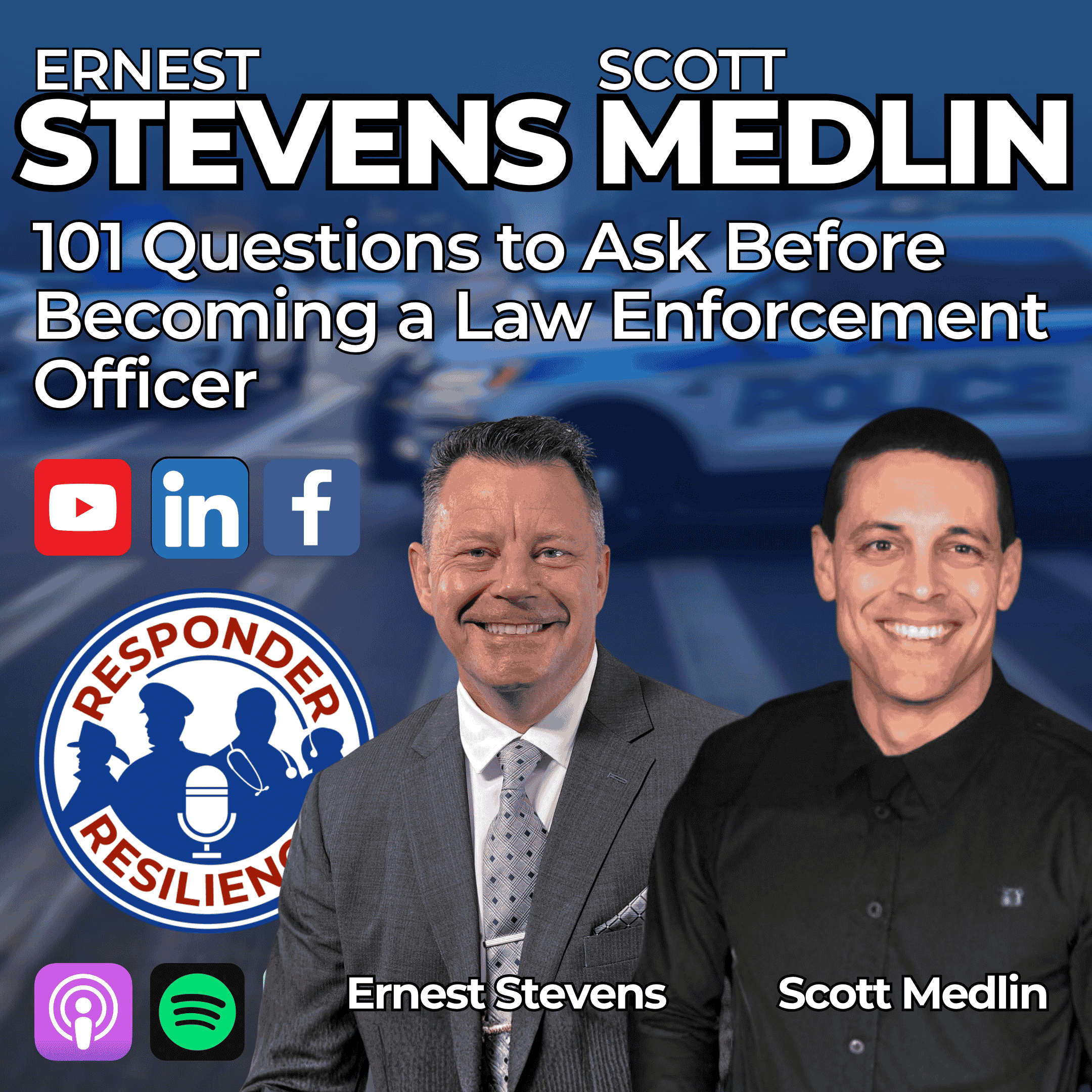
Join us for this compelling episode featuring retired police officers Ernest Stevens and Scott Medlin as they unpack their groundbreaking book, *101 Questions to Ask Before Becoming a Law Enforcement Officer*. We lean into eye-opening discussions that will challenge your perspective on a career in policing.
Join us for this compelling episode featuring retired police officers Ernest Stevens and Scott Medlin as they unpack their groundbreaking book, *101 Questions to Ask Before Becoming a Law Enforcement Officer*. We lean into eye-opening discussions that will challenge your perspective on a career in policing.
Hear firsthand how this powerful toolkit is designed to prepare aspiring officers and their families for the realities of the job. From collaborative writing insights to practical advice for potential recruits, this episode is packed with real-world reflections and valuable lessons for anyone considering a path in law enforcement. Tune in and get ready to think critically about what it truly means to serve and protect!
Now available! Helping the Helpers: A Clinician’s Guide to First Responder Mental Wellness, our new book that equips you to build a First Responder-Centered Practice that works. Get your copy here: https://www.amazon.com/dp/1969267003
Thanks to our resource partner, First Responder Project, whose no-cost first responder retreats offer you a chance to reclaim connection and learn vital skills. Take a stand for your well-being and the connections that matter most. Learn more and register at FirstResponderProject.org
Thanks to our resource partner, CRACKYL. Download the FREE CRACKYL App: http://crackyl.respondertv.com
Thanks also to our resource partner, FightCamp. Harness the strength of boxing to release stress, build resilience, and connect with a supportive community. For free shipping and a free month of membership, go to https://joinfightcamp.com/shop/ and use the code RRPONE.
Contact Ernie Stevens:
Website: http://www.erneststevens.com/
Twitter: @Estevens0845
LinkedIn: https://www.linkedin.com/in/ernest-stevens-b4234a1b6/
Contact Scott Medlin:
Website: http://thescottmedlin.com/
Instagram: https://www.instagram.com/the10codemindset/
LinkedIn: https://www.linkedin.com/in/scott-medlin/
Contact Responder Resilience:
Phone: +1 844-344-6655
Email: info@respondertv.com
Our website with past episodes and more: https://www.respondertv.com/
YouTube: https://www.youtube.com/c/ResponderResilience
LinkedIn: https://www.linkedin.com/company/responder-resilience-podcast/
Instagram: https://www.instagram.com/responder.tv/
Facebook: https://www.facebook.com/responderTV/
Well, Scott writes the 101 question books. What about if we did a book about 101 questions to ask before choosing a career in law enforcement?
SPEAKER_07Therefore, it is important to ask the right questions, and we didn't provide the answers for these questions. We want people to go out there and get the answers themselves because the answers are going to vary.
SPEAKER_02What is my true interest and desire in the population that I want to serve and then find out about it? Like what are what are my options in this field?
SPEAKER_07We really did our best to cover all the foundational steps to not only someone get interested in getting in, but those who want to continuously seek to grow as people throughout their career. I think all 10 chapters covered that foundation.
SPEAKER_05Welcome to Responder Resilience, along with Bonnie Rumley, LCSW EMT. I'm David Dashinger. Joining us tonight are police officers, either retired police officers, Ernie Stevens and Scott Medlin, and they're going to dive deep into their new book, 101 Questions to Ask Before Becoming a Law Enforcement Officer. And this isn't just another book, it's a powerful toolkit for anyone considering a career in law enforcement. They're tackling the tough questions, arming aspiring officers and current officers with the knowledge to think critically and prepare intentionally for one of the most demanding jobs out there.
SPEAKER_10Thanks to our resource partner, First Responder Project, whose no-cost First Responder Retreats offer you a chance to reclaim connection and learn vital skills. This isn't just a retreat, it's a lifeline to keep you mentally strong at work and emotionally present at home. Take a stand for your well-being and the connections that matter most. Sign up now for your FRP retreat. Learn more and register at firstresponderproject.org.
SPEAKER_01There's a new app built by Firefighters for Firefighters, and it's called Crackle. Download the app now for free as a legacy member and get early access to exclusive content, tools, and updates as they drop. Get the free app at crackle.responderTV.com.
SPEAKER_10Thanks also to our resource partner, Fight Camp. For free shipping and a free month of membership. Go to joinfightcamp.com slash shop and use the code R R P O N E.
SPEAKER_05We invite you to like and subscribe, YouTube, Responder Resilience, Facebook, Responder TV, LinkedIn, Apple Podcasts, Spotify, and go to our website, respondertv.com for past episodes and guest information. We'll be right back to speak with Ernie and Scott after this.
SPEAKER_06In this family, more of us die by our own hands and by the hazards of the job. In this family, up to a quarter of 911 telecommunicators have symptoms of post-traumatic stress. In this family, our mental health and wellness are in crisis, while responders are quietly suffering. In this family, many struggle with job-related stress, burnout, moral injury, sleep disruptions, substance abuse, and relationship problems. In this family, we can help the helpers. With vital information and resources, resilient strategies, and success stories of overcoming the obstacles.
SPEAKER_05We'd like to welcome back Ernie and Scott, who have been with us before, and uh they're amazing contributors to some of the work that we've been doing, uh, both our book and our podcast and some documentary stuff we've done as well. So a quick bio. Ernie Stevens is a published author and speaker with 28 years of experience as a police officer. 26 of those were with the San Antonio Police Department. He's a founding member of the mental health unit and has been featured in the Emmy Award-winning HBO documentary, Ernie and Joe Crisis Cops. And currently he serves as a deputy director of law enforcement for the Council of State Government's Justice Center, providing national technical assistance and best practices for mental health crisis responses. Scott Medlin is a Marine Corps veteran, former police officer, and national speaker who understands the toll public safety can take. Midway through his law enforcement career, Scott faced challenges that forced him to reevaluate his mindset and habits. And that transformation not only changed his life, but also reshaped his work, leading him to help others to do the same. Through his 10 code mindset brand, as well as his books, podcasts, and YouTube channel, Scott now equips first responders with practical tools to manage stress, strengthen families, and thrive. Tony and Scott, welcome back to Respond to Resilience.
SPEAKER_02Great to be here. Thank you, David.
SPEAKER_07Appreciate it. Thank you. Honored to be here. Those intros really get me fired up too. I love them.
SPEAKER_03Us too, by the way. As David said, we've had both of you on before, and those interviews were really, really fun for us and rewarding, I know, for the listeners and viewers. Um, and we're bound to have a good time with the four of us on here. So whoever's listening is probably going to get a little chuckled tonight and some really valuable info. So thank you for the time. Um you know, I am really intrigued and want to know how you two met. So please tell us the story of your journey uh before we jump in and talk about all the wonderful things you're doing together.
SPEAKER_02Well, I'll take this one. No, it's gotta be quiet. I got this. So um if anybody spent more than five minutes on LinkedIn, they've seen a post by by Scott, right? So um I I knew I I knew he was I saw a lot of his posts, and then I get a message on LinkedIn. And correct me if I'm wrong, Scott. My memory, I'm I'm older than you, so my memory's not as good. But uh, I get a I get like a message from him saying, Hey, you live in San Antonio? I was like, Yeah, he goes, uh, question for you. We we may be moving there, purchasing a house, you know, could you recommend some areas of town? I think we're gonna come out and visit. So I said, Well, when are you gonna come? Um, and you know, before you get a hotel or something, you know, I got an extra room at my house. Why don't you just stay with me? You know, we'll we'll figure it out. He's like, Okay, yeah, that sounds cool, man. And now we've never met, we've never talked, right? So he's like, Yeah, that's cool. Uh, I'll let you know. So I go tell my wife, hey, uh, I just invited this guy to come stay with us. Him and his him and his wife are gonna be here in like a couple of weeks. She's like, Well, who is he? I'm like, I I don't know. I see him on LinkedIn all the time, but he used to be a cop, so I'm sure he's cool. Then I find out Scott like tells his wife, she goes, I'm sorry, who who are we going? Like, so our wives were like totally skeptical about this. And me and Scott are like, Yeah, I'm sure we'll get along. Uh, and so yeah, he showed up. Now, when he showed up, I didn't know he was like six foot eleven or whatever the hell he is. And I've got like I got like just an extra room, but it had like a twin bed in it. I'm like, oh my god, where's this octopus gonna fit? Like, so yeah, him and his wife came and they showed up. We went to dinner, sat up by the pool, uh, got to know each other a little bit, and then just kind of formed a really good friendship from there.
unknownYep.
SPEAKER_02At least that's my version of the story.
SPEAKER_07That is very that is very accurate, but I will give credit where credit is due. Uh I I connected with Donna Brown a few months prior, and when when somehow she brought up, she said, You need to reach out to Ernie, he's in San Antonio. I was like, Oh, that's right. Okay. So that's what led to the message, and then it turned into a phone call that turned into a visit, which turned into a friendship. Yeah. And what's really cool is my wife works for a big corporate company in San Antonio that that is based in San Antonio. Now she does work remote, but she goes to San Antonio twice a year, and more times than not, she's able to meet up with Ernie and his wife Lisa. So it's pretty cool. Yeah.
SPEAKER_03That's that's a great story. Thanks for sharing.
SPEAKER_05And Donna Brown is the ultimate connector. Uh yeah, Scott, talk a little bit about where the idea came from. How did you decide this is an important book to write and uh decide to put all that time and effort into writing the book? I'll kick it off to Ernie because he gave me the call about that.
SPEAKER_02So I was listening to a podcast with uh Joe Rogan and he had a guest on there, and they were talking about you know things they wish they knew before they started a business. And you know, they threw out the title, wow, if you know somebody could write a book about 101 questions on you know what to know about starting a business, I would I would have bought that. And then they start talking about, well, yeah, how about 101 questions, you know, before you get married, you know, and and you know, and I'm thinking about all these 101 questions, and I'm like, well, Scott writes the 101 question books. What about if we did a book about 101 questions to ask before choosing a career in law enforcement? Because now that I look back, man, I wish I would have asked so many more questions, you know, from you know what, you know, and we we can talk about all what's in there, but wow, looking back, and I thought, well, Scott's, you know, he's very active, and maybe he'll take me up on an offer if I if we you know if I toss the idea to co-author a book with him and um let's see where it goes. So I I I called him up on my walk, and Scott, I'll let you take it from there.
SPEAKER_07Oh, I didn't even hesitate to say yes, of course, let's do this. And uh, but it was also a great idea, just because looking back, I did uh I mean I asked the basic questions. What does police academy look like? What can I do to prepare? What are the jobs you can do when you're in the police department? But that that's just a few. And looking back, I'm like, there's so many more I should have asked for not only success more success, but sustainability, proactive measures to prevent some of the hardships that I went through, particularly at home. Uh and that and that stuff wasn't talked about back then, so I I feel like yeah, there's a shift, but it it needs to be in the basic foundational questions. Uh, but in addition to the extent of what you will be expected to remember and just how many of those skills are perishable, uh, even even case law, something like that. Therefore, it is important to ask the right questions. And we didn't provide the answers for these questions. We want people to go out there and get the answers themselves because the answers are going to vary uh among a lot of the questions based on what jurisdiction or type of career you're looking or like agency you're looking to uh get hired by, that kind of thing.
SPEAKER_03And was there a moment or a few moments where you found yourself surprised with something that you came up or an idea that you stumbled on?
SPEAKER_02Yeah, I think the hard part was, you know, we wanted to write at least like 10 chapters and then provide 10 questions per chapter, and then at the very end, throw in like a bonus question. So the hard part really was, you know, that it's such a broad-based field in law enforcement. You could really talk about anything and everything. So to try to whittle it down to 10 topics of what we felt would be most informative to the reader. And like Scott said, it's it's it's a workbook. You got to go out and do the work. And then it's a living document. Go back after you've filled this out, after you've been on a couple of years and become cynical and see what your answers are. And you know, go back and reread it and see if your answers have changed, right? So I I think it really was trying to find to agree upon 10 solid chapters that would provide the most value and benefit to the reader.
SPEAKER_07Yeah. And that was actually a hard part. We were we were rubbing our eyes or think scratching our heads going, hang on, wait a minute. This there's so many more than 101 questions, but we, you know, obviously 101 just has a ring to it. So uh but we've we we could have done 201 with a lot more chapters, but we we hit the basics. Like we were like, okay, when we actually want to think about foundational principles to law enforcement, I think all 10 chapters covered that foundation.
SPEAKER_03All units stand by for a confirmed structure fire with important person's treatment.
SPEAKER_01In a world where first responders save lives, this book could help save theirs by preparing you to answer when they call for help. Based on over 200 conversations and the trusted team behind the Responder Resilience podcast, helping the helpers gives you the tools to understand their world, speak their language, and earn their trust. This work is challenging, but deeply needed and profoundly rewarding. Their stories don't start with trauma, but too often they end there. Infused with real-life experiences, this guide reveals the human behind the badge and equips you to build a first-responder-centered practice that works, from understanding their culture to the practical realities of working with first responders and chapters across the spectrum of first responder professions. You'll gain insight into the hidden struggles that shape their reality and the steps you can take to help them heal. When trust is shattered, the stakes are high. This book helps you build it before it's too late. Are you ready to make a difference? Be the resource they can count on. Order your copy of Helping the Helpers, the Clinician's Guide to First Responder Mental Wellness today.
SPEAKER_05We can relate to this a little bit because Bonnie, Stacey, and I just collaborated on a book, and probably writing a book by yourself is a little different than writing with uh a partner or collaborator. So, Scott, what was it like working with Ernie? Um, what was your process? Um, how'd you guys work to create chapters together and um come up with a final result that you were satisfied with?
SPEAKER_07Yeah, just uh I I mean, honestly, it it it was wasn't like a ton of meetings or anything like that. We just we met on Zoom a few times. We said, here's our course of action. We did a big uh shared document and we we saw each what each other was doing with it, and then uh you know had the book edited and or proofread and and then there it was. But it really was fun overall to uh pick each other's brain and also our experience levels and say, Well, you take this chapter. Like Ernie obviously took uh you know questions about mental health and de-escalation and communication and stuff like that. And then uh I picked up the mental health part of it. Um and and so we we knew which ones which chapter we would be uh we could decide to work on and stuff like that. So it was a great process. I enjoyed it, I really did, and then we were really stoked to launch it uh when it when it when it came out.
SPEAKER_03Well, you can tell by your chemistry even here that um you complement each other in many, many ways, you know, not just in the the comedic sense of that, but in factual things and in your experience levels. And so, you know, what you're saying really makes sense. And I'm sure that that's also ringing true on the pages, too. The fact that you can meld your ideas, meld your thoughts, and make it one. Um, so I think it's special because I don't think everybody could do this kind of a collaboration, to be honest with you. Um, there are moments where it is hard. You know, David and I can attest to that. It's like, do we do we really love each other this much to be doing this? Um, and I feel like it tests you in some ways. Um you know, but in the end, we came out even stronger. Um, so it seems like you've had that similar process there.
SPEAKER_07Well, we did, and I I I I also let me finish, Ernie. No, okay. It's always Scott. Always about it.
SPEAKER_03It really is a marriage.
SPEAKER_07You know, one one thing, one thing I think we were great about was we never said, Yeah, you're right, I should do this or I should do that to help get it done. It was I will and I can't, I can do that, or hey, I've got this, or it was like talk, like definitive, we're going to do this. And we were just both all in, and there was no wavering in that. And that that was the that was the big key in my opinion. Plus, Ernie's a nice guy.
SPEAKER_02Yeah, I mean, it was it was fun working off a share document because we would get notifications, you know, when somebody would add a comment. And I'm like, oh man, there's Scott's ADHD's kicking off because here comes like 12, here come 12 comments at you know, all hours of the morning and this. So I kind of knew I'm familiar with that. Yeah, yeah. So he's an interesting guy, right? He's Scott is an interesting creature. Um, but you know, I I actually leaned on him, you know, for a lot of advice. You know, hey Scott, what do you think about this picture? Um, what do you think about this background? Like, because he's he's got more experience in writing books than I do. Uh he's very accomplished in in that, and I and I respect that. And I will always yield um my humility to him uh when it comes to to working alongside him. And I think we complimented each other pretty well in writing this because we come from two different types of agencies, two different types of cultures. So I think that benefits the reader because now you have two different perspectives, um, but they're covering topics that doesn't matter if you're at a small agency, rural agency, mid-sized agency, school district, large municipality, these questions are going to be pertinent no matter where you land. And just the top, just the title itself. Um, I think David, you almost slipped up at the beginning. You said 101 questions to ask before you uh choose to be a police officer or something, right?
SPEAKER_05Yeah.
SPEAKER_02But I we we caught that because we almost did that. I said, no, no, law enforcement officer. Because that could be a sheriff, a constable, you know, a park ranger, uh, you know, you name it. There's so many um different career fields within law enforcement that we wanted to make sure that you know we were uh being very inclusive to the audience.
SPEAKER_05So let's let's dive into the meat and potatoes of the book. Um career preparation. Uh you know, people see law enforcement on TV, they see it in the movies. Um that's probably a very different reality than what it's like to actually do the job. So, how does the book address that equipping people, officers, maybe even their loved ones, to understand, um, understand the realities of that career?
SPEAKER_07Just ask the ask the hard questions. I mean, there's obvious questions in there, like what can I do to get in shape for the academy? But we do go into difficult questions. Uh I mean, there's even like in in the use of force section, that's chapter eight. I mean, it's it's you know, will will you under pressure be able to morally do the right thing, even when the officer next to you is not, or or you run into that situation. I mean, it's it's it's hard to talk about, it's hard to think about, but I feel like people can't be naive. They have to understand there could be some conflicts with with other co-workers and in situ compromising situations, and uh they have they have to understand that. So these are the questions that need to be asked in the beginning.
SPEAKER_02You know, but you know, Scott, um when when you bring that up, you know, we talk about you know a duty to intervene. You know, when one officer is overstepping their authority, you know, for even a younger officer to be able to intervene in that situation is very uncomfortable, um, but necessary, very necessary in order not to lose legitimacy between the public and law enforcement. So we address that. Um, and not only is it addressed here, it's being addressed nationally. You see it from the police executive research forum and the standards of policing that they should have something in policy to protect an officer if they do have to intervene. So it's a that's a tough question. That's a tough topic to talk about. But if you spend any time on social media at all, you see officers standing around that should have or could have stepped in to put an end to a situation, and unfortunately, it doesn't happen enough, and it the domino effect just continues over and over. Right.
SPEAKER_03So we have these hundred and one questions. Um, and we know that they're poignant and they cover all the ground that we need to cover. But just practically speaking, here, what do you think the steps are that are really most important and most critical to begin with that you recommend to officers who really are officers and other law enforcement um to figure out if this is the right profession for them? What are those kind of critical key questions that you would say here?
SPEAKER_02I think you know, in chapter one, it's the pathway to law enforcement. It's, you know, what field of law enforcement do I want to be in? Do I want to be in corrections? So does that mean working for a sheriff's agency? Uh do I want to work in a patrol status and work for a municipality? Do I want to work um, you know, a lot of um maybe for a state highway patrol? So it's it's you know, do you gotta kind of do your research and figure out what is what is my true interest and desire in the population that I want to serve and then find out about it? Like what are what are my options in this field? You know, if I do want to do a be a police officer and start out in patrol, you know, what's the difference between trying to get into a larger agency or starting in a smaller community until I kind of learn like because that's what I did, Bonnie. I I started out in a small agency called Terrell Hills here in San Antonio, it's like 6,000 people, um, very rich, very to-do, all the all the San Antonio Spurs and people live in this area. So it was extreme customer service to the to the to the max. And we were a start-to-finish type law enforcement agency, meaning if we handled a burglary call, I actually did the fingerprint lifting, I did the photographs, I casted the mold of a shoe print or whatever. I handled all the evidence, I put it in the property room, and then when I went to San Antonio, I it was wide open, eyes wide open, saying, wait a minute, I don't have to do this anymore. I can just call for somebody and they come and do it. Like this is beautiful. Um, and you know, then we have these evidence technicians that come out and do this. So that's a different type of job within a police agency. Yeah, I was very accustomed to doing it from start to finish. And what was what was good about that was if I started a case and then I went to court and testified, I was a I was a part of that process from start to finish. To where once I, and you, you know, you'll do that if you arrested by DWI, you'll be there from start to finish. But if you're if you go to a larger agency, once you've handled that part of that scene, okay, let's bring in the detective. What did the suspect say to the detective? How was that interrogation or interview conducted? And it just it if you kind of get removed from it a little bit because these agencies get so large and there's um, you know, just um different types of investigative units that can that can do your job so you can get back on the street where you belong.
SPEAKER_09Boxing has the power to change lives, especially for first responders. Fight Camp embraces your journey, whether you're stepping into the ring for the first time, returning after a break, or aiming to elevate your fitness. Harness the strength of boxing to release stress, build resilience, and connect with a supportive community one punch at a time. For free shipping and a free month of membership, go to joinfightcamp.com slash shop and use the code RRP1. That's R-R-P-O-N-E.
SPEAKER_07We also hit on questions, foundational questions, about the person themselves. And this is something I didn't really think about when I was getting into it back in uh 2007. It was just a matter of we wanted questions that would have the person examine who they are and not only like what interests you in the profession, but why? Like what's the purpose behind it? Because in a career like this, it has to be something beyond you. If you really want to be good at it, it has to be beyond you, like basically uh other people's service. But what's your drive for that? And then what values do you have that align with working in law enforcement? Uh so questions like that to not only get the technicalities and the structure and the agency layout and stuff like that, know know about it, which is which is important, but examine the person as well. To which I will say I think I think we need to shift the mentality and the culture in the sense that every single first resp heck, first responder, it's not it wouldn't hurt to re-examine the reasons you got in. And it wouldn't hurt to re you know, re-ex reevaluate to yourself, what am I doing this for now? And I I might take some heat for this. No, I will take some heat for it. I hope it's more than just counting down to the days of retirement. It's gotta be that that higher calling, uh, to to answer to others, uh, not answer to others, but to serve others and answer the call when people need help, that kind of thing. And that when you're when you're doing things beyond yourself, I and you're being helpful, I I I there there's that purpose, there's that, there's that passion, and uh it's totally worth the effort.
SPEAKER_02You know, Bonnie, I'll I gotta I gotta throw this in too, because I know David's probably gonna throw me a fastball. So before he does, it's gonna be a softball. Um so Bonnie, you'll appreciate this. You know, when when about 15 years into my career, you know, I took the crisis intervention training and they they brought in a class um called ACES, and you're very familiar with this, right? Adverse childhood experiences. And what we found was just exactly what Scott was talking about. You got to get to know who you are to find out if you are gonna be good at this job or if if it uh is if it's gonna meet the calling, right? And what we found out was when the officers began to take the adverse childhood experience class, they began to recognize the trauma that had been unprocessed in their own life. And that's what drew them to this profession because they're trying to heal themselves by helping others is what we found. I thought that was interesting.
SPEAKER_03It's super interesting. I'm gr glad that you brought it up actually, because we're seeing on our end clinically that that exists in all branches. And so what I would say as a therapist there is if you're getting in, usually police, fire, EMS, dispatch, veterans, usually uh the ACES scores are somewhat high. Um concerningly high, I would say, um, in a lot of cases. And I think if you are getting into this work because you want to help people and you want to fix the world and you want to be the person that steps in because no one stepped in for you, that's admirable. And most of us came in that way. I came in that way too. Um, and I think we just have to ask ourselves what am I gonna have in place if I'm not able to do what I want to do? You know, the desire is there, the intention, the drive, the passion. You know, we could call it many things, but um, it's not enough. It's kind of like love is not enough. You still have to put your work into the marriage, right? And communicating and all these other things. So that's the caveat that I would sort of add there. And I'm really glad that you brought that up.
unknownYeah.
SPEAKER_05So, Scott, I want to kind of go a little deeper into something you started talking about, and that's uh if you look at the timeline of a career, say, you know, we come into the job the first five years as we're learning the job, it's all, you know, wonderful. Maybe five, 10 years, we're you know, becoming more familiar and a little more settled in. And then 10 to 15, maybe we're starting to feel a little bit of that burnout, compassion fatigue. Um, how does the book help someone who's already mid-career who may be experiencing some of that burnout? Is there a way they can use the book to kind of reevaluate and maybe you know reframe their career and get a little more inspired about what got them into law enforcement in the first place?
SPEAKER_07Oh, yeah. I mean, asking the questions, like I said, about you know, what what what draws you to this, why do you feel the the sense of the sense of calling? But even a question such as what resources are out there for me, I mean it this could lead to a phone call to a trusted friend who might know what resources are available at the agency or per the city or county or wherever. But also a Google search, and then all of a sudden now you find all these uh resources that are available to first responders, whether it be the nonprofits or outpatient places. And so, yeah, these questions are in there to help you find those answers. Remember, we're not, I mean, Ernie and I do uh a chapter intro, and then we do a reflective summary just to kind of summarize the intent behind the questions and what we what we hope you find based on the answers you get, but it's ultimately up to the person, which definitely transpires into how we are when it comes to our mental health. Look, you can you can wish all day for something to change on the outside, but ultimately it takes the person changing on the inside. So it it requires that. Well, I can't keep saying I'm fine because I know I'm not, and I gotta take some different, I gotta change my actions here. Um or uh, you know, just shifting my perspective on things because we definitely don't want to stay in a bad place if we're there, but also nobody's immune to the effects of the career. So therefore, it is important to keep asking questions. What can I do to help my mental health? How can I implement res uh resources that are available to me proactively so that I'm not reacting like like I had to do? Uh those so that's how we that's how we tackle that kind of thing.
SPEAKER_03Do you feel like in the way that you wrote some of those sections? And I purposely haven't read the book because I wanted to have this discussion kind of blind, so to speak, and then read it. Um, but do you feel like the way some of those sections are written would challenge an officer or someone thinking of this career to say, okay, what am I gonna do with that piece? How am I gonna address that? And really, I love what you're saying. Um, you're challenging the person, it sounds like, to say, okay, what do I need for this? What kind of thing?
SPEAKER_02Yeah, you know, uh the way I the way I purposed my questions were learn from my mistakes. Like um, you know, don't don't chase every overtime uh opportunity that comes your way. Um, success is not gonna be valued by your paycheck. Okay, you're you're never gonna get rich being a first responder. Well, sorry, there's sorry to let that cat out of the bag. But you know, there's so much fulfillment though at the same time. So, you know, we talked about you know physical preparation and sustainability because over the course of this career, and and Dave, you know too, you know, we're run being a firefighter for all these years and paramedics, you know, it it takes a toll on you physically. So Scott does a really good job, you know, outlining how do you physically prepare for this and then be sustainable over time. Uh, we know that that one of the highest um causes of death within first responders is cardiac risk, right? So physical preparation is one of those things that you can help mitigate some of these future risks that you're not thinking about 30 years down the road because you're young and in shape and vibrant and strong. But be prepared because the the cumulative stress that this job will put on you will cause you risk factors down the line. So, you know, we talk about mental preparation. So many officers miss the mark on mental preparation, you know, and I was one of them, guilty as charged. You know, I did not take time um, you know, to practice yoga or mindfulness. It wasn't until I took a class that the Air Force was putting on about mindfulness and and resilience. And I learned so much going through uh a DOD course on mental health. And when I thought I was an expert in in law enforcement. So there's there's some really good approaches out there and considerations that the the you know, individual reading this book, I'm hoping will look at this and be like, wow, I'm I feel I'm a lot more prepared now that I know that there are some risk factors, whether it's family drama, um uh cardiovascular risk problems, diet problems, um, what happens if you know if I end up in internal affairs, you know, what you what am I what do I expect? Um, so there's a lot in there to really um I feel bring all those loose ends together that you don't have to go like we had to search them out on our own just trial by fire. You know, I you know I it wasn't a fun experience the first time I got called to internal affairs, you know. But now that I can explain to somebody, hey, this is what you need to prepare for, um, it feels a lot better, you know, that we are contributing, hopefully, and to somebody that's interested in this career field, not to be scared of what could happen, but to be prepared. Yep.
SPEAKER_03Right. And what you're saying is you're trying to put in prevention measures for people getting into this work. And I think that's super admirable that you're taking all of your experiences and putting it there so that we can prevent some of the things that we're all trying to do damage control on.
SPEAKER_02Yeah, preventive and education, right? Because like like uh Scott talked about, you know, we do have a chapter on there on legal and ethical considerations in chapter five. And, you know, knowledge is power. And the more you know about, you know, like he's mentioned case law, the more you know about case law and what gives you the authority to do certain things, instead of just like, well, somebody showed me I could do this, but I really don't remember why or how, you can get yourself jammed up. Like it's important to know uh it's important to know why you have the authority to do the things you're allowed to do, and no more than that. Like there are boundaries within law enforcement.
SPEAKER_00Introducing FDTs, the only gourmet tea crafted with first responders and their families in mind. Proudly firefighter and veteran-owned, our collection of gourmet organic teas is uniquely designed to honor those who are on the front lines to protect our communities. At FDTs, we believe in quality. That's why we source the freshest organic tea available, offering you the most popular flavors that not only excite your taste buds, but also bring comfort and relaxation to your daily life. Indulge in our specialty blends: classic Earl Grey, soothing chamomile, vibrant green tea with ginger root, decadent chocolate salty caramel black tea, and robust Irish breakfast. FDTs makes for a special and unique gift, perfect for any occasion or season. Taste the difference and show your appreciation for the rescuers in your life with FDTs. Exclusively available on FDTs.com and in our Etsy store, Fire Department Prince.
SPEAKER_05Scott, I'm gonna redirect a little bit too the impact on the family. Um you're part of a film by Jason Harney called Is There Something Going On at Home? Uh focuses on the impact that these careers have on the family, and sometimes it's um really, really challenging. Um, how does the book help uh aspiring officer to look at how the family comes into play in this career and this this uh the dynamics of all of it?
SPEAKER_07Uh it yeah, it the questions were just basically how can I how can I uh stress relief from the job, like at without the expense of my family, you know, um and and and stuff like that, and and being able to step away from it, not not living the job, that kind of thing, to ask questions about what can I do to decompartmentalize and and stuff like that versus um versus uh holding, you know, burying it all in and all these things that can just destroy your mental health, thus it bleeds right into family life. And these are just questions I wish I would have known to have asked, or quite frankly, someone would have given me advice on prior to you know getting in. And like I said, I know there's a shift, but we still got a heck of a long way to go.
SPEAKER_02Well, that thing's important about what Scott's saying, and and you bring up the film, David, is there something going on at home? And I and I hope those that are listening and watching this uh have an opportunity to watch it, because Scott, in his situation, I think the important thing was just learning how to communicate, you know, um with your loved one because it's so easy for us to want to um guard them and shield them from the from the trauma that we incur out there on the streets every night. We don't want them to bear that, but over time, you know, that we got to remember they're there, they're our partners in life. You know, they they married into this career with us, and there are certain expectations that go along with that, and some of that is being able to communicate. And I think, you know, in the film, once Scott really sat down and communicated, you know, with his wife, there was there was tough decisions to be made at that point. You know, what do I do going forward? Because my family now is at stake. What is gonna be what's more important in the long run? Is it chasing after this career uh that's never gonna love you as much as you love it, or is it loving my family who will always love me regardless?
SPEAKER_03I think that's a great point. And the the sad thing is um the spouses and the families are incurring trauma, whether you're trying to protect them from it or not, because in your protecting them from it, you're suffering in isolation, which is causing them to incur that trauma. So it's almost like we need to get this information also to spouses, you know. If your spouse is looking at this career, what are things you should be asking? Um, it's equally important, right? And and what is this going to present to my marriage? What kind of challenges are we gonna face outside of the obvious ones that we all talk about, like shift work and long hours? But what are some of the real lived experiences that you both have? Um, and so I think it's a worthwhile conversation. I'm glad you're bringing up the family part.
SPEAKER_07Yes, well, I mean, you know, there there's that saying family first, but I feel like it's too much of a saying and not a way of life. Uh so we got to shift that around. And it won't be easy for many. It won't be. There's some very hard decisions that have to be made sometimes. And I'm not saying everyone has to leave law enforcement like I did, not by any means, but it might mean you you leave a specialized unit or you or you just uh you you really fight for that time off, even though it is it can for many feel like it's easier to be at work than at home. But you need to be at home because that day will come when when you're not on the job. And well, when you're not on the job, that department, it's gonna move on without you. And it's that's you know, we don't always know we don't always we know it, but we don't go about no we don't go about it like i uh actively aware of it or like we've embraced it, that kind of thing. Uh so I a little tangent there. Uh but it is it is a conversation that that definitely needs to be had because family first must be a way of life, no matter what.
SPEAKER_05Any parts of the book that we haven't covered and uh are there what's the upside of all this? I mean, we're looking at some of the really challenging parts of the job and you know some of the more difficult parts that everybody needs to consider before you start um on that career path. But um, in your in your experience, what are some of the real positives about doing this job that aspiring law enforcement officers should know about?
SPEAKER_02Um well, I mean, it's what you make of it, right? There there are there are many people that love this job, officers that I have known over the years that um would do you know do it a hundred times over. And then there are some that are very just very cynical and um it it eats them you know it can be a very um you know law enforcement can it's a culture within a culture and there are places and in situations where it can be toxic and you have to be able to recognize that and be willing to walk away uh from those those toxic situations you know two two of my in you know you said what are a couple of things we haven't really talked about um in two of my favorite chapters of the last two chapters chapters nine and ten uh nine talks about the navigating the digital shift you know with all the new technology like David I don't know could you get back in an EMS unit and and figure your way around in there like I couldn't get in a control car today and figure out how to sign on a computer like so much has changed and it's ever changing it's um uh artificial intelligence is being used in dispatch centers to flag certain calls and dispatch certain units like wow there's so much going on with real-time information centers um um face recognition shot spotter there's just so much so are you able uh because police departments probably like firefighters EMS we hate change right but we hate the way things stay the same right that's just the same so are you able to because I I remember we had we we changed our cat system twice within like three years and you talk about a nightmare trying to navigate that when you go to work and you all of a sudden you have a brand new operating system you don't know how to generate a case uh you don't know how to order a tow truck like nothing and so you have to be able to to to navigate that in chapter nine talks a lot about technology but then my favorite chapter is chapter 10 and that that is I think something I would love each of us to weigh in on and that is how do you define success in this job because I I promise you if when I go around and I speak to different law enforcement agencies and I ask them this question you know how after a 30 year career do you define success I hear the same answer and you probably already know what it is it's well I survived but is that all you did was survive after 30 years can we not set the bar higher than that can we not leave a footprint have we not made a difference have we not added value to our communities each time that we showed up you know but I survived you know I had three divorces I had all this child support but I survived we got to do better than that in this chapter chapter 10 really helps you define what success is over a career well and if someone's answering that way what does that mean?
SPEAKER_03They're burned out that they've tapped out they've given everything they've had and they feel like there's nothing in return. That's what that statement means to me. And what I hope is that in writing this book in getting this information out there people will be able to at the end say I made a difference.
SPEAKER_02You know you I love it Bonnie I didn't I did not mean to cut you off you were you just got you got me thinking something because I heard Dave talk earlier about compassion fatigue and what you just said burned out you know and I heard a a psychiatrist uh Dr. Judy Joseph mentioned the term um high functioning depression and that and if you listen to any of her talks it truly mimics compassion fatigue it's just you have become desensitized and depressed because of all this trauma that you have incurred but it manifests as being burned out and and not but that that's a scary symptom in and of itself.
SPEAKER_07So I didn't I didn't mean to cut you off I just think that the more we're aware of ourself right um emotional intelligence um I I think is something that can and we talk about that in the book as well I think that's something um that will help an officer identify uh when these red flags start popping up yep Scott um share with us where people can find the book and you guys as well your websites any socials oh definitely yeah so my website is thescotmedlin.com there's a link to get to the book there but ultimately just go to Amazon and type the title in and there you have it it is on Amazon and um uh look please leave we are open for feedback leave a review just be nice but no leave a review careful what you're asking for there right right right right right I know especially after the comment I said about retirement but um but it I I must say you're you're I'm not trying to brag here uh but I am proud of the work we did to make a book where it is very insightful we we did our best to make it insightful educational self like what's the phrase I'm looking for just where you you really have to self-evaluate but also become aware of the realities but not not all these bad things I mean one of my favorite chapters was uh communication I mean that's it's a part of you you're gonna be especially law enforcement you're gonna be talking to someone every single shift but it can be tremendously great even during the bad encounters I remember some of the worst encounters I had like one guy and I were fighting for two and a half minutes because he did not he knew he was facing prison time and he did not want to be put in handcuffs but then by the end of the rest process we're talking we're we're having a great conversation um I mean it's just because of communication skills and stuff like that.
SPEAKER_02So we really did our best to cover all the foundational steps uh to not only someone get interested in getting in but those who want to continuously seek to grow as people throughout the career these questions can help you just maintain that foundation and keep keep you growing well dare I ask uh part two or more 101 questions what are we thinking what are we thinking I'm not sure we'll uh we'll Ernie we we can have a zoom meeting over that I don't know if there's enough Red Bull for us to to tackle this again but um you know first of all I I want to say thank you for the platform uh both of you have done a remarkable um job at how you use and utilize your platform uh to help first responders and to bring information and knowledge so for you to give us the time to even talk about this and kind of self-promote uh that that's very uh admirable of of both of you you know we we both um look up to to to to y'all like so highly uh I watch all your podcasts I love all the work that you do um Scott I think you have a book that they just put out oh I am reading I am reading helping the helpers definitely there it is there it is this one is it yeah oh yeah wealth of knowledge in there and you both are part of that book in the in a great way uh Ernie um thank you so much where can people find you websites socials and all that kind of stuff um so I'm on I'm on LinkedIn with Scott I'm out there floating around I'm on Twitter at um uh you can find me on Twitter and then I have a website it's it's ernaststevens.com I've got some items on there if anybody's interested I am running uh kind of a bundle bonus special this month uh for the two books if you get the two books I'm gonna throw in a um this is uh breast cancer awareness month so I've got some San Antonio police um limited uh breast cancer patches that I would uh I'm I'm happy to throw in there as part of that package and um and raise some money and donate back to the breast cancer society so hopefully take a time and and pick something out. Great well and not not to put you on not to put you on the spot Ernie but um any projects or new adventures coming forth that there's a possible project in the works yes um as soon as uh I can release that information you will get the exclusive I promise you uh because I think it's a topic that your listeners will love uh to to hear about so I will keep you posted on that and get back to you. Okay.
SPEAKER_03Well on behalf of David Stacy and I I really want to thank both of you for your time. Thank you for your kind words. Uh we feel the same about both of you and all the other partners that we've mentioned or not mentioned. We're all in this together and I I really feel and we are all seeing it but we're seeing the change um we are moving mountains together so thank you all for that partnership.
SPEAKER_02You're welcome and just so those watching Bonnie did not tell me to wear red and David did not tell Scott to wear it just it just worked out that way. So there you go.
SPEAKER_05Brilliant minds think alike right Bonnie to be yep so from the black squares on this side um thank you both for all you do and you know for being visible leaders uh who are willing to step up and and voice um you know your experiences and to share your wisdom and and expertise especially for putting out this book um we appreciate you so much and pleasure to have you back thank you so much yeah remember to like and subscribe YouTube responder resilience Facebook responder tvedin apple podcasts spotify and go to our website responder tv.com for past episodes and guest information until the next time stay safe be kind to yourself take care of

Crisis LEO | Author | Speaker | Subject of HBO Documentary
Ernest (Ernie) Stevens is a published author with a #1 selling book on Amazon titled: Mental Health and De-escalation: A Guide for Law Enforcement Professionals. Ernie was also a contributing author for, Police Mental Barricade.
Ernie was a police officer for 28 years, serving 26 of those years with the San Antonio Police Department where he was a founding member of the Mental Health Unit. Ernie has been featured on the Emmy Award Winning HBO Documentary, Ernie and Joe: Crisis Cops. He has also been featured in NBC’s documentary, A Different Kind of Force. Ernie was interviewed by ABC’s Nightline’s Byron Pitts and featured on officers trained to respond to mental illness calls. Ernie has been featured in over 30 publications and deemed an expert in Crisis Intervention Training.
He is a graduate of Wayland Baptist University and holds a B.S. degree in Criminal Justice. He is married to his wife Lisa who he attended school with since elementary school. He has two incredible children, Reed, and April. Ernie continues to assist communities build and program manage multidisciplinary response teams in his current position as deputy director for the Council of State Governments Justice Center.

Marine Corps and Law Enforcement Veteran | Author | Speaker | Host of The 10 Code Mindset podcast
40% of first responders suffer from mental health issues. It's no wonder that one of the greatest complaints is lack of fulfillment on and off the job. It's a daily emergency, but is anyone listening? Scott Medlin is, and he is guiding, inspiring, mentoring, and equipping these professionals with powerful tools that enable them to immediately make self-care and life fulfillment a priority - even when your constantly being called to serve. Scott's 20 years of personal experience in the Marine Corps and Law Enforcement makes him relatable and empathetic to balancing your call to duty and the call to taking care of self.