


 Apple Podcasts
 Spotify
 YouTube
 RSS Feed
 The Resilience Blueprint: From Duty to Domicile | S5 E22
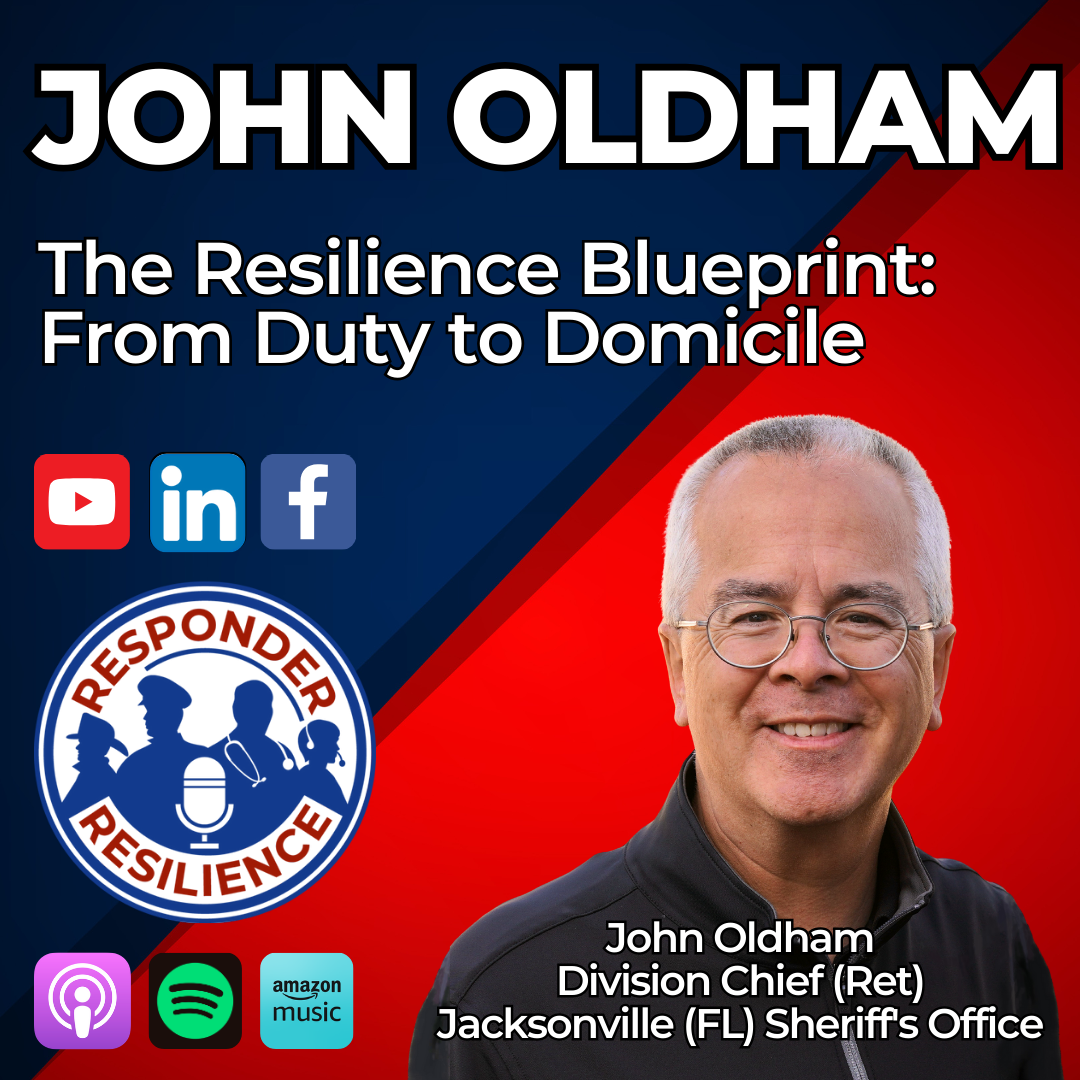
We sit down with John Oldham, a retired Division Chief from the Jacksonville Sheriff's Office, to discuss the crucial intersection of first responder relationships and mental health.
We sit down with John Oldham, a retired Division Chief from the Jacksonville Sheriff's Office, to discuss the crucial intersection of first responder relationships and mental health. As we unpack the effects of psychological trauma, we’ll explore its impact on both first responders and their families. Tune in to learn about the importance of brain and sleep health and discover three innovative tools designed to help strengthen and reconnect those vital home relationships. Join us for an insightful conversation to foster understanding and support for those who serve in emergency services.
Thanks to our resource partners at the CRACKYL App:
This episode is also made possible by First Responder Center for Excellence:
Website: https://firstrespondercenter.org/
Contact John Oldham:
Facebook: https://www.facebook.com/TheBridgeRelationshipCenter
LinkedIn: https://www.linkedin.com/in/john-oldham-4782b822/
Contact Responder Resilience:
Phone: +1 844-344-6655
Email: info@respondertv.com
Our website with past episodes and more: https://www.respondertv.com/
YouTube: https://www.youtube.com/c/ResponderResilience
LinkedIn: https://www.linkedin.com/company/responder-resilience-podcast/
Instagram: https://www.instagram.com/respondertv/
Facebook: https://www.facebook.com/responderTV/
I got a call from a commander that said, Have you heard from your recruit? And I was like, I haven't. Should I have? And they said, Well, his roommate called and said that he's missing. It's not a common story among field training officers to be one that said, Hey, I actually had a recruit that ended his life. I started noticing that I was getting difficult to get along with others. And I thought it was them, but it was really me. I would say the first month was great, and then I got into shooting. And after that, for four years, it was terrible. We really thought we're not going to make it. In the first responder role, we go to all these calls and we do all of these assessments, but we do them of others. And we totally dismiss ours.
VoiceoverWelcome to Responder Resilience, along with my co-host, Dr. Stacey Raymond. I'm David Dashinger. Today we're diving into first responder relationships and mental health of John Oldham. He's a retired division chief from the Jacksonville Sheriff's Office. We're going to explore the hidden impacts of psychological trauma on first responders and their families. We'll talk about brain health and sleep health. We'll discover three breakthrough tools to help reconnect and restrengthen those crucial home relationships. So don't miss this meaningful conversation. We invite you to like and subscribe YouTube Responder Resilience, Facebook Responder TV, LinkedIn, Apple Podcast, Spotify. Go to our website responderstv.com for past episodes and get information. This episode is made possible by the First Responder Center for Excellence. Discover more at firstrespondercenter.org and connect with us on X, Facebook, LinkedIn, Instagram, and YouTube. There's a new app built by firefighters for firefighters, and it's called Crackle. Download the app now for free as a legacy member and get early access to exclusive content, tools, and updates as they drop. Get the free app at crackle.responderTV.com. We'll be right back to speak with John after this. In this family, more of us die by our own hands and by the hazards of the job.
SPEAKER_05In this family, up to a quarter of 911 television have symptoms of post-metic stress. In this family, our mental health and wellness are in crisis, while respondents are quite suffering.
SPEAKER_06In this family, many troubles are struck with stress.
VoiceoverOur guest today is John Oldham. John retired in 2023 after 28 years of policing, having held command assignments as a lieutenant of patrol, investigations, internal affairs, as an assistant chief of information technology, and divisional chief of support services. Currently serves on the police professional standards, ethics and image committee, and is involved in the Office of Safety and Organizational Wellness section of the IACP. John's an advocate and educator for fostering healthy relationships among first responders and promoting brain sleep health. John, welcome to Respond Resilience.
SPEAKER_04Hey, good morning. Great to be with you.
SPEAKER_05So, John, I'd like to start out by asking you uh, can you just share with us your journey um in law enforcement that led you to become a division chief?
SPEAKER_04Sure. I uh actually got a late start in law enforcement compared to uh some people uh about when I was 25 years old, uh just really wasn't satisfied with working in the private sector. A friend of mine had become a police officer, a friend of mine from high school, and so uh he encouraged me to do a ride-along. I did that here in Jacksonville and uh was totally hooked. So uh 1994, uh I got my first job at the University of Florida Police Department as a police officer there. Did that for about nine months and then transferred just right down the street to the Gainesville Police Department where I worked for seven years. Uh most of that was in patrol, uh, did some uh extra duty assignments such as crime scene technician, uh, did a lot of DUI investigations, uh, was a field training officer for a long time. That created some trauma and stress that I wasn't prepared for in that particular role. And then uh I transferred to Jacksonville, where it had long been my dream to work there. Uh it just wasn't possible in 1994 due to uh their hiring situation. But in 2002, I transferred over, uh, started out like everybody else on the street, worked patrol for until probably about for about five years, tested for sergeant. Really thought that I wanted to stay on the street my whole life as a patrol officer. But my wife said, hey, you really need to think about promotional opportunities. And so uh was a sergeant for uh a few years, tested for lieutenant and and got that. Um loved the street, never wanted to leave it. Um, but I remember uh a uh another chief called me one day and said, You're gonna get a phone call tomorrow. And when that phone rings, they're gonna uh ask you to take another role and you really should take it. And I didn't want to, uh, but I did. I could I couldn't turn it down. There was uh the person couldn't give me a reason not to take the job. Uh so I moved downtown in investigations, um, and then uh was uh uh took over the job in internal affairs after three assignments and investigations, and that was a totally different scenario uh for four years, and then uh Sheriff Mike Williams in 2017 uh appointed me to his staff where I ran uh information technology for five years, and then he moved me up to a division chief over support services where I spent about the last year to year and a half before I retired.
VoiceoverWell, quite a career. And um I just wanted to rewind because you mentioned um about the FTO piece. What was um talk a little bit about the trauma and the stress of doing that, like uh especially as it relates to you know accumulative effective trauma.
SPEAKER_04So, you know, when I got into field training, um I was asked to do that. And I thought it would be a great assignment because you have this opportunity to share and pass on knowledge and mentor younger officers as they come along. But what ended up happening over the the years that I was doing that was that you you always have uh people that are having challenges transitioning to the job. And so uh I started being given the the ones that it's either helped them to succeed or get them by or help them to find somewhere else to go. And that was usually getting them out of the department. And so uh I so ended up you know having all the challenging folks, and you know, you know, my whole objective was to try to help them to succeed. I wanted them to succeed, right? Uh, but there were ones where uh occasionally it really just came down to the point of having the frank conversation that this may not be the job that you're cut out for. And that's kind of that's really hard to do because you think back on it, you know, I was pursuing that as kind of a somewhat of a maybe not necessarily a dream, but a calling job. And now this person's probably doing the same. And after all these attempts to help them to get better, uh, it's how do you help them get to the realization that it would be more detrimental for you to stay uh than to not? And then probably the thing that really ended it for me was I did have a really challenging recruit toward the end of my time in Gainesville. And he just wasn't getting it. So uh this particular recruit, he was having a challenge, and and we were probably close to that having that end discussion as well. Uh you could just see it, he was stressed out. He wouldn't even get out of the car when we would go to meal breaks, he would just stay in the car and actually sleep. Um and and be surprised when we would come back to the car after meals because we'd wake him up and he just had when he woke up, he was like, you know, where's the threat? Um, but one day he came to work and he had a totally different attitude. He was happy go lucky. He started really getting it. Um and then five days later, after our last day together, I got a call from a commander that said, Have you heard from your recruit? And I was like, I haven't, should I have? And they said, Well, his roommate called and said that he's missing from home, and so is his duty weapon. And so uh they weren't they wouldn't release really tell me any more details other than that. And so, you know, the the fear in me said, Well, is there any indication that he's looking for me? Uh, because it was a long session, you know, those several weeks are trying to help him and and if he's not okay. And they didn't say anything, but they put a police officer outside my house overnight. Um, and so the next morning they found him uh at a rock quarry. He had consumed quite a bit of alcohol and he committed suicide. And so it's not a common story among field training officers to be one that said, Hey, I actually had a recruit that ended his life. And so, you know, that kind of trauma is something you just don't for you just don't forget about. But I never I never went back into field training after uh after that time.
VoiceoverI understand that. Hey, firefighters, let's take a moment to talk about something important. There's a new app built by firefighters for firefighters, and it's not just another wellness tracker or generic resource hub, it's called Crackle. You've probably seen the magazine, but this is the next evolution. The app is about one thing helping firefighters not fail, not just on the job, but in life, in your health, your relationship, your mindset, and your longevity. That's why Crackle is designed to meet firefighters exactly where they are, with resources that you have to respect your top. You can download the app now for free as a legacy member. That means you get early access to exclusive content tools and updates as they drop off. Use the QR code on the screen to download the Crackle app, or you can download it from the App Store or Google Play and stay in the fight. Not just at work, but at home and in your own head too. Because your best days shouldn't be behind you, they should be ahead of you.
SPEAKER_05You know, it's interesting, as you said, his last day with you, he was um upbeat and feeling really positive. And you know how they say that people, once they've made the decision, they they feel it is kind of like a relief.
SPEAKER_04Yeah, and I missed it. And that was the thing that you know um kind of bothered me about it because you know, when you're trained to look for those things and when you're so close to it, yeah, uh that you miss it. But you know, when it's a little bit of a distance and you don't have that relationship with a person out on a call, uh, you tend to pick that up. But it's so close that sometimes I think we forget that, you know.
SPEAKER_05And you wanted him to succeed, right? So he comes back and he's feeling upbeat, and you're like, wow, maybe he's turned a corner. So and you're not a psychologist, so you know, how could you catch that? But anyway, um, so John, in your experience, so why is the first responder world different than anything else? Because you said you did work in the private sector, and then you spent the rest of your career as a an officer. Can you answer that?
SPEAKER_04You know, just from my perspective, and it's probably only mine, uh, and looking back over all that time and and just seeing things uh for what they may be, yeah, it's it's different in that uh there's a statistic out there, and I think it's very interesting that the average human, on average, in a lifetime, may only experience like three 2.7, I think it is critical incidents in a lifetime, but over a 20-year career, a police officer will experience 800 or more. And so uh I've had conversations with folks and uh that say, well, what about you know the military? It's gotta be the same. And it's I think I I would give a little bit different spin on it because it's kind of unique. I would say yes, if that soldier was in the theater of combat all the time. It's usually only a very short amount of time there in that, but yeah, first responder is doing it 40 hours a week for you know, for the most part. Fire fire might have a break where they can sleep and rest and recover at the station. But for the police officer, he's doing it from the minute he gets puts the uniform on and leaves the house until he gets home. And so it's it's um, I don't know that when I talk about that with folks, friends that are in the private sector, most of the time the response is I never had any idea that it was that amount compared compared to the regular um the private citizen.
VoiceoverPicking up on the thread of the psychological trauma of doing the job, you are pretty articulate when it comes to talking about brain health. And uh seeing you do a presentation where you're literally showing brain scans, um showing like some of the trauma that's um actually starting to um show up show up in our brains. Can you talk a little bit about that in terms of um you know what you've learned uh about brain health and the psychological traumas of the job?
SPEAKER_04Sure. Uh yeah, I can tell you that my journey started last September. So it hasn't even been a year. Um I noticed that in the last couple of years that while I probably had a semi-short fuse, that that fuse, even after retirement, started to get even shorter. And probably in the last three to four years, and still while I was on the job, I noticed that I was starting to have more difficulty concentrating. Uh I probably was doing a little bit of self-help with you know, drinking some energy drinks to help with that or to kind of I thought was helping me to concentrate more. But then uh I started noticing some just unusual outward physical symptoms to where, you know, uh I would go into a room and I would be like, I forgot why I came into the room. And then it really manifested probably about a year and a half ago when let's say hypothetically you're in front of two filing cabinets, one on the left and the right, and you're like, should I reach for that file or this file on the right or the left? And you, you know, most people would just look and make a decision. But for me, it would, and my wife was the one that first saw it, what I would actually re reach, and then my hand would get caught between the two, like it was stuck. And I was like, why is that happening? And so uh last year in the spring, I started noticing that I was getting uh difficult to get along with others, and I thought it was them, but it was really me. And I actually had two kind of semi-explosive incidents with people close to me. And after the second one, which my wife actually witnessed with a family member, I said, you know, we've known about this resource uh with these spec scans for years. Maybe I need to go do it and and see what's going on. And so I I went uh into the Amin Clinic in Atlanta last September. Um I you know, I knew what they do because I'd seen it at other first responder retreats and seen and talked to people that have been there. They did my spec scan and it um it kind of confirmed what I suspected, but it also told me a lot more about what was going on in my brain that I was not aware of. Okay. Specifically, the scans showed a lot about decreased blood flow, not just in one or two places, but I've got them in like five or six. Okay. From front to back, the underside, the top, you name it. Uh, what looks like what should look like just kind of a bowl of uh jello, your brain, your outer surface. Mine had gigantic holes in it, okay, to where you know that's not happening. And then uh they looked at some brain functioning. My thalamus is like fired up all the time. And and this thing called the ACG, uh, mine is stuck in the on position at both at rest and at concentration. And so the really unusual thing was that so my brain is constantly at work, or some some people call it on fire. Sure. Um, mine is actually more active and on fire when I'm at rest than it is at concentration.
SPEAKER_05Yeah, it's probably because you're looking for stimuli. I think that happens to a lot of uh first responders that retire.
SPEAKER_04Yeah, and so it is no telling how long it's been that way, but they they you know went through my history of uh physical head trauma, you know, and then when they first asked about it, I thought uh maybe two or three times, but when you start going through that list of a lifetime, mine was like nine significant brain uh traumas that were never looked at by a doctor or followed up on because a lot of them happened when I was a child. And so if you're still alive and breathing and can carry on a conversation and there's no blood, you're probably okay, which actually turned out to probably not be the truth. And so um, so I'm on this journey now of just you know trying to discover, but also trying to figure out how to make my brain healthier um through you know the help of the A-min clinic. But I will say this um I know that some folks are kind of skeptical of those kind of things, but one thing that going there did was it helped me to get uh more health assessments back here at home. And so the very first thing they did was is you know, I was having trouble uh falling asleep and staying asleep over the last year and a half, and they sent me for a sleep study. And guess what? I have moderate almost to high sleep apnea. Oh, yeah. So now now I'm on a CPAP, which which I hate. Um but it'll help your brain heal. It did. And because when I first started, my O2 sat um was running about 94 to 95, which is not not really good. Uh now after sleeping through the night with a CPAP, it's 97, 98. Um, and there's no telling how long that's been uh been that way. Um but I knew that no matter how much I slept, I just could not feel okay. And you know, I I probably had that issue when I was in Gainesville where I worked five years on the midnight shift and wasn't getting you only had two days off there, and I just wasn't getting sleep. And um, so now I'm at the tail end of it. Hopefully, mayocardiology has just finished my last test for that. Because the bigger concern was that did the apnea cause any damage to my heart muscle? And so right now, uh it doesn't look that way, but they found some a lot of extra beats that I have, but none of that would have actually happened had I not stepped out and had the brain scan to start with.
SPEAKER_05Right. Right. So, yes, I I've heard really good things about the um the Amen Clinic. They they're around uh the country. You said Atlanta, I think there's um there's uh Los Angeles as well. And and the SPECT scan is single positron emission computerized tomography. It's a mouthful, it's very different than functional MRI and PET scans, but it shows something very different. It shows um activity where there's activity. And in your case, you said there was there were several places where uh there was not rain activity that needed to be active. Yes.
SPEAKER_04So especially, especially right here in the front. Where I always need the indention. This is my 13. When I was 13, I got hit by a door. Um, and but there was other things I'd had frontal trauma to my brain that I was like, it's probably nothing. But guess what? On the spec scan, that whole front is flat. There's there's they're trying to get that uh blood flow uh moving forward. And because you need that part of your brain to really to do well.
SPEAKER_05That for planning, and you need it also to stifle an intense emotional response. So you you know, losing it again on a uh family member, if that if you don't have blood flow here, it's very hard to stop yelling at that person. It's a real problem. Yeah.
SPEAKER_06As firefighters and first responders, we're brilliant at the basics. We master the art of stretching the line and we expel it being there for those who need us the most. Yet, even the best of us can be caught off guard. We sometimes face unexpected challenges like injured or post-track. But you're not alone.
VoiceoverIn terms of um self-assessment for the first responder or especially law enforcement officers, like what do you recommend? Um, you know, is there something some we should be aware of noticing that might tell us we need to get checked out for um some kind of you know, either traumatic brain injury or other trauma that's happened to the brain by proxy of doing the job?
SPEAKER_04I I you know, I think it's I think it's really important that, and I was really bad about this, is that when the people that are closest to you, especially the ones that are not first responders, they might be friends that you have, uh, even though we tend to lose those over time in the first responder world, or even family members that don't have an agenda, when they say you're different, uh, we really should, or you're just different than you've been in the past. We really should not uh be defensive about it and dismiss it, but we should think about it and say, you know, I I probably should at least get looked at. You know, that's that's the journey I'm on right now is I'm looking at every everything in my body to see what may be an issue, what may not, rules things out, says you're okay here, you might not be okay here. Uh because all of those things um obviously they affect our relationships and how we interact with others. And mine was getting to the point to where uh I was predominantly damaging relationships. Uh so that healthy piece wasn't in the picture. So that you know, we we do these, you know, in a first responder world, we go to all these calls and we do all of these assessments, but we do them of others. And we totally uh dismiss ours. And and but we don't what we don't realize is that if we don't give permission to others to keep us in check or at least give us honest feedback about us, um, it's so easy to slide into that space to where where we can decline rapidly and and we just become in denial of it. And it damages everything around us.
VoiceoverYeah, probably more so in retirement too, because um no longer sort of have supervisors and peers who are seeing us on a regular basis at work. They kind of know our baseline. Um, but now that's out of the that's out of the loop. We just have our you know friends and loved ones who may or may not understand the implications of what we've done, what we've experienced on the job. So um that's a great point, and especially more important in retirement, I think.
SPEAKER_05Yeah, for sure. John, can you um articulate what you teach about maintaining healthy relationships? Can you just spell that out a little bit?
SPEAKER_04Sure. Kind of all started back in 2012. Um my Steph is my second wife, um, and I'm her third husband. And so we came into this marriage uh with this thing that we're we're gonna do it different, we're gonna do it right. But but what we didn't realize was that uh each of us individually had really not truly processed our past set separate from each other. And so the first four years we were we they moved into my house, so they sold theirs, and uh Steph had a son, he was 12 at the time that we uh got married, and they moved into my house. And the first four years were the first I would say the first month was great, and then I got in a shooting. And after that, for four years, it was it was terrible. We really thought we're not gonna make it. And so finally, after four long years, uh somebody had to decide to say we need to figure out what's wrong. Because I I can tell you this, I was not gonna go to therapy, I wasn't gonna get counseling. I had the the typical you know attitude about that, and uh, but I was fortunate enough to say to find a book uh that Dr. John Gottman wrote, um, The Seven Principles for Making Marriage Work. And I said, Yeah, I'm gonna read the book, but I'm not even gonna spend the money to buy a new copy. I found it on Amazon used for half price, so I bought it, and I still have it. Somebody else had marked it up, and that was fine. But it didn't take me about about three chapters to realize that the solution had to start with me, and I had to be open and honest about the things that I brought into the relationship uh and start trying to work to correct those and understand how relationships actually work. And the what I found out was that we all have our thoughts about how they work, but here's our resource where they've been actually it's evidence-based, none of its opinion. Uh, they've been doing it since the 70s. Um, extreme monitoring of people in their love lab. Oh yeah. I found that so interesting about how they did it. So, you know, as a police officer, we love facts and evidence, right? So here's something that's not just solely somebody's opinion. They've got facts and evidence. So I'll give this a little credibility. And once I actually started doing it within a few weeks, my wife was like, you know, something's different. Uh you know, we're getting along better and all those kind of things. So we started on this journey because that book did not fix me, it didn't fix us. But we started on a journey of trying to get better understanding about how relationships work, uh, why there's uh masters and disasters and what you know it is so uh of those individual pieces and looking at relationships because they're all different. And so when we started doing that, we actually started having people ask, you know, ask us for advice on it. And and we don't we're not therapists, we don't have any licensing, none of that. So what we basically do is we share knowledge that we've found out from a lot of different places, and we've never stopped that journey of exploring content, uh, no matter who provides it, and trying to, you know, vet it and say, where would that fit into what we already know? And so we've created for ourselves this massive toolbox to where uh if a situation comes up that we're unfamiliar with or we just can't work through, we'll look through our toolbox of resources and say, well, here's what this says, here's what this says, and then we work together. So um we teach uh what we have acquired uh to churches uh at responder retreats. But the one thing that we do more than anything is that we use the real life examples of what we've been through and what's happened to us so that it's not just you're hearing somebody talk about they read somewhere. Uh we we relate it to well, here's how it played out in our marriage. Sure. And it's usually very bad. But we we want that transparency to be there because uh we've found out that a lot of people over the years is that they think they're the only ones going through correct or whatever it is, and we say, Well, here's a scenario that we went through, and for them it's like, oh, you get it. And and so in the first responder world, and y'all know this, is that if if I've got an issue and the best thing for me to do is to reach out for help, if I don't believe the other person on the end of that phone that I'm calling can understand what I'm going through, then we're not I'm not gonna get help. I may call them once, I probably won't call them again. And so we actually teach uh relationship dynamics, and it's not just specific to marriage, it's it kind of expanded into you know, because we're a blended family, uh, so we have a lot of uh resources we pull from for blended families, but we've also been through that. So uh that's that's a lot of what we teach is that things that we have learned over the years, but we are very cautious that we don't follow a single model. Um we determine you know what is that person's situation specific, and then we apply, we gather the knowledge and uh apply it to their situation to help them the best. Because we're just we're like a lot of people. We want to help them to be able to get to um a resolution to be self-sustaining as quickly as possible, but also in a healthy way. So sorry for the long, but that uh the long uh explanation, but our journey started with a reason, and we had to be very purposeful in getting to um to where we're at we're at the same, we're on the same journey as everybody else. We're we're not there yet. And so we're a work in progress just like they are. We're just really walking alongside them and providing them with tools and information that we've acquired that they may just not know about. Correct.
VoiceoverAre you a clinician working with first responders? Or perhaps a first responder eager to enhance your mental health knowledge? We have something special just for you. Introducing the clinician's guide to working with first responders theories exclusively on responder TV. Join us as we explore vital topics that can transform your practice and boost your resilience. Dive into masterclass episodes like Clinician's Guide to Wellness Programs and Internships with Wendy Hummel, building trust with law enforcement with Dr. Medina Baumgart, Clinician's Guide to Peer Support and Officer Wellness with Captain Mike Fumiati, mental health canines and crisis response with Brad Cole, Clinician's Guide to Inpatient Treatment Facilities with AdFit Gibbons, working with unique fire and law populations with Dr. Robbie Adler Tapio, and Clinician's Guide to Psychological Autopsies with Elizabeth Fole and more. Don't miss out. Tune in to elevate your practice and increase your cultural competency. Visit responderTV.com or find us on YouTube, Facebook, Apple Podcasts, and Spotify. When you're doing this work or when you're speaking to people, like what should they know in terms of signs that um, or maybe what should the spouse of a first responder know to look for that indicate uh that might indicate they need some help?
SPEAKER_04Well, I'll tell you that if there was one single thing that every first responder couple or person uh should do is to read Dr. Kevin Gilmartin's book, uh Emotional Survival for Law Enforcement. When I first heard about that book in 2017, you know, we were five years into understanding relationship dynamics, but we didn't really understand um the application to the first responder world. And as soon as I read it, I read it cover to cover, I saw I saw me in there, and then I told my wife, I said, Hey, can you take a look at this? And she read it almost cover to cover, and she goes, This is you. And so um, and so it's interesting because it relates to uh probably the majority of first responders. There's probably some that are very healthy and they uh know how to manage it well, but over time, uh I think it's really important to realize is that the some of the first things that start changing is that friends and associates in your circle before you became a first responder, those relationships for whatever reason start to diminish and become fewer and fewer. And then your circle switches over to nothing but the first responders in that. Yeah, and that's not only not healthy for the first responder, but it's also troubling for the spouse or partner. And that's what happened to my ex-wife was that now suddenly, you know, we move to a different city, away from her family and my family. I start transitioning away from having the same social circle, and now she's stuck because she feels like I now have my only friends I that I can have are his friends or the partners of his friends. And that didn't match up real well for her. And so it was probably the number one thing that that led to the destruction of our marriage, is is that the second piece is is that at least for me is is I started controlling or treating people in my circle or my family like I treated people on the job. And so my uh my current wife, she during that rough period, she finally gathered enough courage to say, she stopped that stopped me uh mid-sentence one time and said, Hey, I don't work for you. And unfortunately, my response because I didn't know any better at the time, was to immediately say, Well, that's a good thing, because if you did, I would fire you. And so those types of interactions, if we're not aware of them and how we are acting toward others, those are big red flags. And so um it creates this opportunity, I hate to say it, for um either or both uh partners for infidelity to open it opens that door wide open. Uh, because you know, Dr. uh Dr. Gottman talks about uh sliding doors types of moments. And so when you have uh each one of these interactions that are a negative, they create an opportunity for one or both partners to start thinking, is there something better outside of this relationship? Am I in the right relationship or not? And so just the mere thinking of that is a red flag. Sure. And if and if we don't recognize that, it is so easy for that door to open and for a first responder or even the partner to um find satisfaction from somewhere else, even if they're not even seeking it, because there's people outside that will gladly pursue that. And so um it's unfortunate, but uh uh that's that's happened. Um, and so if you we know this about most a lot of first responders, is that infidelity is a big thing, and it's a lot of it's led because of this mindset that we have to stay strong, handle every situation, be in control of every situation, but that buildup inside of us, uh, when we don't release it, we often release it with another first responder. And if that just happens to be a per a first responder of the opposite sex, you have now got a wide open window for emotional connection over time to start to develop. And often uh part of an information author, Dr. Shirley Glass wrote a book on not just friends, and it talks about all the different scenarios to where emotional connections develop and how uh people end up in infidelity and they're like, I don't even know how I got here. And so that slide can happen extremely fast. So there's a lot of warning signs, but yeah, for first responders, we just ignore them. And then if our non-first responder partner starts to bring them to our attention, we do what we normally do and we get defensive about it and say, You're crazy. And we gas, and I was very good at gaslighting. I learned it well well from family members, so it was easy. And in interrogating suspects, a lot of times you do gaslight, and um, and so it it's you just it becomes you you kind of I call it drifting because a lot of times we don't do things intentionally, we but we drift into those spaces to where these things change who we are, and we don't see all the yellow signs or the yellow flags, and then we miss all the red lights, don't go through here, and we move through it. So I I would say that that recognition, but being open to uh others giving you feedback is critical. And I that's the one thing that helped me to start moving out of those dangerous spaces was I gave a handful of other men, even outside of law enforcement, permission to call me out and hold me accountable for things that they were seeing in my blind spots that I could not see.
SPEAKER_05You know, John, that takes a very humble person to arrive there, right? That person has to be mature, um, and then they have to be comfortable with vulnerability.
SPEAKER_04And we're not as a as a profession, we're just we don't like that space. Um it's it's it's unusual for us after we get, you know, I had that in before well before I got into the profession. But five to ten years in, I would had a totally different mindset about that. Uh there was no need for me to be vulnerable and transparent like that. Uh, and it was only after the just the destruction that took place in my first marriage and in my second marriage for me to say something's got to be different because I knew that my emotional health uh was being damaged at the same time.
VoiceoverSo, John, talk about what you're up to these days. Um, I know you you've got a project called the Bridge Relationship Center. Talk about that. Um, what does it do and where can people find it?
SPEAKER_04So the the bridge actually started uh becoming kind of a thought and a concept uh before I retired. And I just felt like there was uh a need to put a resource out there where people can go to anonymously and confidentially to access good vetted relationship resources. And so um, you know, as soon as I retired, and it was kind of one of the reasons that that I left early. I still had a year and a half left uh before for retirement, but uh I felt like that it was the best time to do it because the need was so great. And one of the things that really spurred that was we found a 2018 study, I think it was in the Journal of Psychology or somewhere like that. I love evidence based stuff, and it said they looked at low income couples and the reasons why they they knew they needed help, but they didn't get it. And the first reason it was interesting, the the two top reasons. Were the same, but they were different between husband and wife. But they were still the same. The first one was the cost, which we all get because it can be expensive to get long-term help for uh relationship issues. But the second one kind of blew my mind. It said that people absolutely did not even know where to look or where to start at. And so we knew that the need was there. Uh and so we we had been doing a Facebook page uh called Vision Builders since 2015, and that's literally all it was. We would just grab stuff that we would see online content and put it, post it out there for people to see. And so that kind of grew. Uh, but this one specifically, we switched it over to the Bridge Relationship Center. And so my wife's kind of joined the project. We've got an advisory board where we recruited in uh three couples, uh, not just from here locally, but they've been in relationship type of work for decades. And so we wanted to have a good team to you know tell us what you know what we're doing. And so now uh Monday through Friday, we uh go out and we don't produce content, but we grab it from every source. And so uh we've got probably 25 different providers that we pull their content, and over a week, Monday through Friday, we'll post up to close to about maybe 180 to 200 different uh items. And so and we've now got it to where it's organized by the provider. So Monday's got its own set of people. It's usually the same Wednesday. Monday starts off with some big ones like focus on the family and family life. A lot of the content is primarily geared toward uh Christian type relationships, but you'll you can find things in there that are not. Uh, Tuesday is also a marriage focus. Wednesday's big on parenting, blended families, and things that uh people have a hard time finding. Thursday is a lot about women uh and things that are specific to them, but Friday is really set for uh professional services such as therapy and counseling and what those organizations are producing. So if you like something specific, you know what day and time it'll be out there. And uh it also has uh information going back all the way since we started, which was actually almost a year ago, May 17th was when we went live. And then we're putting together a Facebook page because we found out that probably about close to 50% of people are not on social media and they don't have access to it. And so we want to fill that gap as well. But um so we do that, and then we also uh so the resource thing is the big one. The second one is that if people are looking for help, uh but they don't even know where to start, and uh and they don't have the energy or the time, which happens a lot with people in crisis, is that they just don't have the energy, and you don't want to get on Google and just start looking through millions of providers and saying which one is right for me. So if if somebody reaches out to us, uh we will gather information on what they'll share about their situation. We'll talk about, you know, do you need a provider that will accept insurance or won't? Um, and then we find out what their locality is and we will go out and do the research for them and come back and provide as many resources as we can within say 10 miles of their location. We give them a list to where they can start with, and then we tell them if those don't work, tell us and we will try to find you more. Maybe a little bit further out, but we'll do that. And so we we do that research for free. We will do it for anybody. And uh, I think the farthest away that we've had so far is we had somebody reach out from New Jersey and we found them three vetted providers or what ones that they felt comfortable with within 10 miles. And then the last thing that we do is that um for organizations, uh predominantly churches, is that if they want to have a relationship education or a marriage event at their church, uh, and this happens a lot for smaller churches, but they either don't have the bandwidth, they don't know how to uh put one on, or whatever that may be, we will come alongside them and walk them through the entire process. We've been doing these for about five years now, and we will help, we will show them and actually do it for them if they need us to. Everything from budgeting, uh content development, uh pre-event messaging, uh the hospitality piece, which is big and a lot of people miss that. Catering, uh, if they need somebody to facilitate the event, we'll do that for them for free or that first year. Uh and then post-event messaging and also the surveys, which are key to determining your return on investment, and the and then the messaging after the event will go or will happen. We do that for free as as well. Um so we've done a handful of those, but we do it for the smaller organizations so that we ask for them to provide a uh a team that will learn it the first time so that they can do it themselves the second and third and fourth. But we also come alongside them after that. Uh, and and the whole purpose is that we really want this to be an outward uh thing to where a lot of organizations can do this themselves.
SPEAKER_03Right.
SPEAKER_04And so we were fortunate to have really good training on this, how to do that back in 2018. And so uh those are the mean main three core things we do is the resource uh resource toolbox on social media, helping people get connected to professional resources and help, and helping organizations to actually produce and and execute their own events successfully.
VoiceoverWow, that is a lot, John. And uh very thorough. Yeah you're keeping yourself quite busy. Um and it's all for a great cause. So um Stacy, any final thoughts uh before we wrap up?
SPEAKER_05Well, I just um just impressed with how you know you you took your own uh struggle and now you're paying it forward. And I just uh just want to express my appreciation for that.
SPEAKER_04Appreciate it. We we we really hope that nobody goes through what we've had to go through. Um but we know that people will, so that we don't we don't want you want to be stranded out there uh because we we all know what that could lead to. Sure. And so I you know, we didn't come up with a bridge name ourselves, it just kind of happened by fate. And but that's really what we do is we just help bridge people to what they what they need. And we never want cost to be a factor, so everything that we do is is free. And so it and so yeah, it's just kind of uh our journey that we're on is that we really want to spend, I guess, that last half to quarter of our life really giving back and helping uh people to be successful in their own relationships at work and at home.
VoiceoverThat is wonderful. Where can people find the Bridge Relationship Center and you if you want to share that?
SPEAKER_04Uh on Facebook, they can just literally search the Bridge Relationship Center. They can find that there. Uh if they want to reach out by email, it's uh all one word. The bridgerc at proton.me is our email address. And then uh hopefully once we get this website kicked off, we'll we'll have that out there as well so people can reach us there directly.
VoiceoverFantastic. John, thank you so much. You've covered a lot, and that's all really important information. Some of these things we haven't really covered in this kind of depth or at all. So really appreciate you bringing this to the forefront.
SPEAKER_04Thanks, I appreciate it.
VoiceoverRemember to like and subscribe, YouTube, respond resilience, Facebook, responder TV, LinkedIn, Apple Podcasts, Spotify. Go to our website respondertv.com for past episodes of guest information. Till next time, stay safe. Kind to yourself. Take care.

Sheriff's Office Division Chief | Advocate/Educator for First Responder Relationships and Brain/Sleep Health
I retired in 2023 after 28 years in policing after holding command assignments as a Lieutenant in Patrol, Investigations, and Internal Affairs, as an Assistant Chief in I.T., and as a Division Chief in Support Services. I currently serve on the Police Professional Standards, Ethics, and Image Committee and in the Officer Safety & Organizational Wellness section with the IACP. I am a graduate of the Senior Management Institute for Police (Session 81, PERF) and the School of Police Staff and Command (Class 397, Northwestern University). I currently serve as an advocate/educator for healthy first responder relationships and brain/sleep health.


