Apple Podcasts
 Spotify
 YouTube
 RSS Feed
 Clinician’s Guide to Legal Insights, Ethics & Advocacy | S5 E31
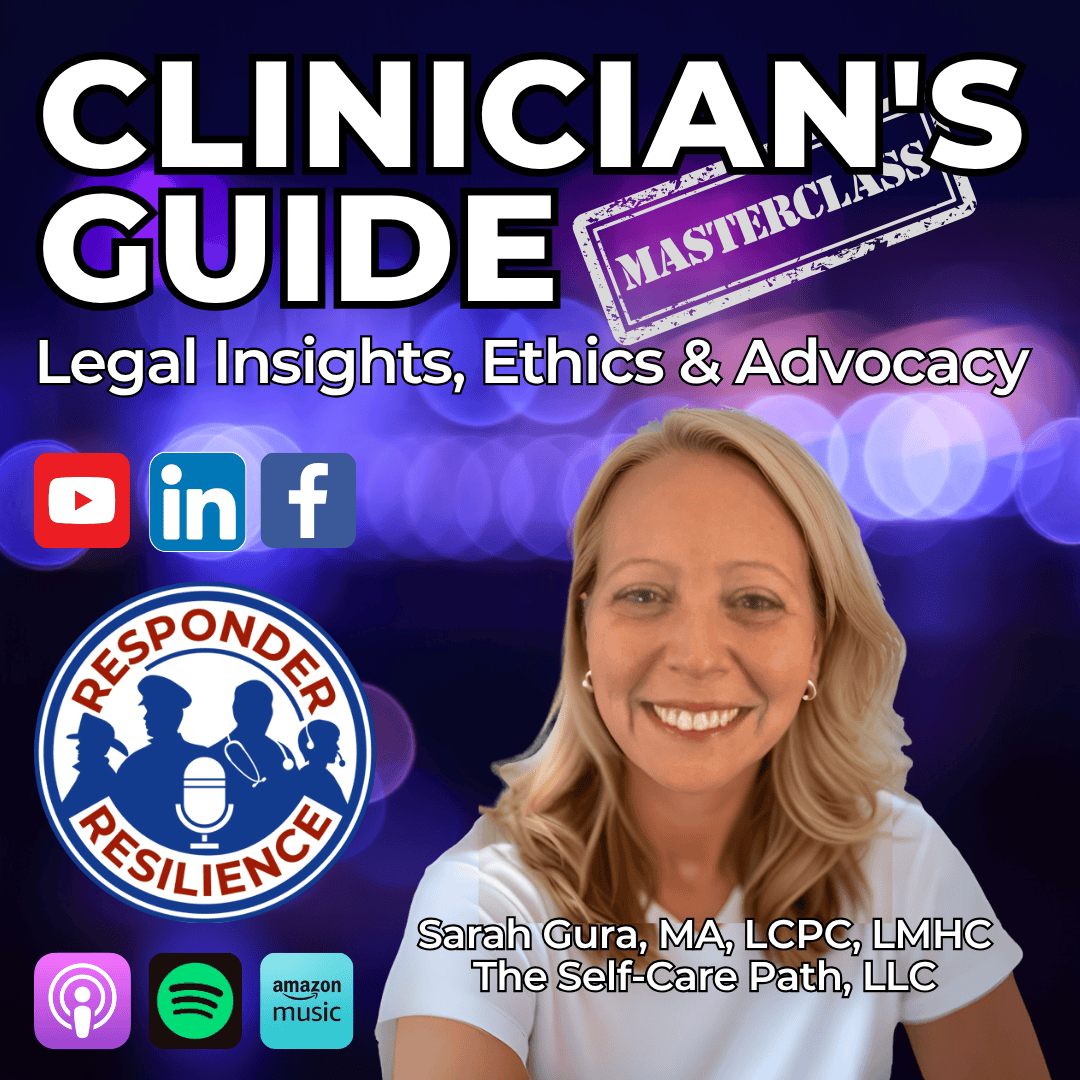
In this Clinicians Guide Masterclass, we delve into the intricate world of first responder mental health with Sarah Gura, MA, LCPC, LMHC, EMDR, a seasoned clinician whose expertise sheds light on the intersection of legal intricacies and compassionate care.
In this Clinicians Guide Masterclass, we delve into the intricate world of first responder mental health with Sarah Gura, MA, LCPC, LMHC, EMDR, a seasoned clinician whose expertise sheds light on the intersection of legal intricacies and compassionate care.
Join us as we explore essential topics, including confidentiality standards, navigating workers' comp and FMLA cases, and best practices in releasing information—all pivotal for clinicians working to support those who protect our communities. Whether you're a newcomer or an experienced professional, you’ll gain valuable insights on documentation, preparing for depositions, and how to protect yourself with legal support.
Coming September 2025!! Helping the Helpers: A Clinician’s Guide to First Responder Mental Wellness, a new book that equips you to build a First Responder-Centered Practice that works. Get a FREE sample Chapter and Book Launch Invite!! Go to helpingthehelpers.me to get Early Access when you sign up!
Thanks to our resource partner, Circl Brain. Because the toughest battles deserve the sharpest minds. Go to https://www.circlbrain.com/ or contact sales@circlbrain.com
Thanks also to our resource partner, the First Responder Center for Excellence, https://firstrespondercenter.org
Thanks to our resource partner, CRACKYL. Download the FREE CRACKYL App: http://crackyl.respondertv.com
Contact Sarah Gura:
Website: http://www.selfcarepath.com/
Facebook: https://www.facebook.com/SCPFlorida
LinkedIn: http://www.linkedin.com/in/sarah-gura-8a8285238
Contact Responder Resilience:
Phone: +1 844-344-6655
Email: info@respondertv.com
Our website with past episodes and more: https://www.respondertv.com/
YouTube: https://www.youtube.com/c/ResponderResilience
LinkedIn: https://www.linkedin.com/company/responder-resilience-podcast/
Instagram: https://www.instagram.com/responder.tv/
Facebook: https://www.facebook.com/responderTV/
Go sit at the lunch table like I did and have lunch with everybody and talk. You know, go on a couple ride-alongs. Feel what it's like to be in these situations. You say you're a first responder clinician, like go witness an arbitration, go see a pension hearing on a psych test or case. We're all new at this. We're all pioneers. Nine years of schooling and not one special even hour for first responders. It's about being open, it's about learning, it's asking questions. If you're gonna serve this culture, you gotta do the ethnography, you've got to do the work because every lawsuit, I'm telling you, David, everyone shocked me.
VoiceoverWelcome to Respond Resilience. Today we're gonna be speaking with Sarah Gura. She's a seasoned clinician who will shed light on the legal considerations, laws, and legislation, confidentiality, and best practices when working with first responders. So whether you're just starting out or looking to refine your approach as a clinician, this discussion will provide invaluable insights and enhance your practice and support those who serve and protect. This episode is made possible by Circle Brain. If you're a first responder, it's time to take brain health seriously. Go to circlebrain.com to learn more because the toughest battles deserve the sharpest minds. This episode is made possible by the First Responder Center for Excellence. Discover more at firstrespondercenter.org and connect with us on X, Facebook, LinkedIn, Instagram, and YouTube. There's a new app built by firefighters for firefighters, and it's called Crackle. Download the app now for free as a legacy member and get early access to exclusive content, tools, and updates as they drop. Get the free app at crackle.responderTV.com. We invite you to like and subscribe. YouTube, Responder Resilience, Facebook, Responder TV, LinkedIn, Apple Podcasts, Spotify, and go to our website, respondertv.com, for past episodes and guest information. We'll be right back to speak with Sarah after this. In this family, more of us die by our own hands and by the hazards of the job.
SPEAKER_03In this family, up to a quarter of 911 telecommunicators have symptoms of post-traumatic stress.
SPEAKER_05In this family, our mental health and wellness are in crisis, while responders are quietly suffering.
VoiceoverIn this family, many struggle with job-related stress, burnout, moral injury, sleep disruptions, substance abuse, and relationship problems.
SPEAKER_05In this family, we can help the helpers with vital information and resources, resilient strategies, and success stories of overcoming the obstacles.
VoiceoverIn this family, no. Welcome to Responder Resilience. We co-host retired Lieutenant David Dashinger, Dr. Stacey Raymond, and Bonnie Rimley, LCSW EMTB. So we welcome Sarah Goura to the show. She's an MALC PC, LMHC, and EMDR certified, and the founder of the Self-Care Path LLC. And she's a master's level licensed clinical professional counselor in Illinois and licensed mental health counselor in Florida. She specializes in treating first responders. Sarah, welcome to Responder Resilience.
SPEAKER_05Thank you so much. Thanks for having me.
VoiceoverSo we're going to be diving into some really kind of off-the-beaten path topics, at least as far as what we've covered so far in the clinician's guide. So really kind of looking forward to seeing what you have to shed light on because it's super important information. So let's dive in. Absolutely. I'm ready. Talk a little bit about your background. How did you get to where you are now in terms of specializing and working with first responders?
SPEAKER_05Well, initially I, you know, would see like a handful, maybe a firefighter here, a police officer there after I graduated back in 2007. But it wasn't until 2010 that I feel like my practice got taken over full-time by first responders after working with uh Jeff Dill from Firefighter Behavioral Health Alliance. And we just started writing curriculum, creating programs, doing our work. And now it's 18 years later, you know, of working full-time with first responders.
VoiceoverFirst topic that we're going to look at is um psych testing. So I remember um when I got hired, it wasn't part of the process, but in a lot of departments it is. So talk about psych testing and how that should play a part in, I guess, starting a first responder's career and maybe later on down the line, how does that come into play if um if responders need to go for a psych test or evaluation?
SPEAKER_05Well, you know, like you said, it wasn't always around and it isn't for every department to this day. Sometimes we have pre-employment testing. We might have an issue and it be used as a discipline or feels like punishment, you know, or to actually see are you fit for duty? And in the long history, we've had independent medical examiners that would be hired to do that psych testing, but we have seen that it isn't normed on first responders. So one of the first things I always look for when I'm getting that report and the list of recommendations for counseling is is this psych testing normed on first responders? And you have to find a psychologist, a doctoral level psychologist that will do that.
VoiceoverJust to go into a little deeper, why are first responders different in this testing process than, say, you know, your average civilian?
SPEAKER_05Well, when we see a culture, right, there's diversity within every culture, and first responders are their own diversity, their own culture. And so, you know, when you see on average more of human illness, human death, human suffering, human stupidity, property destruction, you're exposed to more trauma than the average bear. So you could look worse when you are taking a psych test that's normed on the general population. And so a psychologist needs to take a look at what is the appropriate measure here so that I can accurately report if this person is fit or not fit for duty.
VoiceoverAnd having said that, what have you seen what are some of the uh sort of poor outcomes or downsides when someone is um, I guess, incorrectly um assessed or tested as a first responder?
SPEAKER_05Well, maybe um not being allowed to return to work, maybe not awarded a psych pension, uh, maybe not getting the proper care that they need. So there's a ton of consequences when you're looking at somebody who's here to serve, protect, rescue, help, you know, and then you say you're not fit for duty when actually compared to their peers, they're just fine.
SPEAKER_03What do clinicians need to know about working with people from the various departments and attorneys associated with them, uh administrative staff? How do you recommend they work with them in terms of receiving advice or clinical perceived as clinical suggestions, but um how would you counsel someone to work under those um parameters?
SPEAKER_05Well, it there's so many different situations, right? So an independent medical examiner or psych test, you know, is going to say something about this patient and understanding why they are coming to you? Are they here just for some behavior, you know, suggestions and coping skills? Are we doing post-traumatic growth? Are they in the middle of a workman's comp case? Are they trying, you know, for that pension? There's so many things to consider. But one of the first things I encountered, like way back before 2010, was an attorney, for example, sent me a letter that um the administration felt 40 therapy sessions was, you know, gonna be helpful to this person. And I was like, well, I would love, right, to take 40 hours worth of money. But that's exactly what that would be is I didn't assess this patient, I didn't design a treatment plan, I didn't assess to see how long it might take. And so I had to, you know, call that attorney and say, you have no, you have no place, the administration has no place in mandating 40 therapy sessions. I'm not participating in mandated therapy, I don't participate in mandated therapy sessions because I need to assess the patient first. So that would be the first thing I tell a counselor is it could feel uh intimidating to be told what to do with your patient. But if you haven't so much as assessed them, you don't do any of that.
VoiceoverGot it. And I'm gonna ask this because I've actually recently got a call like this. Um I want to I would say that the situation was the department administration and even HR had an employee, a you know, a firefighter employee who they really felt needed to be assessed and and maybe you know seen by a mental health professional. Um can you speak to like situations where it's kind of like they don't really know what to do with someone, so they just push it out to a mental health uh clinician?
SPEAKER_05Yeah, so I always say if they will sign an informed consent and they want the help, then I'm happy to assess the situation, create a treatment plan and deal with that. But oftentimes, you know, it's a whole system. You know, there's politics and BS in every department, no matter how good you try to be. And, you know, when the department is saying we're mandating, we want to take a look at this person, this is their livelihood, their bread and butter. No one wants to psych pension out. There was huge rumors like that when I first started. They're like now, just all these people are gonna try to, you know, say their feelings are hurt and try to leave. And that's so not the case in this population. So I think it's really important to take a look at the entire culture of that department. I mean, we break, you know, like different places in a state run differently, different counties. If it's a protection district with a board versus a city with a mayor that's tired of giving that department money. I mean, unfortunately, legally, we have to take a look at all those structures and see where's my patient in the middle of all of this.
VoiceoverStand by for an important announcement about our book launch coming September 2025. All units, stand by for a confirmed structure fire with important person's training. In a world where first responders save lives, this book could help save theirs by preparing you to answer when they call for help. Based on over 200 conversations and the trusted team behind the Responder Resilience podcast, helping the helpers gives you the tools to understand their world, speak their language, and earn their trust. This work is challenging, but deeply needed and profoundly rewarding. Their stories don't start with trauma, but too often they end there. Infused with real-life experiences, this guide reveals the human behind the badge and equips you to build a first responder-centered practice that works, from understanding their culture to the practical realities of working with first responders and chapters across the spectrum of first responder professions. You'll gain insight into the hidden struggles that shape their reality and the steps you can take to help them heal. When trust is shattered, the stakes are high. This book helps you build it before it's too late. Are you ready to make a difference? Be the resource they can count on. Get early access, including a free sample chapter and book launch invite. Go to helpingthehelpers.me to get your early access when you sign up. Helping the helpers book launches in September 2025. Let's talk about release of information to keep the clinician and the patient safe. What advice do you have on that?
SPEAKER_05So much. Um so a couple things. In the beginning, they some departments will have the employees sign a massive release of release of information saying, any physician, any counselor, any service that you've received, we get that information. And an attorney will bring that up to them, and that patient will feel like, oh my gosh, I signed this when I in orientation, you know. But that's not a release that's legal for me. And so they have to sign your release of information as a clinician. And not only do they have to sign it, but they have to say, to whom am I releasing it? And that party cannot release it a third time because it's considered private healthcare information. And that would happen a lot when I was younger in the field, and I wouldn't know to say to the patient, like, look, this file can't go to your attorney and the other attorney and to the department and to whomever. That's not how this works. Furthermore, you have to specify that they know that their rights and that they don't have to sign it, that they can talk to an attorney first, especially when it has to do with their bread and butter and their private healthcare information. So there's definitely like maybe one more thing I would say. Um, like our releases are only good for one year. Um, so there are definitely limits to releases of information, not just to who, but in time. And most of the time I will tell them just say that this release is over at the end of the month and then we cut it off. And if we need to sign again, we can. But don't just open yourself up to like, hey, you get my notes, you get my assessment, you get my billing, you get everything.
VoiceoverIs that very state-to-state or is it national? How is what's the jurisdiction on that?
SPEAKER_05So every state will have a law for the mental health counselors to follow. Um, so one time someone had said I released their information without their permission and I about died. Like my body felt like on fire. And I had 11 releases of information signed by this person and their spouse. So having a witness was very helpful. And going in and explaining, like, not only did I not release this information, but I hand gave it. I asked that I'm releasing this information to you, and you can give it to that party. You know, that's what protected me was it was my release, it was duly signed, it was within time limits, and that um first responder was the one that handed it off, not me. And that was so important because breaking the law on that is like $50,000 fine, and then your malpractice insurance goes up. So you need to be really clear and make sure that in your state your release covers all the bases.
VoiceoverSo let's talk about depositions. What do clinicians need to know if they do have to prepare for a deposition or um show up in court or a legal proceeding and make a deposition? What are what are some of the um considerations they should be aware of?
SPEAKER_05Well, the first is do no harm. So how you write everything and everything that you say is really important. And I always say less is more, but also emotionally speaking for the clinician, it it can feel threatening. Like you want a good outcome for your patient. We're like worm fuzzy people, we want everything to be okay, but the opposing attorney doesn't, you know, they're and they're just doing their job. But I have definitely felt like they've hired some independent medical examiners to um, as crappy as this sounds, they make you feel bad about your work, or they try to word things so that you're a little bit confused, or when you you have to like stick to, I am like an expert on my patient, I assess them, I've provided treatment, I've seen the outcomes, I also know where they're stuck, I know that therapy takes time. Um but to prepare for a deposition is to prepare a little bit to be bullied and to kind of question yourself. So while you're practicing with a first responder, you better know what you're doing. And you and you should know the law and you should know their structure and their culture and what treatment you're providing and why.
VoiceoverAnd at the same time, are you able to advocate for or advocate for the uh first responder who you're representing or who you're um they're speaking about?
SPEAKER_05I don't know if I would call it advocating because I you just stick to the facts. You know, what is the truth, you know, in these situations. But do no harm is a part of our ethics. And so yeah, it's really important to talk with your patient uh before going in and understanding where we at. This is the information, this is what my notes say, and make sure that you're both on the same page.
VoiceoverGreat, thank you. So there's a lot of laws coming into play on state level, national level, pertaining to first responders. Um there's peer support law, there's um some best practice, and of course, want to keep our chiefs and administrators and officers uh uh educated about how the laws work and affect their employees. So, can you speak to the kind of ever-changing landscape of uh laws and legislation and how clinicians can kind of stay uh current with that?
SPEAKER_05So, again, it depends on what state you're in. Um, in Illinois, I have public act 101-0375, but in Florida it's House Bill 421 for peer support law. And you should print it up, you should have it in your binder, you should understand it. Because when things go wrong with peer support, you want to be able to understand and answer the questions that the peer supporters may have. So, administration, even though they might say, hey, we have a peer support team and we really support this, they don't when the crap hits the fan. And then all of a sudden, like we're getting, you know, um, administration versus a peer supporter. We've definitely seen that. And we need to understand the privacy and confidentiality laws that they've been granted in that state. If they haven't been, then we prefer to best practice and then maybe hopefully establish a law in that state. Um, but it's really important to understand that it is a different hat, even if you are at work providing peer support, the peer support hat is different than firefighter paramedic or sergeant or deputy chief or whatever role you're in.
VoiceoverOkay, great. And I know um Florida has recently passed a law that pertains to peer support and confidentiality. Is that correct?
SPEAKER_05Absolutely, that's House Bill 421.
VoiceoverOkay. Are you a clinician working with first responders? Or perhaps a first responder eager to enhance your mental health knowledge? We have something special just for you. Introducing the Clinician's Guide to Working with First Responders series, exclusively on Responder TV. Join us as we explore vital topics that can transform your practice and boost your resilience. Dive into master class episodes like Clinician's Guide to Wellness Programs and Internships with Wendy Hummel, Building Trust with Law Enforcement with Dr. Medina Baumgart, Clinician's Guide to Peer Support. And Officer Wellness with Captain Mike Fumiati. Mental health canines and crisis response with Brad Cole. Clinician's Guide to Inpatient Treatment Facilities with Pat Fitzgibbons. Working with unique fire and law populations with Dr. Robbie Adler Tapia and Clinician's Guide to Psychological Autopsies with Elizabeth Pole and more. Don't miss out. Tune in to elevate your practice and increase your cultural competency. Visit responderTV.com or find us on YouTube, Facebook, Apple Podcasts, and Spotify.
SPEAKER_05I don't know if it's legislation so much as the NFPA 1500 and 1582, right? Like an understanding that there are standards built within the career, that we have standard operating procedures and guidelines, and that those are forever changing. And we could, you know, you and I click on there and we could see, you know, which um I I don't even know what to call it, but session or if whatever there's 1,5152, whichever will tell you about independent medical examiners and procedures for workman's comp and et cetera.
VoiceoverSo do you have anything you would add in terms of working within a department's SOPs, like if they happen to have a mental health SOP or peer support SOP? Anything you can add to the conversation that clinicians might need to know?
SPEAKER_05They're not always like legit. They're like a hope and a standard and something that they're working toward. But they are, we're all new at this, we're all pioneers. And so one department's going to be different than another. One might have higher hopes, one might have like zero S to give. Yeah. Um, so understanding if there is something written there and it goes outside of the therapy office because something is happening with discipline or some other issue, then you want to say, can I see that and give it a read-through and understand it in the context of whoever's sitting in front of you.
VoiceoverLet's talk about legal exposure and responder work. So um when and why might you be subpoenaed as a clinician?
SPEAKER_05So many reasons, right? Um, so again, workman's comp, a pension hearing, a psychiatric issue, uh, an arrest, uh, you know, outside or within work, uh, behavioral issue, a disciplinary issue, uh, anything that has to do with that first responder's behavior um can sort of warrant a discussion, an administration, maybe a consultation with the city um administration or even the board. So it it depends on what setting you're in, but all of those things can pull in multiple professional roles.
VoiceoverDoes um officer-involved shooting ever come into play as well for that kind of um for being subpoenaed?
SPEAKER_05It it definitely can. Um I feel like that's less, you know, those are a little more cut and dry. And I think like when they're doing their job and they followed the standard operating guideline and procedure, like then we're just kind of doing after-action reviews. But if they're coming into counseling and there is a psychiatric issue identified, then that changes the game a little bit.
VoiceoverOkay. Let's talk about um confidentiality and privilege and what you're legally obligated to disclose. What do people need to know about that?
SPEAKER_05You don't have to disclose much. So it's really important. You know, I have heard of guys going into work drunk. I can't report that. Um, doing drugs, can't report that, having domestic violence issues. I mean, obviously we're all human. And when we have high stress, our behavior can uh be a reflection of that. But when you come into therapy, everything is private and confidential, unless you're gonna hurt yourself or you're gonna hurt someone else, or a child is involved in being hurt in some way. Um, so people are really shocked about that. That boy, I could pretty much disclose anything and you can't tell anyone. True. And same and peer support, which people don't like that quite yet either. Um, there was also a major law in California that went across the United States, Terrasoff is the reference, but that's also duty to warn. So we do have to disclose if someone says, I'm going to kill my wife tonight, she cheated on me. Oh, that one, we gotta, you know, report. But if you're just pissed off and you're angry and you're not making any threats, and I don't have the evidence to break confidentiality and warn somebody, then I'm silent and I need to listen and then help.
VoiceoverLet's talk about documentation. So, what should clinicians know about how to document, and especially if they ever do need to kind of refer back to their notes in a legal proceeding or something along those lines.
SPEAKER_05I'm gonna say less is more again. Less is more. Um, but also like maybe an example of something I write in a daily note is W N L within normal limits. And if they're not within normal limits, then I say not W N L, you know, and then I might write right after that denied HRI, denied high risk ideation, or we talked about high risk ideations, and then you would have to say I safety assessed and safety planned. So those are like those are mandated to fulfill insurance, but also just to keep yourself safe. Um, next I'll write down something like what is the focus? And the focus is really from my patient's point of view, discuss recent traumatic call, discuss marriage concerns, you know. And then the next thing that I might document is something as simple as listen, validated, provided emotional support, used CBT, and I and I hate to say it like this, but every counseling session is a little bit of cognitive behavioral therapy, and it is not to me the best one that we could be using in different scenarios with first responders, but the law, the opposing attorney, and everyone will ask, Did you use cognitive behavioral therapy with your patient? And if you didn't, why didn't you? So CBT, you know, is always there because it is the very basic of listening to somebody and challenging them back. After that, if I have to get specific about EMDR or like any other type of therapy, I do, but I keep the person's details private and confidential because in the first responder world, there's something called a FOIA. And you know, the freedom of information with this population, um, all of that information can get into the public. So stay mindful, write enough to understand what and remember what you did, but otherwise, less is more.
VoiceoverYeah, okay. If one has to prepare to testify as a clinician, um, what should they expect? And how do you best protect your credibility in that scenario?
SPEAKER_05Um, if you are going to specialize in treating first responders, get the training, go on some ride-alongs, learn from first responders themselves, um, so that you can say, I am a first responder clinician. If you're not and you're in the middle of something like big and legal, prefer it out. Like just say, you know, if you had some depression or marriage issues, that'd be one thing with a workman's comp case, a pension case, something where you're being fit for duty. Like go to someone that has some experience, in my opinion. And if you want that experience, go interview a pension board, go talk to the union members, go sit at the you know, lunch table like I did and have lunch with everybody and talk, you know, go on a couple ride-alongs, feel what it's like to be in these situations, um, so that you can say, one, I have the experience, and I know I'm kind of going on and on. But then the next thing would be is to continue to um educate yourself. Whenever you don't know something, you find out. You don't say, Oh, that's just, you know, something my client's saying. No, go find out what that means.
VoiceoverAnd you're talking about like the lexicon of uh first responder um work and culture and that sort of thing.
SPEAKER_05Not only that, but like how that HR department uses FMLA or like what they're doing, you know, as far as um preparing on the other side and what they've communicated to your patient. Sometimes I think clinicians want to back out and say, well, that's not my role, but there's a context there. And if you're gonna end up in a deposition, you'll be really shocked how fast like another IME or someone, you know, a different attorney turns on you and you are like, I was just trying to be helpful.
VoiceoverRight.
SPEAKER_05Yeah.
VoiceoverAnd how do you um how would you advise a clinician to prepare mentally, emotionally um for the deposition or court appearance in terms of um, you know, demeanor, um, you know, kind of getting into the right mindset. And if they're getting the hard line of questions into their work, into their integrity, how do you how do you suggest they kind of prepare for it mentally? And then if they're in the you know in the thick of it, what what would you recommend?
SPEAKER_05Um one, the the truth sets us free, right? Uh so one, always speak the truth. Secondly, um when they're coming at you or it feels like that, I use the same advice that I tell my clients, right? I find my breath, I pull my shoulders down and away from my ears, I might groot down through my hip bones, I might spread my toes and feel my feet because it can take you out of your body, and you need your body for mental clarity. And the other thing I've always kept in mind is that when my patients are in a lawsuit, it's almost like holding a gun to their head. That's my metaphor for it. And there isn't any amount of counseling or medication that's gonna make them feel better until that gun is down. So I know that my patient has got extra symptoms that have to do with the lawsuit and not necessarily what we were working on. And I need to verbalize that and say when you threaten someone's money, their insurance, their retirement, their livelihood, their identity, like yes, it is more difficult to treat that patient for just the one call that you said might have upset them. So you have to go in mentally understanding that there are additional symptoms that need explanation. Um, and to have that empathy and compassion in your answers, I believe. And you and you do, you have to prepare your body for that and and to feel stabilized and grounded.
VoiceoverWhat else do clinicians need to know about uh working with clients if testimony becomes a factor?
SPEAKER_05So there's many different places you might end up. Like we have arbitrations, right? And that you know, space doesn't feel as political or legal. Going into court might feel a little different. Witnessing a pension board where everyone is moody and against like pensions is intimidating. I don't care how tough I think I am, like I I don't like it. And I'm I'm shocked. I'm shocked that like they'll eat their own. Um so depending on what environment you're in, again, it stands, I think, to justify why it's important before you say you're a first responder clinician, like go witness an arbitration, go see a pension hearing on a psych test or to case, um, familiarize yourself with the different roles.
VoiceoverCan you get a little deeper into things you've you've encountered that you have to be aware of in terms of how you respond to different questions in order to uh not get taken down a path that you'd prefer not to, it's not going to look good for you.
SPEAKER_05Well, sometimes we have to get in the weeds. I find myself in those situations being an educator. Like at that point, I'm I'm just teaching, you know, and that some of my testimony is not about the patient, but about psychology and about first responder mental health and about what I'm used to seeing unfold over the last 18 years of doing this, you know. Um, so I think it's okay to get into those weeds, but when it comes to your patient, like the facts, the truth, the clinical part, you know, can be said very, I think, short and sweet. And so that that would be what I would say you can practice, but also no, you're you might be the educator in the room.
VoiceoverWell, I suppose there's times when the clinician has to go and get their own uh legal um advice or representation. What the clinicians need to know when might they need to seek outside advice and counsel? What's your wisdom that you'd like to share on that?
SPEAKER_05Whatever you don't know, ask. And there are attorneys that specialize in mental health law. So you should have that person on like your speed dial. Like I know in Illinois there's a guy that spent specializes in mental health law, and he has a program you can pay, you know, 200 bucks or something like that a year, and you get to call and ask him a question anytime. The one time I used him was because I felt my patients were signing releases of information under duress. So when the chief says sign this or you're fired, well, now their whole file's leaving. And I'm like, but that's you're signing under duress. You're so scared that if you don't comply with an order, that you know you're you're gonna lose your job. But there still is private health care information law. So when I called this guy and I wanted to protect my patient, I was like, he signed it, but it was under duress. He said to me, Sarah, he's an adult, he's a god of mind, he signed his name with informed consent. You have to release that file. And I was sort of mortified, and this attorney was coaching me. You know, he was like providing the counsel back. He's like, if they sign, unless they withdraw that release, they are responsible for their signature, and now you need to release that information. So, what I would say to my um patients after that is if you feel like you're signing under duress, you need an attorney not to sign this just to get it done. And so the clinician cannot do anything. Once that release is signed, you are obligated to release that in a timely fashion. Um, so that's some weight there that I think um therapists and the first responder patients need to understand.
VoiceoverOkay, excellent advice. This episode is made possible by Circle Brain. If you're a first responder, it's time to take brain health seriously. Go to circlebrain.com to learn more because the toughest battles deserve the sharpest minds. This episode is made possible by the First Responder Center for Excellence. Discover more at firstresponder.org and connect with us on X, Facebook, LinkedIn, Instagram, and YouTube. There's a new app built by firefighters for firefighters, and it's called Crackle. Download the app now for free as a legacy member and get early access to exclusive content, tools, and updates as they drop. Get the free app at crackle.responderTV.com.
SPEAKER_05I think, you know, my my own dislike of the justice system, you know, plays in. So it depends on what your experience is. You know, it's a lot of time, it's a lot of energy, it's a lot of money. Sometimes I'm like, there's just so much evidence collected that we've lost sight, that this is a human being who felt sad that the pit bull ate the baby and they couldn't save the baby that was torn apart. Like, hello, are we human in here? You know, and do we care that this person isn't doing well, is drinking too much, gotten the divorce, kids don't want to talk to him, and you're gonna take his identity away. Like, so I think for me, when I hear that antagonistic approach from the opposing council, I ground myself in knowing I'm gonna protect, help, and see if I can save the integrity of first responder psychological support right now. So that works for me. I don't know if that would work for every clinician, but like this is a little bit of my baby. I didn't want this baby, but it's been mine for a while, you know. So I want to um practice as mindfully as possible. So I think that might be my main point or um idea to convey about that is that no matter how antagonistic they get, you are paving a road to make a really great point about mental health in the first responder world.
VoiceoverAny other legal legal considerations that clinicians should be aware of that we didn't already cover?
SPEAKER_05Um there is I've I've been surprised every single case. So I could probably go through every single case, and there'd be a here's a story that you could learn from, here's a story that you can learn from. Um, I don't have anybody's permission to share their legal stories, so I can't get into that, but um, I think it's something that we need to study, and I think we should collectively come together to say, here's how this worked out, or here's how this did not work out, and start talking about that privately. But mostly it's about being open, it's about learning, it's asking questions. It's if you are gonna serve this culture, you got to do the ethnography, you've got to do the work. Because every lawsuit, I'm telling you, David, everyone shocked me. I'm like, what? They're doing what?
VoiceoverSo any other resources you can recommend to clinicians that kind of help them just get more acquainted with some of these uh aspects of the legal system that you've been talking about?
SPEAKER_05You know, I've learned a lot from workmen's comp attorneys and labor union attorneys. Um, also the union itself, so helpful. You talk to a union president that knows their contract in and out, like you start to feel like, okay, okay, then that's okay. And I need to tell my client that like this is all a part of it, and we're okay, you know. Um, you become a bit of an emotional navigator of everybody. Um, so use those resources and like I said, ask the questions. I might I can name drop. Um, there was a Chicago police officer that turned psychologist, her name is Dr. Carrie Steiner, and she's a psychologist that does independent medical examinations and psych testing normed on first responders. She is a Wealth of information about this type of stuff and maybe working with her and getting the actual psychologist point of view because I'm the counselor, she's gonna be doing some of the other work, you know, and she's been really instrumental. But other than her, those IMEs are not first responder specific people.
VoiceoverWe touched on this briefly, but I'd like to see if you have anything to add to it. What do clinicians need to know about workers' comp and fMLA cases?
SPEAKER_05I think FMLA is easier. And again, less is more. So I can write that I support that this patient be out because of a particular diagnosis. Um and usually everything just goes fine there. Up until when you return, right? You have to say, I agree that this person can return to work, which that client might then be faced with different independent medical examiners to um evaluate that. That's normal and okay. Um on the other side for workmen's comp, I remember Form 45 being insulting for me because it, you know, says, hey, why are you calling your patient out? Why are you saying they can't work? And it was about all the physical requirements of being a police officer or a first responder, a firefighter. And a little body chart, you know, and they would be like, You need to circle where the injury is, Sarah. And I'm like, Do you know I'm a counselor? Do you know I didn't evaluate their body? Like, I actually can't, I have to write, you know, not licensed to comment on how much weight they can lift. And they're like, well, if it's not filled out, then you're, you know, they're not going to get this benefit or time off. So I had to just start kind of creating my own DSM V form, you know, and I would circle the head on the body chart, but then reference, like, you know, the CPT code or diagnosis code. Um, so the other thing is learning to get along with the paperwork that they haven't caught up with in the reality of today. Like this is 20 years in the making. Uh, we have peer support laws, we should have different forms. Um, and maybe we do now. Uh, I haven't done one really since I've come to Florida. Um, but if you're not sure about the form, call somebody and ask.
VoiceoverSo you talked about uh as a clinician, you assess the patient, you diagnose the patient, you create the treatment plan, you execute the plan, and you provide any after aftercare and necessary referrals. What's the question?
SPEAKER_05Um, so that that kind of goes along with taking ownership of who you are and what your role is. So um, in the very beginning, I don't know if it's imposter syndrome or because no one else taught me how to be a first responder therapist, you know. Um, I would be shy to say, I am the therapist, I diagnosed them with this, I created this treatment plan, and I do these things. And you have to own it with those I statements, um, especially in the legal world. Um, and I actually remember uh having another psychologist take a look at a letter I wrote, and he basically said I was like not getting to the point. And he reminded me to take ownership of what I was doing there and to stop saying my patient has bipolar. No, I diagnose my patient with bipolar and I am treating them for this, and I'm doing it in this way, and I'm confident that this will be helpful because I chose it for these reasons. So I think there, what I'm saying is you need to be confident, you need to know what you're doing, or at least why you're doing it, and get some results. And if you're not, refer out. Like, just know I've had to refer out. I have other clinicians that I love and trust, and I would just be like, I'm not sure. Do you want to check this out? Don't hoard clients, don't think you're the only one that can do this work. Um, takes a village. We can definitely talk about some of the crazy situations, and some of them range from, like you said, gunshot wounds to, you know, being in a May Day, or if a firefighter is burned, or if in training they rip off their own mask, you know, and then we've got an issue and they're coming to therapy. There's so many reasons why someone might ask you for help. And there's so many reasons that some of those might get highlighted as a psych issue or a performance issue that before you know it, you're getting phone calls and they're like, hey, it's chief so-and-so, give me a call. No, I can't, I can't just give you a call. You know, I can't even confirm or deny that I have that person as my patient, or you get a subpoena in the mail, you know, or some kind of email saying, Hey, what can you tell me about this guy? Um, so I would say all of those different types of situations, you want to at least be able to flag them at the beginning when they ask you for help, because if it sounds like something you're not familiar working with and you're going to get in some weeds with the attorneys, refer it, or at least get um case consultation.
VoiceoverYou've covered quite a bit, and uh a lot of it seems so important and vital, and yeah, probably never gets taught when you're getting your uh certifications, your degree, your uh license. Is it does it does stuff ever get talked about or is it like nothing? Wow.
SPEAKER_05David, nine years of school, nine years of schooling, and not one special even hour for first responders. And that's why I'll emphasize again I did ride-alongs in every area, even at a hospital emergency department room. You go wherever your clients are and you observe and you listen and you pick up on those cultural vibes to understand what you're doing, and you learn so much. Like I said, in ethnography, I think is an important part of doing this work.
VoiceoverSarah Gura, where can people find you? Any projects you have going on? You want to talk about your podcast? Um, fill us in and all the good stuff.
SPEAKER_05Sure. So again, Sarah Gura at the self-care path. Um, I'm a practice in Lake Mary, Florida, but I am licensed in both Illinois and Florida. So the majority of my caseload is still in Illinois, three years later since I've moved here. Um, but I can see people in person and through telehealth and my podcast as first responder psychological support. It's got um a YouTube page and a space on Spotify. So thanks for letting me plug that in.
VoiceoverThank you so much for sharing all this. This is basically uncharted territory for us and the clinician's guide. And as we were talking about a few minutes ago, it must be uncharted territory for clinicians in general. So it's so important and appreciate your your wealth of knowledge and expertise and being being willing to talk about it.
SPEAKER_05Thank you. Thank you so much. Important stuff to me.
VoiceoverRemember to like and subscribe, YouTube Responder Resilience, Facebook Responder TV, LinkedIn, Apple Podcasts, Spotify, and go to our website, respondertv.com for past episodes and guest information. Until the next time, stay safe, be kind to yourself. Take care.