Apple Podcasts
 Spotify
 YouTube
 RSS Feed
 Clinician’s Guide to Structuring a Practice That Works | S5 E33
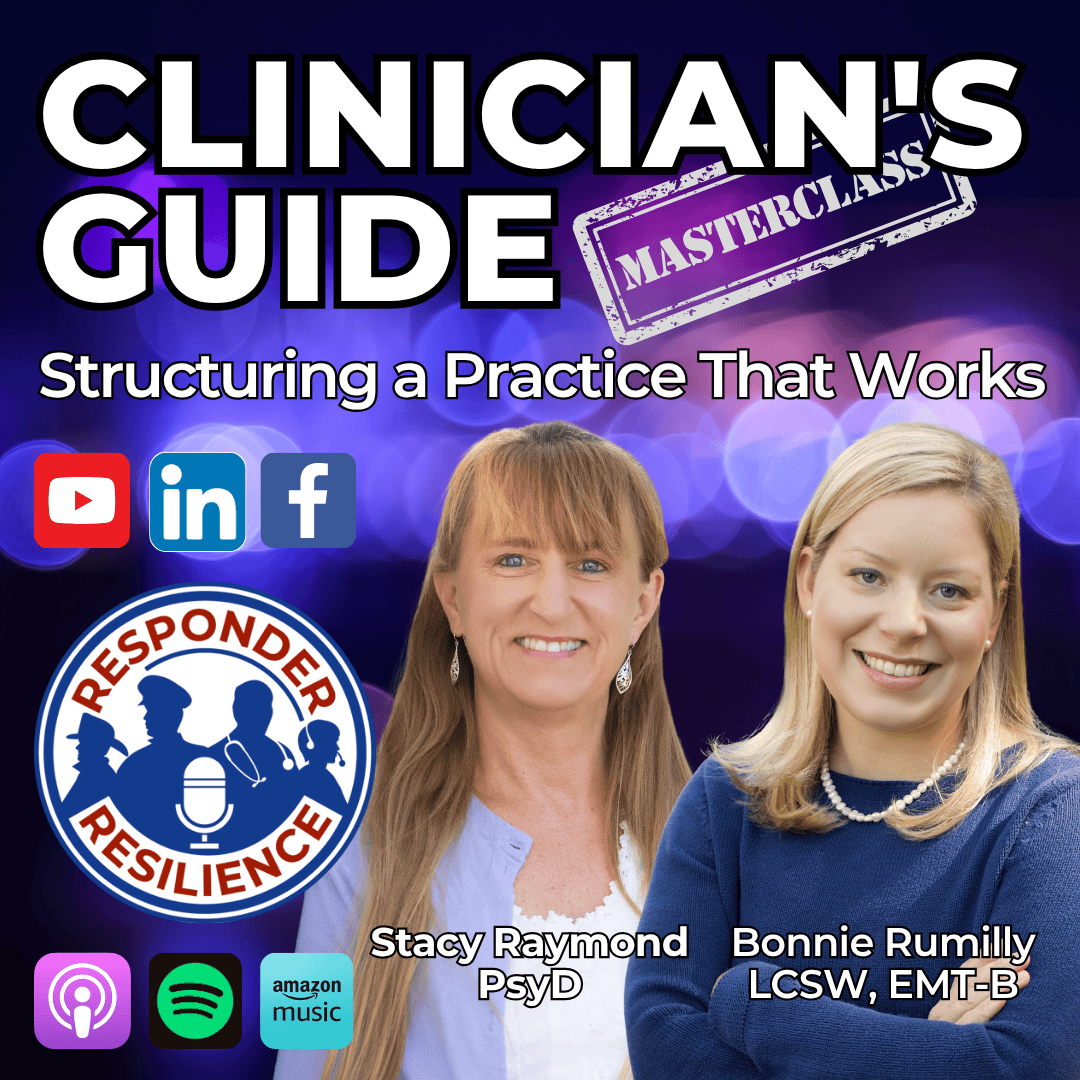
Bonnie Rumilly, LCSW, EMTB, and Stacy Raymond, PsyD, share their expertise on building a practice tailored for clinicians working with First Responders in this engaging episode.
Join our very own Bonnie Rumilly, LCSW, EMTB, and Stacy Raymond, PsyD, in this engaging episode as they share their expertise on building a practice tailored for clinicians working with First Responders. They will offer effective strategies for integrating support networks, managing insurance and payment hurdles, and fostering a therapeutic environment that respects the unique mindset of First Responders. Additionally, they'll address the recognition of burnout signs and emphasize the essential role of clinician self-care. Tune in for invaluable insights that will enhance both your practice and well-being in this challenging field.
SPONSORS:
Coming September 2025!! Helping the Helpers: A Clinician’s Guide to First Responder Mental Wellness, a new book that equips you to build a First Responder-Centered Practice that works. Get a FREE sample Chapter and Book Launch Invite!! Go to helpingthehelpers.me to get Early Access when you sign up!
Get ready for the EMS & FIRE PRO EXPO, September 24th to 27th, 2025, at the Mohegan Sun in Connecticut! Connect with over 2,500 fellow first responders, learn from 90+ world-class speakers, and explore 300+ continuing education opportunities designed just for you! Register now at EMSPro.org and be part of this transformational experience.
Thanks to our resource partner, CRACKYL. Download the FREE CRACKYL App: http://crackyl.respondertv.com
Contact Bonnie and Stacy:
Bonnie: https://www.instagram.com/agmllc2017/
Stacy: https://www.drstacyraymond.com/
Contact Responder Resilience:
Phone: +1 844-344-6655
Email: info@respondertv.com
Our website with past episodes and more: https://www.respondertv.com/
YouTube: https://www.youtube.com/c/ResponderResilience
LinkedIn: https://www.linkedin.com/company/responder-resilience-podcast/
Instagram: https://www.instagram.com/responder.tv/
Facebook: https://www.facebook.com/responderTV/
I cannot marinate in first responder trauma 24 hours a day, seven days a week. I will become one of my patients. And I can't let that happen.
SPEAKER_05You may need to have a session with the therapist yourself in order to heal from that trauma because that's vicarious trauma.
SPEAKER_07Sometimes it's not the stigma that's preventing them from going to therapy. Sometimes it's the cost.
SPEAKER_05If you're a trauma therapist, you know, you're listening to the worst of what happens to humans. It's so important to balance that out.
SPEAKER_07It shows them that you're doing your homework and that you want to know what's going on and you have a finger on the pulse. You cannot make this population wait. It just can't happen.
VoiceoverWelcome to Responder Resilience, along with my co-hosts Bonnie Romoli, LCSW EMT, and Dr. Stacy Raymond. I'm David Dashinger. Today's episode will be looking at building resilience as a clinician who's working with first responders. So join us as we discuss best practices for clinicians, working with extended support networks like peer support, how to structure your practice with respect to responders' shift schedules, things like trauma exposure and their worldview. We'll get into common challenges with insurance, copays, and EAP limits, and we'll shine a light on the critical importance of clinician self-care in the TIE stress field. This episode is made possible by Circle Brain. If you're a first responder, it's time to take brain health seriously. Go to circlebrain.com to learn more because the toughest battles deserve the sharpest minds. This episode is made possible by the First Responder Center for Excellence. Discover more at FirstresponderCenter.org and connect with us on X, Facebook, LinkedIn, Instagram, and YouTube. There's a new app built by firefighters for firefighters, and it's called Crackle. Download the app now for free as a legacy member and get early access to exclusive content, tools, and updates as they drop. Get the free app at crackle.responderTV.com. Remember to like and subscribe, YouTube, Responder Resilience, Facebook, Responder TV, LinkedIn, Apple Podcasts, Spotify. Go to our website, respondertv.com for past episodes and guest information. So stay tuned. We'll be right back right after this. In this family, more of us die by our own hands and by the hazards of the job.
SPEAKER_06In this family, up to a quarter of 911 telecommunicators have symptoms of post-traumatic stress. In this family, our mental health and wellness are in high risk, while responders are quietly suffering.
VoiceoverIn this family, many struggle with job-related stress, burnout, injury, sleep disruptions, substance abuse, and relationship problems. In this family, we have helped the helpers. With vital information and resources, resilience strategies, and success stories of overcoming the obstacles. Welcome to Responder Resilience. We co-host retired Lieutenant David Gatchinger, Dr. Stacey Raymond, and Bonnie Rimley, LCSW EMT. We're going to jump into this discussion with the umbrella of working with the extended support network. So that means, you know, the different organizations and teams you might be working with as a clinician, things like peer support, chaplains, coaches, uh EAPs, and the families in the unions. So Stacy, let's start with you. What does a clinician need to know about working with these different entities and how they can kind of best uh coordinate efforts?
SPEAKER_05Well, I can speak uh to working with uh peer support team. Um there's a local police department for which I am a clinical supervisor. So um, you know, when they put their team together, they were looking for a clinical supervisor, and my name came up, and I ended up meeting with the leader at that time, and we interviewed each other because I didn't really know what a peer support team was. And um, you know, so the ideal is to work is to meet on a regular basis with that peer support team and to kind of get a sense of what is it that the department is is needing and looking for, you know, areas of where they're struggling, um, and then guiding the team in that regard. Um, and then if they happen to have an individual uh that they're they're concerned about, they will likely refer that person to me if if they feel like they're in over their head clinically.
VoiceoverBarney, what would you add to that? And do you have any um tips working with other uh entities like EAPs, chaplains, coaches, families, and unions?
SPEAKER_07I mean, I think if you're a clinician who wants to work in this first responder population, you have to know the lay of the land where you live or where you work. Um and some people work and live in the same place, so they already have a lot of the natural knowledge that would take place that you'd need in work. So I think it's really important to know what the entities are. You know, if we've just said anything that you don't know about, if you don't know what an EAP is, like these are the these are some of the things that you need to familiarize yourself with. So I suggest getting to know who your first responders locally use, if anyone, because we're still coming across agencies and departments who do not have clinicians. Um, you know, they're still formulating peer support programs, they may not really know who to refer out to. So I think it's really important before you start doing anything, be a good observant. It's kind of like when the first day we become an EMT, we can't jump in there and run everything. We have to get the lay of the land. We have to see how everything already currently works. And I think in gaining that knowledge, then you can see where the gaps are, where the faults are. You know, if you if you're doing that background knowledge and you see, oh, uh, the fire department does not have a peer support team. Okay, maybe that's an area of need in which you can start looking at what you can do with that particular avenue. So I I think not coming in with a blanket approach and not coming in guns blaring, ready to change everything, but getting the lay of the land as to where you are, what's currently in place, and then what might need to take place to make that better.
VoiceoverYeah, and you're really speaking to the fact that every department is different. There's just, you know, there's no standardization per se across departments, and uh everyone may have a different uh set of resources to to uh work with.
SPEAKER_07Right. And we we have state mandates in Connecticut, and there are state mandates in other states, but it still looks very different town to town, city to city. So I think it's really, really important to know your locale and and how it all works. Do you have a police, fire, and EMS department all in one? Are they separate entities? Um, because it can be so different in every place, do a lot of research first.
VoiceoverStacy, you mentioned uh the situation where you might get a referral in your experience. What are best practices for referrals and collaboration and especially staying in your lane if it's something that you're not uh equipped to handle?
SPEAKER_05Yeah, so for example, if I get a referral for um someone who's struggling with alcohol or substance abuse, because I don't have that credential, the LADC licensed alcoholic drug certification, um, I will, I guess, first want to know is this first responder in so deep that they need rehab before considering a referral to a clinician that has that credential. Um, the other referral that I wouldn't take would be like a couples situation or family therapy, because I'm really not um, you know, that's not my in wheelhouse to do couples therapy or family therapy. I'm primarily individual trauma focused, you know, PTSI-focused um therapy. So um that's how I would handle a referral. And if the person cannot, I offer a reduced fee. If they cannot do even a reduced fee, um, I would uh refer them back to their EAP and hopefully there will be someone on that panel that is culturally competent who can who can help them.
VoiceoverAttention, all first responders. Join us for the largest gathering of EMS and fire professionals in New England. Get ready for the EMS and Fire Pro Expo happening September 24th to 27th, 2025, at the Mohegan Sun in Connecticut. Connect with over 2,500 fellow first responders. Learn from 90 plus world-class speakers, and explore 300 plus continuing education opportunities designed just for you. Dive into hands-on workshops that challenge your skills and elevate your career while enjoying fine dining and entertainment. This is your chance to gain insights that could change lives, yours included. Don't miss out. Register now at emspro.org and be part of this transformational experience. See you there. What can you advise clinicians to know about those kind of collaborations and consultations?
SPEAKER_07Well, I'm gonna say it again, but I think know your audience, know the department that you're trying to go into. Um, you know, usually we will hear different things. The more you work in this environment and with these populations, you'll hear certain things about different departments. You know, I'd go in with a list of questions, wanting to understand how that environment works, what is the structure, what is the current system that they have in place, why are they bringing you in? Are they looking to supplement what they already have? Are they looking to change what they already have? So I think be very clear in what you're asking of them and what they're really looking for, and then on the flip side, know what you're willing to do and what you're not willing to do. You know, if you're asked to be on call 24-7, are you gonna take a phone call at 3 a.m.? Being a liaison for a department. You know, these are things you have to think about because these things do happen in the real world. Um, you know, Stacey and I have the real fortunate benefit of also working with the Fairfield County trauma response team. And so we have a structure in place for working with departments, for liaising with them, for taking referrals, for giving referrals to some of our therapists under our umbrella. So um that's another thing to consider is do you want to do this kind of work alone, or do you want to be either with a partner or with another group of therapists who could maybe do this kind of work together? And again, depending on where you are and who your colleagues are, but I feel very fortunate that we have that capability where we are.
VoiceoverWell, Stacy, if you can speak to this, um what would you advise in terms of um how to help agencies build a culture of care, whether that's um helping them build a peer support team or bring on clinicians more for a proactive approach rather than crisis management?
SPEAKER_05Well, I know I've met with a few um police departments locally and spoken to the chief and and um you know asked them about their interest in a wellness program, what do they have in place, um, suggesting that at the very least they have on their website a portal that where uh the police officers can enter and access a list of vetted therapists or chaplains or couples therapists, financial advisors, whatever um they may need. So that's usually what I suggest when I meet with a with a chief. Um, you know, most departments are doing training on uh mental wellness, you know, um, you know, because there are there are certain classes that they have to kind of check the box on when they when they train. Um so that's that's how I have done it, but it's it's really just been locally and it's been with a couple of chiefs.
VoiceoverOkay.
SPEAKER_05Bonnie, anything you want to add to that?
SPEAKER_07Yeah, I mean, I think in an ideal world, we would have feedback from the officers or the EMS providers in an agency or the firemen in a department, right? We would know from them what is lacking, what do you need that you're not getting? But there's the reality of the situation, right? If you're being brought in by the chief, we have to work in the confines or the constraints of that. But what I would always want to encourage is what are your people telling you? You know, and people don't love doing surveys, especially first responders, uh, because they don't know who's looking at them. They may not be honest. But if you have a peer support team that's functioning really well, and the peer support team sends out a survey to its membership, or the union sends a survey out to its membership, that looks different than it coming from admin or the press. Right. So I might want to be creative in a department and see what kind of data and what kind of feedback we can get first. What do people feel like they need? Um I think for our listeners to understand a lot of our police, fire, EMS, dispatch, and all of the other branches have basic needs that are not being met sometimes. I mean, they're sitting in furniture that's broken. They work in a department that doesn't provide even a cup of coffee for them, or there's a vending machine, but the snacks are $5 each. You know, there's very, very simple things I think that we can take care of in environments. And the small things actually go a long way because what I hear feedback on is big complaints, right? Like no one cares about me. They don't do debriefings when we've had terrible calls, you know, my kid is sick and no one's checking on me. Um, those are all the big ones that really do come up quite often, I think, for Stacey and I in therapy. So, what are we doing to address those? How do you let your people know that you care about them? But I would argue it's really small stuff that opens the door to caring about the bigger stuff. You know, if you have a chief or admin that cares whether you're hydrated or have access to snacks or have a nice gym to work out in the department, um, that you're sitting in a chair that's not 30 years old and filthy. You know, these little things are sort of symptoms and markers of the bigger system. And if your basic needs are being cared for, likely your bigger needs are going to be cared for. It's kind of like Maslow's hierarchy of needs, right? So I think it's important to address both of those things at the same time. And getting feedback from the employees or the volunteers at a department is really important in any way you can get that.
VoiceoverIn terms of building and sustaining an effective clinical practice for first responders, how do you work around shift schedules and their um exposure to trauma, which may happen at any time of the day or night? Um, how do you kind of roll with those things as a clinician?
SPEAKER_05Well, I do let my um first responder clients know when I'm available, um, when they can contact me. Um and working around shifts, you know, if somebody is working the eight to four shift, you know, if they need to have a five o'clock appointment, then I will, you know, I will accommodate that person. I tend not to stay in the office that late. But, you know, I will probably if I take on someone who needs to be uh seen at five o'clock, then I'll stack my uh day differently, probably just because of that person. Like then I'll just push my clients to the afternoon and take the morning off, that type of thing. So um that's that's how I accommodate.
SPEAKER_07Yeah, jumping off of what Stacy's Stacy said, you have to be really, really flexible. If you want to be a therapist who works with first responders, you have to be able to work around their schedule, which is incredibly difficult for them, their spouses, and their families to manage, let alone us. Um, we have to account for late cancellations. I know a lot of therapists, you know, including myself, if you get late cancels, we all have a policy on if we're gonna charge or not. But if I have an officer who's stuck on a scene, I'm not gonna charge for that session. I'm not gonna hold it against them that they get late canceled. You know, so some of the things that we're sort of trained to do and the parameters we're trained to set, we have to be more fluid with this population. So for myself, I do not offer, okay, I'm gonna see you every Tuesday at 9 a.m. That does not work for first responders. And any civilians that I take on in my practice as well, I will say to them, look, the way my schedule operates is around the schedule of first responders. So we will not have every Tuesday at 9 a.m. It will be more fluid than that because my schedule changes week to week based on the responders. So I think just even offering that kind of a schedule that's open and flexible and understanding of responders' schedules and realities shows that you care and that you understand the population. Um, yes, we have to have some parameters, like Stacy said. You know, if I take Mondays off, I'm gonna do everything under the sun to not work on a Monday. But if I have a fireman who's struggling and the only day he can come is Monday, guess what? I'm going to my office. You know, like we have to be able to be flexible. And because we're there 911 and we're so crucial to them, uh, we need to have that kind of availability.
VoiceoverRight. And um, the other piece to that, and I know we've spoken to this in the past, but just briefly talk about if there's a critical incident or if someone reaches out to you and they've just had a bad call and they need help immediately. Um, how do you how do you roll with that? Like how do you work that into your routine?
SPEAKER_07Well, again, I know that it's gonna happen. You know, I know that there are some weeks where you're gonna get a call at eight o'clock at night and hey, I just got back from this terrible call or a request for a debriefing. So, you know, I figure out what am I handling in my practices at one of my clients who just needs to be seen quickly, and then I'll get them in ASAP. Um, Stacy and I are both trained in an EMDR protocol called RTEP. So if one of my clients goes on a call and they're struggling, they know they can come in for RTEP ASAP. So I will get them in as soon as possible to do that with them. Um so it's it's definitely having that flexibility. And anybody that works with myself or Stacy knows they can reach out to us at any time. Do I answer my phone at 2 a.m.? No. But when I wake up in the morning and I put my phone on, if I have a call from one of my responders, they're gonna get a call back pretty quickly. We don't make them wait. Um, you cannot make this population wait. It just can't happen.
VoiceoverStand by for an important announcement about our book launch coming September 2025. All units, stand by for a confirmed structure fire with important person's trade. In a world where first responders save lives, this book could help save theirs by preparing you to answer when they call for help. Based on over 200 conversations and the trusted team behind the Responder Resilience podcast, helping the helpers give you the tools to understand their world, speak their language, and earn their trust. This work is challenging, but deeply needed and profoundly rewarding. Their stories don't start with trauma. But too often they end there. Infused with real life experiences, this guide reveals the human behind the badge and equips you to build a first responder-centered practice that works, from understanding their culture to the practical realities of working with first responders and chapters across the spectrum of first responder professions. You'll gain insight into the hidden struggles that shape their reality and the steps you can take to help them heal. When trust is shattered, the stakes are high. This book helps you build it before it's too late. Are you ready to make a difference? Be the resource they can count on. Get early access, including a free sample chapter and book launch invite. Go to helpingthehelpers.me to get your early access when you sign up. Helping the helpers book launches in September 2025. In terms of your office and the room, the space that you do therapy in, um, what are things clinicians should know that work well for you? In terms of the physical and emotional safety in the room, perhaps language and the tone, um, the setting of your layout of your office. What uh what's what do you find works the best?
SPEAKER_05Yeah. Well, first off, I have a sound screen right outside my door to ensure that if there's anyone in the waiting room, they can't uh hear what's being said. They might be able to hear human that there's human voices, but they can't make out the the words. Um definitely staggering first responder um appointments, you know, around clinician around um civilian appointments, so that because I don't know who knows who, especially in a small community, even if one's a firefighter and you know, at one department and one's a police officer at another department, I I don't ever want them to bump into each other and um have that be embarrassing for either one of them. So staggering clients that way. Um, and I learned this from uh people with PTSD, combat veterans, first responders. I find that they feel most comfortable if they have uh a view of the door, you know. So wherever they sit in my office, I close the door. We have privacy, but there is um, you know, there's a path of egress. Not that they need to leave, um, but that it's just more comfortable to them if they can, if they can, there's nothing between them and the door, you know, and I sit across from them and they're sitting across from the door. Um and so I think that that just offers a comfort level. Other things, I have an American flag, you know, um on one wall in my in my office. I also have any of the patches or challenge coins that have been given to me by various uh departments, you know, I have those displayed. And so, you know, you can see someone's face light up and say, Oh, there's, you know, that's from my department, you know, and they they they immediately feel kind of a connection, you know, that I I probably have seen somebody from that department. Um, and that that gives them some level of of comfort.
SPEAKER_07Yeah, I'm the same as Stacey. I have a lot of different paraphernalia in my office so that they can see, okay, this is somebody who gets my culture. Um, they probably have worked with people like me before. Uh, because I'm an EMT, I have a lot of EMT stuff in my office as well. Um, not just the other branches, but again, the the patches, the challenge points, all of these things let people see, okay, this person understands my culture. They understand me. You know, the other thing that's really important to me with um bringing first responders in is they have to feel comfortable in their environment. So when they sit down, I will literally say to them, Hey, why don't you take a minute, look around my office? They want to know their environment. Every first responder surveys the scene. So I give them permission to do that here because for a lot of them, they've never been in a therapist's office and they don't know if they should even be looking all around the office or just staring at me. So I literally say to them, listen, take a minute, why don't you look around, um, check out the stuff I have because they're curious. And I then will follow up with, do you have any questions for me? You know, is there anything you want to know about me as a human being? And I'll thank them for trusting me. I thank them for their honesty. I thank them for taking the step to come here. And I feel like those human steps really go a long way. And along the lines of what Stacey said, I'm also very, very careful about my scheduling. So if I have two people from the same town or city, I'm not gonna have them come at the same time. If I have a responder and I know I have a civilian who lives in their city that they work in, I'm not gonna put them back-to-back appointments because I don't know if they know each other. And a lot of our responders come in with their uniform on so they're identifiable right away. Like sometimes they're in plain clothes, but sometimes they come right from work. So I don't want them to have to have that interaction of being in their uniform and seeing a civilian from their own town or city. So I really will go to great lengths to schedule people at different times and make sure that those kinds of things don't happen.
VoiceoverJump back to something that Stacy mentioned that's um payment and access. Um, Stacy, any common challenges you found with insurance or co-pays or sliding scales or people's ability to work within, you know, whatever their coverage is?
SPEAKER_05Yes. So, you know, there are clinicians who do not accept insurance. Um, and for that reason, I think, you know, some first responders will just go through their EAP because they, you know, they may get like three free sessions before they have to pay like a very low fee to continue with that um that therapist. The only risk there is not knowing if that therapist is culturally competent and if they are um you know trauma trained. So um myself, I do not accept insurance, right? So I offer a greatly reduced fee for first responders and um veterans, and that seems to work out because then I give them a paid invoice, you know, at the end of the month that they can submit to insurance and they can get reimbursed, at least partially for that fee. So that has worked out for me. But you know, there are clinicians that are on the insurance panels, and you know, they'll just they'll just submit on behalf of the first responder, um, and there will likely be a copay, but it's usually small.
SPEAKER_07I think if you're gonna work with this population, one of the first things you have to know is that finances are generally an issue. Um, and first responders have a lot of pride. They don't want to ask for help in any way, shape, or form. Um, there's also a lot of pride around paying for therapy. Um, so I think you should always be aware that finances really could be a concern. And so for that reason, I'm very, very flexible in that regard as well. Um, I think anything you can do to remove the financial barrier for a first responder, the better. Because sometimes it's not the stigma that's preventing them from going to therapy, sometimes it's the cost. And no first responder in our country should ever have to say, I can't afford to get help. That is not good enough. And so when I made the decision to be primarily a first responder therapist, I decided, okay, like I am going to take a hit financially. That's not why I'm doing this work. Yes, we all have to work and get paid, but for me, it was more important to remove that barrier for responders than it is to have some kind of a magical number going on.
unknownOkay.
SPEAKER_07If that makes sense.
VoiceoverSure. All right. Let's move into this other area, and that's um as a clinician, protecting yourself while helping others. So that's um, you know, exposure to other people's trauma, keep keeping yourself resilient and taking, you know, doing self-care. Stacey, any thoughts about uh recognizing signs of burnout, compassion fatigue, vicarious trauma?
SPEAKER_05Yeah, you have to have some form of routine to unwind, disconnect, right? So whether that's um just spending some time alone, you know, listening to calming music, meditating, for me it's yoga. I do yoga three times a week. It grounds me. If I miss a class, I feel it. I feel like uh there's more going on in my head. Um walking in nature, growing a garden, having a hobby. It could be anything with your hands, um, reading and get, but not reading about trauma, you know. Um, reading something that will, or listening to a book um on Audible or whatever platform, you know, that takes you away from um, you know, the day-to-day, if you're a trauma therapist, you know, you're listening to the the worst of what happens to humans. And um, it's so important to balance that out. Staying away from the news, uh, you know, headline news, a lot of it is negative. Wars, um, you know, uh murders, um, you know, just atrocious things that have happened uh in the world. And the more it all goes in, you listen to it, if you see it, it is going to affect you, it's going to accrue. Um, but also, you know, if if it just comes to the you should also take regular vacations, you know, maybe you take a long weekend or you take a week off, you have somebody carry cut you know cover your practice, you definitely need to insert um vacations. If there's a particular session or client that, you know, they have something that's really they're bringing to you that's close to home for you, and then you start taking that home. And what I mean by that is when you close your eyes at night, you see it or you hear it, even though you didn't witness it. You just created some images um, you know, through empathy of sitting with your client, then you know, you may need to have a session with the therapist yourself in order to um, you know, uh heal and let heal from that trauma, because that's vicarious trauma, and to let it go. And don't wait for that stuff to accrue, and then you've you're losing sleep, you might be having dreams about it, nightmares about it. That's that's not never good. So nipping that in the bud early is is uh the best thing to do.
SPEAKER_07So for myself, I I really consider it this way, and it's a very interesting way to look at it. But in working with first responders, I think of myself as I'm going on thousands of really bad calls every year, right? So every call a first responder goes on isn't the bad, the worst one, the bad one, people will say. When I think of my office, all I'm getting are the worst calls. So I feel like I'm literally on shift with these people because I've been an EMS myself. When they tell a story, when they describe a scene, when they use their acronyms, I know exactly what they're talking about, and I can put myself in their shoes. So, in knowing that, I have to work extra hard to take care of myself. So over the years, I've gotten really very good at it, to be honest with you. I have no qualms about saying no to colleagues or other people. If I need time to rest up, if I need to boundary my time, which I do do on the weekends and things like that. Um, I have to do that. I cannot marinate in first responder trauma 24 hours a day, seven days a week. I will become one of my patients. And I can't let that happen. So I have to have good boundaries. I have to model the things that I'm telling people to do when they come in here. So if I'm telling someone to work out, I have to be doing that too. And they can see it on us. They know if we're lying, they know if we're overweight or we look like we don't sleep at night. I mean, they see all of this on us. So I work really hard. I do Pilates, I do spinning classes, I do Reiki to make sure that I'm clearing my own energy, do acupuncture. Um, I try to do a lot of different things because one day, maybe the Reiki is not gonna work today, but I know the Pilates will. Like the more that you kind of put in your tool belt as a therapist, the more that you can draw on um during those tough times. But I feel like going into it, just being mindful that I'm going on all these bad calls, I have to take care of that. It's not just gonna passively take care of itself. So if you're a trauma therapist working with population, you have to assume you're going on these calls with them. And what are you gonna do about it? What are you telling them to do, and how are you gonna model that for them?
VoiceoverAre you a clinician working with first responders? Or perhaps a first responder eager to enhance your mental health knowledge? We have something special just for you. Introducing the Clinician's Guide to Working with First Responders series, exclusively on Responder TV. Join us as we explore vital topics that can transform your practice and boost your resilience. Dive into master class episodes like Clinician's Guide to Wellness Programs and Internships with Wendy Hummel, Building Trust with Law Enforcement with Dr. Medina Baumgart, Clinician's Guide to Peer Support and Officer Wellness with Captain Mike Fumiati, Mental Health Canines and Crisis Response with Brad Cole, Clinician's Guide to Inpatient Treatment Facilities with Pat Fitzgibbons, working with unique fire and law populations with Dr. Robbie Adler Tapia, and Clinician's Guide to Psychological Autopsies with Elizabeth Pole and more. Don't miss out. Tune in to elevate your practice and increase your cultural competency. Visit responderTV.com or find us on YouTube, Facebook, Apple Podcasts, and Spotify. So we also touched on this, but let's go a little deeper, um, having to do with peer consultation, supervision. Uh I think in some cases, with you guys with Fairfield County trauma response team, you obviously are a group of peers who um probably can turn to each other in in when you have uh when you have the need to. Perhaps there's clinicians out in more rural or areas where not served by um you know trauma-informed therapists that may not have that luxury. But what would you say about um you know the importance of peer consultation and supervision in this line of work?
SPEAKER_05I think it's uh very important. Like for um uh FCTRT, Fairfield County trauma response team, we have regular small group meetings that happen uh quarterly where we gather together and um everybody's got something, you know, and then we we can listen to that person and we can um offer our suggestion about how they need to deal with a difficult client or a legal situation or the you know their own overwhelm uh dealing with scheduling, for example. So, and then it's a learning experience too, because we we can, you know, so maybe someday we'll be in that situation, and so we we can we can learn from it. Um so I do think that trauma therapists should be uh in touch with other trauma therapists and reflecting on their work together. And and you can do that even if you're in a rural area, you just may have to be on Zoom. You know, you just you have to reach out to other trauma therapists and then have a set day, maybe once a month, that you meet and you can talk about cases, you know, without using names, obviously, um, and then get some consultation that way.
SPEAKER_07Yeah, I agree. And a lot of therapists are very isolated, they work alone in an office, they don't have office mates or anyone in their office. So I think you have to be really proactive. And sometimes it might take you time if you're in the middle of nowhere and there aren't a lot of therapists around. You may need to go to your own governing body, whether it's NASW or NASP, you know, whichever governing body that you have, you can usually find colleagues. But I think if you're gonna do any kind of therapy, you should have colleagues to run cases by, but also to talk about if something comes up for you. You know, those things do happen to us. Um, and in our profession, it has to be okay to get guidance and to get supervision. You know, we're trained that way. Um, but it's really important when you're in a private practice setting, if you don't have that natural meeting group every week, um, you really have to seek it out yourself and be proactive. It's more of a pr preventative thing. You shouldn't be doing it as damage control.
VoiceoverIs there something you do after you see a client with a particularly bad um, you know, intense session? Is something you do to reset before the next client comes in? Um, what types of things do you do along those lines to kind of keep resilient yourself?
SPEAKER_05Well, definitely don't schedule clients back to back. That's what I felt works for me. Um, have a 10 or 15 minute window between clients so you can decompress, you know, um stand up, walk out of your office, maybe walk down the hall. If if it's a nice day, go outside. Um, drink some water, stand in the sunshine. Um, you know, those of us that do EMDR, we have access to uh handheld tappers, you know. I've had a couple of sessions where, you know, I didn't I didn't know that the person was going to bring in what they brought in. And um, you know, it'll help me calm my nervous system to just sit, take five minutes and hold on to the tappers and uh and and release it so that I'm not bringing it into the next session or bringing it home. So I find that to be very helpful. So but just like changing, you have to change the channel in your head. Uh it's not easy it's easier said than done. But you, you know, that's why I don't think having back-to-back to back-to-back trauma clients is is healthy because how can you not have what someone just shared with you bleed into the next, you know, be still on your mind as you sit with the next client. So I'm just speaking for myself.
SPEAKER_07For myself, because of EMS, I know how to go from call to call to call. So it's a it's easier for me to get into that rut of like back to back, but I do still like a reset. So even if it's like a one or two minutes, if I can close the door, I mean it sounds funny, but the environment really matters, I think, in a in a therapist's office. So when the next client comes in, it's important to me. And it helps me actually reset. So it's almost like a ritual. But I'll straighten up the pillows on the couch, you know, I'll make sure make sure that the tappers are wound back up. I do get up, I take a minute. I might even sage my office if it's something really, really heavy. You know, I have a sage spray that I use and people can laugh at me, but sometimes I'll do a little of that just for a reset. Um, so for me, the the ritual of taking care of the environment also helps me compartmentalize it and move forward to the next one.
VoiceoverAny other um tips in terms of uh retreats, sabbaticals, and um just continuing ed, like how to how to use those to kind of stay resilient in your practice.
SPEAKER_07I mean, you always have to be looking for new things as a therapist. You can't just use the same old tricks all the time. You have to be open to learning and expanding your own mind and expanding. Your own bailiwick because people expect us to do that. They expect us to be on the cutting edge. You know, if if I'm we have to have CEUs for our licenses. But even outside of that, I don't want to be a stale therapist using the same strategies for 20 years. I want to be constantly adding and seeing what the new research is showing and what can I impart into my clients. Um, you know, very recently with someone from a police department, I was able to say, look, next time you're on a scene like this, I think you should limit the amount of time that you consistently and continuously spend inside the home. I encouraged him to take breaks. You know, the next time this kind of a scene happens, because we know there will be a next time. Take breaks, go outside, get some air, shift the mood, shift your mental state. Um, that's something that I advised on based on just new research and something that I was listening to, I think, on one of our podcast interviews. Um, and just thinking about how long you're in an environment, does that help it get stuck further into the brain? And does it does that feed the amygdala to continue to be in fight mode? So again, that all comes out of being open and willing to learn new things.
VoiceoverStacy, anything to add to that?
SPEAKER_05Um, you know, when I do my uh continuing education, I am definitely drawn to, you know, um learning something new about EMDR or EMDR with a different population, a different problem to address with EMDR. So, you know, there's always something new coming around the corner. So that's, you know, yes, and it keeps it interesting for me. And then I never know when I might have that client that's going to benefit from that particular um technique. So it's always good to you know keep learning, keep expanding.
VoiceoverWhat would you advise a clinician who uh maybe just getting into this field with first responder work um to not lose themselves in the work? Bonnie.
SPEAKER_07I said it before, but you have to have good boundaries. Um, you know, I think there's a temptation in the beginning where, okay, I'm gonna know everything that's going on in my area, like every single patch article or alert that comes out. I'm gonna know what the police department's doing every single day. Um, I think that some therapists get really, really addicted to the culture, just like the responders do. Um, and of course, there's a draw there, and and it's something you can easily do because it's a 24-7 business. But I think it's really, really important to pay attention to that. Do you really need to look up every single incident that's going on in the area at all times? Do you need to um look it up? Do you need to read the article about your client's call that they just talked to you about? No, you don't. What you need to do is be in the room with your responder, do the work for them. But I really encourage people to not get too invested in the mental space outside of the therapy session. Uh, because you will burn yourself out. And when I worked in Sandy Hook, the reason I'm saying this and that I know it is because at the time I thought I'd be a better therapist to my clients if I read the articles that were coming out every day in the New Town B and in the surrounding papers. Because I thought, okay, if there's a piece of information or a fact that's being stated here and someone comes in upset about it, I want to know about it. I want to know what's upsetting them and what's impacting them. And I was spending a lot of time reading all the news articles because I thought, okay, I can't miss anything because I don't want to miss anything with them. And it's wrong. You know, I learned very quickly, I don't need to do that. It's not helping anybody because what helps the person is me being present in the room. I don't need to be present every other minute of every other day reading a news article. I need to just be with them in the room. So that's something that I think it's easy to do, but be really careful about how much you focus on this when you're not at work.
VoiceoverStacy, anything to add to that?
SPEAKER_05Yeah, I think over the years I've found that, you know, there's something very uh tempting to get swept up into the excitement of um the trauma that people bring to you, right? So then when you go home, and there may not be as exciting things happening um that will pique your interest, but you really have to be careful to, you know, to find what's interesting for the, you know, to the people at home and and to become invested in that, what lights them up, you know, so it doesn't seem like they're falling short and they're not all that exciting. Um so it, you know, to make sure that, you know, you you kind of leave the excitement at the office and don't come home and be disappointed like there's nothing happening here. Um you know, you just have to switch gears and find out, well, all right, at home, what are people interested in and how can I be a part of that and and and find some excitement in that for myself. You know, so that's that's kind of critical as a as a trauma therapist.
VoiceoverSure. And yeah, I think for first responders and probably for clinicians who work with first responders coming home and spouse doesn't always want to hear about all the you know the uh juicy calls that uh were discussed or that the responder went on. So um got to take that into account.
SPEAKER_07Well, we can't talk about that, first of all, right? And so there's that, but but then second of all, no, our families they don't want to do trauma therapist work. It's not their job, it's not their role, right? And that's what Stacy's alluding to. Um but yeah, there is some thrill seeking, and and I do think that that's why there are some therapists out there who may be working with this population for more self-serving reasons, like to have something exciting. And and I I think we have to be really careful about why you're choosing this work, what is your goal um, and why are you going about it? Right. And I think that it you really have to be clear on that before stepping into this work.
SPEAKER_05Yeah. You have to have other things in your life that light you up.
VoiceoverAs a clinician, how do you uh represent yourself out there in different ways in terms of social media, um, advertising, networking, um, just creating an image of someone who's professional and um someone that is would be trustworthy. Like, do you have any tips in terms of how you put yourself out there in the world?
SPEAKER_05Any images of myself are gonna be prof you know professional images, you know, um fully clothed, uh, not gonna be out on the, not gonna be putting up on social media, you know, me on the beach. Um, you know, that's that would be unprofessional.
SPEAKER_07Um I think that um one thing to keep in mind is that you can have professional affiliations, right? Stacy is an IFF um therapist, you know, there are different ways that you can be vetted by governing bodies in the first responder world that I think are really important to people because if they see that you've taken the interest and taking the effort to go through the hoops to get those things, that that's really important to them. I think being authentic to the culture, being genuinely interested in the things that are impacting them, um, following their unions, following different um, whether it's Instagram accounts or LinkedIn, people that you know are influential in their world, it's really important. It shows them that you care. It shows them that you're doing your homework and you're doing your research and that you want to know what's going on and you have a finger on the pulse. That's what I think my clients enjoy about um the presence that we've built here on the podcast. They enjoy knowing that I have access to people all over the country who are giving me different knowledge, different advice, you know, what's happening, what's working. And I think they enjoy that. So I think having professional affiliations and following the things that matter to them is important.
VoiceoverOkay. Well, we've covered a lot, um, and we're at the time to wrap up. So thanks for sharing all this great information for clinicians who want to work with first responders. Um it's a wealth of really valuable stuff that I think would help anybody who wants to just um get their practice rolling in the right in the right way. So appreciate you.
SPEAKER_05Thank you, David. Thank you.
VoiceoverRemember to like and subscribe, YouTube Responder Resilience, Facebook, Responder TV, LinkedIn, Apple Podcasts, Spotify. Go to our website, respondertv.com for past episodes and guest information. Till the next time, stay safe, kind to yourself. Take care.

Clinical Psychologist / EMDR Trauma Specialist
Dr. Stacy Raymond is a Clinical Psychologist, and is an approved EMDR and trauma specialist. Half of her practice is dedicated to First Responders and Military Veterans. Stacy created Responder Wellness Inc - a non-profit charity for EMS, Police & Fire. Stacy co-leads a weekly Peer Support Meeting for first responders Along with Bonnie Rumilly.

Bonnie is a Licensed Clinical Social Worker specializing in the treatment of Adults, Adolescents, Children and First Responders. Bonnie worked in Newtown treating Trauma directly after the Sandy Hook School Shootings and is an EMDR therapist. A Board Member of the Fairfield County Trauma Response Team, Inc., which treats First Responders for PTSD and Trauma, Bonnie is also a 21 year Emergency Medical Technician.